 |
|
USDA Plant Database |
 |
| http://commons.wikimedia.org/wiki/User:Selso |
Translate this page:
Summary
Bloom Color: Green. Main Bloom Time: Early spring, Late spring, Mid spring. Form: Oval, Upright or erect.
Physical Characteristics

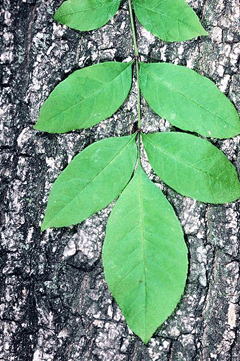
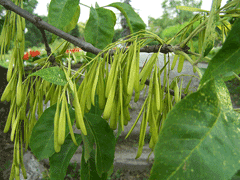
 Fraxinus pennsylvanica is a deciduous Tree growing to 20 m (65ft) by 20 m (65ft) at a fast rate.
See above for USDA hardiness. It is hardy to UK zone 4. It is in flower in May, and the seeds ripen in October. The species is dioecious (individual flowers are either male or female, but only one sex is to be found on any one plant so both male and female plants must be grown if seed is required). and is pollinated by Wind. The plant is not self-fertile.
Suitable for: light (sandy), medium (loamy) and heavy (clay) soils. Suitable pH: mildly acid, neutral and basic (mildly alkaline) soils. It cannot grow in the shade. It prefers moist soil. The plant can tolerates strong winds but not maritime exposure.
It can tolerate atmospheric pollution.
UK Hardiness Map
US Hardiness Map
Synonyms
F. lanceolata. F. pubescens.
Plant Habitats
Woodland Garden Canopy;
Edible Uses
Edible Parts: Inner bark
Edible Uses:
Inner bark - cooked[105, 161, 177]. The cambium layer can be scraped down in long, fluffy layers and cooked[257]. It is said to taste like eggs[257]. Inner bark can also be dried, ground into a powder and then used as a thickening in soups etc or mixed with cereals when making bread.
References More on Edible Uses
Medicinal Uses
Plants For A Future can not take any responsibility for any adverse effects from the use of plants. Always seek advice from a professional before using a plant medicinally.
Bitter Diuretic Tonic
The bark and leaves are a bitter tonic[4, 61]. An infusion of the inner bark has been used in the treatment of depression and fatigue[257]. The root is diuretic[4].
References More on Medicinal Uses
The Bookshop: Edible Plant Books
Our Latest books on Perennial Plants For Food Forests and Permaculture Gardens in paperback or digital formats.
Edible Tropical Plants
Food Forest Plants for Hotter Conditions: 250+ Plants For Tropical Food Forests & Permaculture Gardens.
More
Edible Temperate Plants
Plants for Your Food Forest: 500 Plants for Temperate Food Forests & Permaculture Gardens.
More
More Books
PFAF have eight books available in paperback and digital formats. Browse the shop for more information.
Shop Now
Other Uses
Basketry Dye Shelterbelt Wood
Agroforestry Uses: A fairly wind resistant tree, it can be grown as part of a shelterbelt planting and is used in reforestation projects[74, 200]. Landscape Uses - Aggressive surface roots possible, Pollard, Street tree. A red dye is extracted from the bark[226]. Logs of wood can be beaten with mauls to separate the growth layers, these layers can then be cut into strips and woven into baskets[257]. Wood - hard, heavy, rather strong, tough, elastic, brittle, coarse-grained. It weighs 44lb per cubic foot. Used for tool handles, furniture etc[61, 82, 149, 171, 235]. The wood is of poorer quality than F. americana, though it is usually sold under that name[226].
Special Uses
References More on Other Uses
Cultivation details
Prefers deep loamy soil, even if it is on the heavy side[1, 200]. Fraxinus pennsylvanica tolerates a broad range of temperatures and precipitation and is probably the most adaptable of all the ash species[338
]. It is a very cold-hardy plant, able to tolerate temperatures down to around -30°c when fully dormant[200
]
Prefers a deep loamy soil, even if it is on the heavy side[1
, 200
]. Most members of this genus are gross feeders and require a rich soil[11
, 200
]. Plants succeed when growing in exposed positions[200
] and also in alkaline soils[11
]. They tolerate atmospheric pollution[200
]. A fast-growing tree[188
]. Plants have little tolerance of shade[226
].
Cultivated as a timber tree in C. and S.E. Europe where it is sometimes naturalized[50
]. The cultivar 'Patmore' is disease resistant[188
].
A recently introduced invasive pest, the Emerald Ash Borer has rapidly spread across much of N. America and is devastating the genus Fraxinus. The borer infests and feeds on all the North American ash species it has so far encountered. The nature of the infestation (larval feeding in the phloem) effectively girdles trees as small as 25mm in diameter, which is many years before reproductive maturity, leading to death within five years of infestation. The borer, therefore, causes virtually 100% mortality of Ash populations. The Ash species are unable to persist for very long through vegetative reproduction, and seeds only remain viable in the soil for at most 7 - 8 years, so regeneration after borer infestation is minimal or nonexistent. Furthermore, the borer persists in forests with low population densities after major ash population crashes, so the orphaned cohort of ash seedlings that remains is quickly infested as they reach a suitable size[338
].
A dioecious species - both male and female forms must be grown if fruit and seed are required. The cultivar 'Patmore' is disease resistant[188]. Dioecious. Male and female plants must be grown if seed is required. Special Features: North American native, Attracts butterflies, Inconspicuous flowers or blooms.
References Carbon Farming Information and Carbon Sequestration Information
Temperature Converter
Type a value in the Celsius field to convert the value to Fahrenheit:
Fahrenheit:
The PFAF Bookshop
Plants For A Future have a number of books available in paperback and digital form. Book titles include Edible Plants, Edible Perennials, Edible Trees,Edible Shrubs, Woodland Gardening, and Temperate Food Forest Plants. Our new book is Food Forest Plants For Hotter Conditions (Tropical and Sub-Tropical).
Shop Now
Plant Propagation
The seed is best harvested green - as soon as it is fully developed but before it has fully dried on the tree - and can then be sown immediately in a cold frame[80]. It usually germinates in the spring[80]. Stored seed requires a period of cold stratification and is best sown as soon as possible in a cold frame[200]. Prick out the seedlings into individual pots when they are large enough to handle and grow them on in a cold frame for their first winter. Plant them out into their permanent positions or a nursery bed in late spring or early summer of the following year. If you have sufficient seed then it is possible to sow it directly into an outdoor seedbed, preferably in the autumn. Grow the seedlings on in the seedbed for 2 years before transplanting either to their permanent positions or to nursery beds.
Other Names
If available other names are mentioned here
Native Plant Search
Search over 900 plants ideal for food forests and permaculture gardens. Filter to search native plants to your area. The plants selected are the plants in our book 'Plants For Your Food Forest: 500 Plants for Temperate Food Forests and Permaculture Gardens, as well as plants chosen for our forthcoming related books for Tropical/Hot Wet Climates and Mediterranean/Hot Dry Climates. Native Plant Search
Found In
Countries where the plant has been found are listed here if the information is available
Weed Potential
Right plant wrong place. We are currently updating this section.
Please note that a plant may be invasive in one area but may not in your area so it’s worth checking.
Conservation Status
IUCN Red List of Threatened Plants Status :

Growth: S = slow M = medium F = fast. Soil: L = light (sandy) M = medium H = heavy (clay). pH: A = acid N = neutral B = basic (alkaline). Shade: F = full shade S = semi-shade N = no shade. Moisture: D = dry M = Moist We = wet Wa = water.

Expert comment
Author
Marshall.
Botanical References
1143200
Links / References
For a list of references used on this page please go here
Readers comment
| Add a comment |
|
If you have important information about this plant that may help other users please add a comment or link below. Only comments or links that are felt to be directly relevant to a plant will be included. If you think a comment/link or information contained on this page is inaccurate or misleading we would welcome your feedback at [email protected]. If you have questions about a plant please use the Forum on this website as we do not have the resources to answer questions ourselves.
* Please note: the comments by website users are not necessarily those held by PFAF and may give misleading or inaccurate information.
To leave a comment please Register or login here All comments need to be approved so will not appear immediately.
|
Subject : Fraxinus pennsylvanica
|
|
|
|