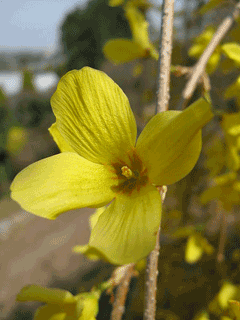
 |
|
http://commons.wikimedia.org/wiki/User:KENPEI |
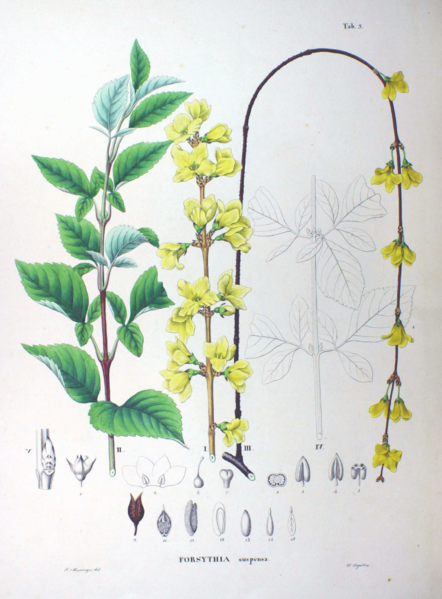 |
| http://commons.wikimedia.org/wiki/File:Forsythia_suspensa_SZ3.png |
Translate this page:
Summary
Bloom Color: Yellow. Main Bloom Time: Early spring, Mid spring. Form: Upright or erect, Vase.
Physical Characteristics

 Forsythia suspensa is a deciduous Shrub growing to 5 m (16ft) by 5 m (16ft) at a medium rate.
See above for USDA hardiness. It is hardy to UK zone 5 and is not frost tender. It is in flower from March to April. The species is hermaphrodite (has both male and female organs) and is pollinated by Insects. The plant is not self-fertile.
Suitable for: light (sandy), medium (loamy) and heavy (clay) soils, prefers well-drained soil and can grow in heavy clay soil. Suitable pH: mildly acid, neutral and basic (mildly alkaline) soils and can grow in very alkaline soils.
It can grow in full shade (deep woodland) semi-shade (light woodland) or no shade. It prefers moist soil.
UK Hardiness Map
US Hardiness Map
Synonyms
Syringa suspensa.
Plant Habitats
Woodland Garden Dappled Shade; Shady Edge; not Deep Shade; Ground Cover;
Edible Uses
Edible Parts: Leaves
Edible Uses: Rutin
Young leaves - cooked[105, 177, 179]. Some caution is advised due to the presence of a glycoside[179]. The leaves are rich in rutin[218].
References More on Edible Uses
Medicinal Uses
Plants For A Future can not take any responsibility for any adverse effects from the use of plants. Always seek advice from a professional before using a plant medicinally.
Antidote Antiphlogistic Antitussive Cancer Diuretic Emmenagogue Febrifuge Laxative
Tonic Urinary Vermifuge
Lian Qiao has been used in Chinese herbalism for over 4,000 years and is considered to be one of the 50 fundamental herbs[218]. A bitter tasting pungent herb with an antiseptic effect, it is chiefly used to treat boils, carbuncles, mumps and infected neck glands[254]. The fruit is a bitter astringent herb that stimulates the heart, nervous system and gall bladder[238]. It contains vitamin P, which is used to strengthen capillaries[238]. The fruit is also antidote, antiphlogistic, antitussive, diuretic, emmenagogue, febrifuge, laxative and tonic[116, 147, 174, 176, 178, 218, 238]. It is used internally in the treatment of acute infectious diseases such as mumps, and also for tonsillitis, urinary tract infections allergic rashes etc[238]. The fruit is harvested when fully ripe and is dried for use in decoctions[238]. The plant has a similar action to Lonicera japonica and is usually used in combination with that species to achieve a stronger action[176]. The flowers have a broad-spectrum antibacterial action, inhibiting the growth of Staphylococcus aureus, Shigella dysenteriae, haemolytic streptococcus, Pneumococcus, Bacillus typhi, Mycobacterium tuberculi etc[176]. The plant is vermifuge, though the part used is not stated[116, 147, 174, 178]. The leaves are febrifuge and are also poulticed onto ulcerated glands and haemorrhoids[218]. A decoction of the leaves and twigs is used in the treatment of breast cancer[61]. The root is used in the treatment of cancer, colds, fever and jaundice[218].
References More on Medicinal Uses
The Bookshop: Edible Plant Books
Our Latest books on Perennial Plants For Food Forests and Permaculture Gardens in paperback or digital formats.

Edible Tropical Plants
Food Forest Plants for Hotter Conditions: 250+ Plants For Tropical Food Forests & Permaculture Gardens.
More

Edible Temperate Plants
Plants for Your Food Forest: 500 Plants for Temperate Food Forests & Permaculture Gardens.
More

More Books
PFAF have eight books available in paperback and digital formats. Browse the shop for more information.
Shop Now
Other Uses
The sub-species F. suspensa sieboldii is a lax grower that roots freely where the branches touch the ground. It makes a very good tall ground cover when planted about 2.5 metres apart each way[208]. Landscape Uses: Border, Erosion control, Espalier, Massing, Screen.
Special Uses
Espalier Food Forest Ground cover
References More on Other Uses
Cultivation details
An easily grown plant, it succeeds in all soil types[202] but prefers a rich soil. Succeeds in limey soils. Grows well in heavy clay soils. It prefers a sunny position but succeeds in semi shade though it is apt to get leggy if grown in the shade of trees[182]. Succeeds against a north-facing wall[219]. Plants are hardy to about -25°c[184]. The flowers are produced quite early in the year and are frost-resistant[182]. Plants are medium to fast growing[202]. Flowers are produced on wood that is more than one year old[202]. Any pruning is best done after the plant has finished flowering[182]. A very ornamental plant, there are several named varieties[182]. This species is notably susceptible to honey fungus[200]. Special Features:
Not North American native, Blooms are very showy. In garden design, as well as the above-ground architecture of a plant, root structure considerations help in choosing plants that work together for their optimal soil requirements including nutrients and water. The root pattern is fleshy. Thick or swollen - fibrous or tap root [2-1].
References Carbon Farming Information and Carbon Sequestration Information
Temperature Converter
Type a value in the Celsius field to convert the value to Fahrenheit:
Fahrenheit:
The PFAF Bookshop
Plants For A Future have a number of books available in paperback and digital form. Book titles include Edible Plants, Edible Perennials, Edible Trees,Edible Shrubs, Woodland Gardening, and Temperate Food Forest Plants. Our new book is Food Forest Plants For Hotter Conditions (Tropical and Sub-Tropical).
Shop Now
Plant Propagation
Seed - sow spring in a cold frame. The seed usually germinates within 2 months[K]. When they are large enough to handle, prick the seedlings out into individual pots and grow them on in the greenhouse for at least their first winter. Plant them out into their permanent positions in late spring or early summer, after the last expected frosts. Cuttings of half-ripe wood 10 - 15cm taken at a node, July/August in a frame. Plant out in autumn or spring. A very high percentage, they root within 3 weeks[78]. Cuttings of mature wood in a sheltered outdoor bed. Good percentage[78]. Layering in spring or summer. Plants often self-layer[K].
Other Names
If available other names are mentioned here
Native Plant Search
Search over 900 plants ideal for food forests and permaculture gardens. Filter to search native plants to your area. The plants selected are the plants in our book 'Plants For Your Food Forest: 500 Plants for Temperate Food Forests and Permaculture Gardens, as well as plants chosen for our forthcoming related books for Tropical/Hot Wet Climates and Mediterranean/Hot Dry Climates. Native Plant Search
Found In
Countries where the plant has been found are listed here if the information is available
Weed Potential
Right plant wrong place. We are currently updating this section.
Please note that a plant may be invasive in one area but may not in your area so it’s worth checking.
Conservation Status
IUCN Red List of Threatened Plants Status :

Growth: S = slow M = medium F = fast. Soil: L = light (sandy) M = medium H = heavy (clay). pH: A = acid N = neutral B = basic (alkaline). Shade: F = full shade S = semi-shade N = no shade. Moisture: D = dry M = Moist We = wet Wa = water.

Expert comment
Author
(Thunb.)Vahl.
Botanical References
11200266
Links / References
For a list of references used on this page please go here
Readers comment
© 2010, Plants For A Future. Plants For A Future is a charitable company limited by guarantee, registered in England and Wales. Charity No. 1057719, Company No. 3204567.