 |
|
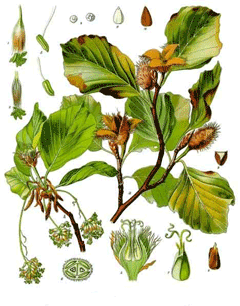
http://commons.wikimedia.org/wiki/File:Koeh-060.jpg |
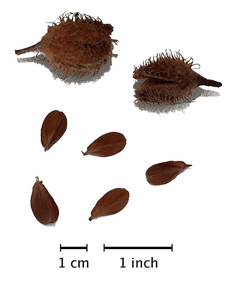 |
| http://commons.wikimedia.org/wiki/User:Andel |
Translate this page:
Summary
Main Bloom Time: Early spring, Late spring, Mid spring. Form: Oval.
Physical Characteristics

 Fagus sylvatica is a deciduous Tree growing to 30 m (98ft) by 15 m (49ft) at a medium rate.
See above for USDA hardiness. It is hardy to UK zone 5 and is not frost tender. It is in flower from April to May, and the seeds ripen from September to October. The species is monoecious (individual flowers are either male or female, but both sexes can be found on the same plant) and is pollinated by Wind.
It is noted for attracting wildlife.
Suitable for: light (sandy), medium (loamy) and heavy (clay) soils and prefers well-drained soil. Suitable pH: mildly acid, neutral and basic (mildly alkaline) soils and can grow in very acid and very alkaline soils.
It can grow in full shade (deep woodland) semi-shade (light woodland) or no shade. It prefers dry or moist soil. The plant can tolerates strong winds but not maritime exposure.
It can tolerate atmospheric pollution.
UK Hardiness Map
US Hardiness Map
Synonyms
Plant Habitats
Woodland Garden Canopy; Hedge;
Edible Uses
Edible Parts: Leaves Oil Seed
Edible Uses: Coffee Oil
Young leaves - raw[183]. A very nice mild flavour, they go well in a mixed salad. However, the leaves quickly become tough so only the youngest should be used[2, 5, 12, K]. New growth is usually produced for 2 periods of 3 weeks each year, one in spring and one in mid-summer. Seed - raw or cooked[2, 5, 7, 63, 183]. A pleasant sweet flavour, though rather small and fiddly[K]. The seed can also be dried and ground into a powder and then used with cereal flours when making bread, cakes etc[12]. The seed is rich in oil. The seed should not be eaten in large quantities because it contains a deleterious principle[65, 238]. The seed contains 17 - 20% of an edible semi-drying oil[4, 7, 8, 57]. This stores well without going rancid and is said to be equal in delicacy to olive oil[183]. It is used as a dressing for salads and also for cooking[238]. The seed residue is poisonous[9, 57]. The roasted seed is used as a coffee substitute[2, 63].
References More on Edible Uses
Medicinal Uses
Plants For A Future can not take any responsibility for any adverse effects from the use of plants. Always seek advice from a professional before using a plant medicinally.
Antacid Antipyretic Antiseptic Antitussive Bach Expectorant Odontalgic Skin
The bark is antacid, antipyretic, antiseptic, antitussive, expectorant, odontalgic[7, 9]. A tar (or creosote), obtained by dry distillation of the branches, is stimulating and antiseptic[4]. It is used internally as a stimulating expectorant and externally as an application to various skin diseases[4, 238]. The pure creosote has been used to give relief from toothache, but it should not be used without expert guidance[7]. The plant is used in Bach flower remedies - the keywords for prescribing it are 'Intolerance', 'Criticism' and 'Passing judgements'[209].
References More on Medicinal Uses
The Bookshop: Edible Plant Books
Our Latest books on Perennial Plants For Food Forests and Permaculture Gardens in paperback or digital formats.
Edible Tropical Plants
Food Forest Plants for Hotter Conditions: 250+ Plants For Tropical Food Forests & Permaculture Gardens.
More
Edible Temperate Plants
Plants for Your Food Forest: 500 Plants for Temperate Food Forests & Permaculture Gardens.
More
More Books
PFAF have eight books available in paperback and digital formats. Browse the shop for more information.
Shop Now
Other Uses
Charcoal Fuel Hedge Hedge Oil Stuffing Teeth Wood
A semi-drying oil is obtained from the seed, it is used as a fuel for lighting, as a lubricant, for polishing wood etc[12, 13, 46, 57, 63]. The seed residue is poisonous[9, 57]. The leaf buds harvested in the winter and dried on the twigs are used as toothpicks[66]. The leaves are gathered in autumn and used as a stuffing material for mattresses etc[115]. Wood - hard, heavy, strong, very durable[13, 46]. It is not suitable for outdoor use[1] and is often attacked by a small beetle[4]. It has a wide range of applications, including furniture, flooring, turnery etc[100]. It makes a very good fuel[6, 66], burning with a lot of heat[4], and yields a charcoal known as 'Carbo Ligni Pulveratus'[46]. The wood has often been used as a source of creosote, tar, methyl alcohol. acetic acid[123]. A dynamic accumulator gathering minerals or nutrients from the soil and storing them in a more bioavailable form - used as fertilizer or to improve mulch.
Special Uses
Attracts Wildlife Dynamic accumulator Food Forest Hedge Hedge
References More on Other Uses
Cultivation details
Landscape Uses:Firewood, Pest tolerant, Hedge, Aggressive surface roots possible, Screen, Specimen. Thrives on a light or medium soil, doing well on chalk, but ill-adapted for a heavy wet soil[1, 11]. Prefers a calcareous soil but succeeds in acid soils though it does not make such a fine tree in such a situation[186]. Succeeds in almost any soil and any pH, it is also very tolerant of a wide range of climatic conditions so long as there is sufficient rainfall[200]. Established trees are drought tolerant[186]. Very wind tolerant but dislikes salt[200]. Trees are shallow rooted and this might make them less wind resistant[186]. Trees have two growth periods a year, each of about 3 weeks in duration. The first is in spring around the end of April, the second is in summer, around the end of July. Trees are often slow growing and also can be very slow to establish after transplanting. However, in good conditions they are capable of growing up to a metre in a year. Young trees are very shade tolerant, but are subject to frost damage to their flowers and young leaves and so are best grown in a woodland position which will protect them[200]. An important food plant for many caterpillars, it has 64 species of associated insects[24]. Trees have a heavy canopy and cast a dense shade, very few other species can grow in a dense beech wood and on suitable soils it becomes the dominant species[186]. Very intolerant of coppicing, trees producing none or only very weak growth afterwards and this is soon smothered by other plants[186]. Plants are very tolerant of light pruning however and if this is carried out in late summer the plants will retain their dead leaves over winter[29]. There are many named forms selected for their ornamental value. Those forms with purple leaves prefer a position in full sun whilst forms with yellow leaves prefer some shade[188]. This species is notably resistant to honey fungus[200]. Special Features:
Not North American native, All or parts of this plant are poisonous, Inconspicuous flowers or blooms. The plant is heat tolerant in zones 9 through 4. (Plant Hardiness Zones show how well plants withstand cold winter temperatures.
Plant Heat Zones show when plants would start suffering from the heat.
The Plant Heat Zone map is based on the number of "heat days" experienced in a given area where the temperature climbs to over 86 degrees F (30°C).
At this temperature, many plants begin to suffer physiological damage. Heat Zones range from 1 (no heat days) to 12 (210 or more heat days).
For example Heat Zone. 11-1 indicates that the plant is heat tolerant in zones 11 through 1.) For polyculture design as well as the above-ground architecture (form - tree, shrub etc. and size shown above) information on the habit and root pattern is also useful and given here if available. A sprouting standard sending up shoots from the base [1-2]. The root pattern is suckering with new plants from underground runners away from the plant [1-2].
References Carbon Farming Information and Carbon Sequestration Information
Temperature Converter
Type a value in the Celsius field to convert the value to Fahrenheit:
Fahrenheit:
The PFAF Bookshop
Plants For A Future have a number of books available in paperback and digital form. Book titles include Edible Plants, Edible Perennials, Edible Trees,Edible Shrubs, Woodland Gardening, and Temperate Food Forest Plants. Our new book is Food Forest Plants For Hotter Conditions (Tropical and Sub-Tropical).
Shop Now
Plant Propagation
Seed - the seed has a short viability and is best sown as soon as it is ripe in the autumn in a cold frame. Protect the seed from mice. Germination takes place in the spring. When they are large enough to handle, prick the seedlings out into individual pots and grow them on in the greenhouse for at least their first winter. Plant them out into their permanent positions in late spring or early summer, after the last expected frosts. The seedlings are slow growing for the first few years and are very susceptible to damage by late frosts. The seed can also be sown in an outdoor seedbed in the autumn[186]. The seedlings can be left in the open ground for three years before transplanting, but do best if put into their final positions as soon as possible and given some protection from spring frosts.
Other Names
If available other names are mentioned here
Native Plant Search
Search over 900 plants ideal for food forests and permaculture gardens. Filter to search native plants to your area. The plants selected are the plants in our book 'Plants For Your Food Forest: 500 Plants for Temperate Food Forests and Permaculture Gardens, as well as plants chosen for our forthcoming related books for Tropical/Hot Wet Climates and Mediterranean/Hot Dry Climates. Native Plant Search
Found In
Countries where the plant has been found are listed here if the information is available
Weed Potential
Right plant wrong place. We are currently updating this section.
Please note that a plant may be invasive in one area but may not in your area so it’s worth checking.
Conservation Status
IUCN Red List of Threatened Plants Status :

Growth: S = slow M = medium F = fast. Soil: L = light (sandy) M = medium H = heavy (clay). pH: A = acid N = neutral B = basic (alkaline). Shade: F = full shade S = semi-shade N = no shade. Moisture: D = dry M = Moist We = wet Wa = water.

Expert comment
Author
L.
Botanical References
1117200
Links / References
For a list of references used on this page please go here
Readers comment
© 2010, Plants For A Future. Plants For A Future is a charitable company limited by guarantee, registered in England and Wales. Charity No. 1057719, Company No. 3204567.