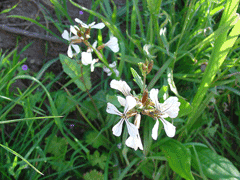
 |
|
http://commons.wikimedia.org/wiki/User:Retama |
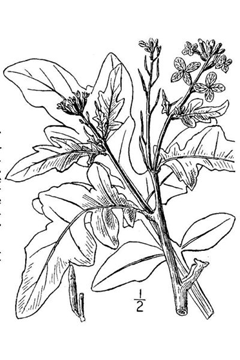 |
| SDA-NRCS PLANTS Database / Britton, N.L., and A. Brown. 1913. Illustrated flora of the northern states and Canada. Vol. 2: 192. |
Translate this page:
Summary
Physical Characteristics

 Eruca vesicaria sativa is a ANNUAL growing to 0.6 m (2ft) by 0.3 m (1ft in) at a fast rate.
See above for USDA hardiness. It is hardy to UK zone 7 and is not frost tender. It is in leaf all year, in flower from May to August, and the seeds ripen from July to September. The species is hermaphrodite (has both male and female organs) and is pollinated by Insects.
Suitable for: light (sandy), medium (loamy) and heavy (clay) soils and prefers well-drained soil. Suitable pH: mildly acid, neutral and basic (mildly alkaline) soils. It can grow in semi-shade (light woodland) or no shade. It prefers dry or moist soil and can tolerate drought. The plant can tolerates strong winds but not maritime exposure.
UK Hardiness Map
US Hardiness Map
Synonyms
E. sativa. Mill. E. vesicaria. Brassica eruca.
Plant Habitats
Woodland Garden Sunny Edge; Cultivated Beds;
Edible Uses
Edible Parts: Flowers Leaves Oil Oil
Edible Uses: Condiment Oil Oil
Young leaves - raw or cooked[2, 27, 33, 34, 74]. A distinct strongly spicy flavour[183], the taste is best from fast, well-grown plants[200]. A few leaves added to a salad are acceptable though the flavour is too strong for many tastes[K]. Some people really like these leaves though most are not very keen[K]. Older leaves that have become too hot to eat on their own can be pureed and added to soups etc[183]. In the milder areas of Britain it is possible to produce edible leaves all year round from successional sowings, especially if the winter crop is given some protection[K]. Flowers - raw[52}. A similar taste to the leaves, they make a nice garnish on the salad bowl[183]. The seed yields a semi-drying oil[1, 2, 74] which is edible if stored 6 months[61, 114] and is a substitute for rapeseed oil[34]. It contains 32% fat, 27% protein[114]. It is known as 'jamba oil'[183]. A mustard is obtained from the seed[46, 74, 183], the strong flavour comes from an essential oil that is contained within the oil of the seed[114]. The pungency of mustard develops when cold water is added to the ground-up seed - an enzyme (myrosin) acts on a glycoside (sinigrin) to produce a sulphur compound. The reaction takes 10 - 15 minutes. Mixing with hot water or vinegar, or adding salt, inhibits the enzyme and produces a mild bitter mustard[238].
References More on Edible Uses
Medicinal Uses
Plants For A Future can not take any responsibility for any adverse effects from the use of plants. Always seek advice from a professional before using a plant medicinally.
Antibacterial Antiscorbutic Aphrodisiac Diuretic Rubefacient Stimulant Stomachic
Rocket was at one time used medicinally, though it is now used only as a salad herb[238]. The leaves are antiscorbutic, diuretic, stimulant and stomachic[4, 46]. The seed is rubefacient and stimulant[4, 46]. The powdered seed possesses antibacterial activity, but no alkaloids have been isolated[240]. The oil from the seed is said to have aphrodisiac properties[264].
References More on Medicinal Uses
Now available: PLANTS FOR YOUR FOOD FOREST: 500 Plants for Temperate Food Forests and Permaculture Gardens.
An important new book from PFAF. It focuses on the attributes of plants suitable for food forests, what each can contribute to a food forest ecosystem, including carbon sequestration, and the kinds of foods they yield. The book suggests that community and small-scale food forests can provide a real alternative to intensive industrialised agriculture, and help to combat the many inter-related environmental crises that threaten the very future of life on Earth.
Read More
Other Uses
Oil Oil
The seed yields a semi-drying oil which is a substitute for rapeseed oil[46]. It can also be used for lighting, burning with very little soot[114].
Special Uses
Food Forest
References More on Other Uses
Cultivation details
A very easily grown and fast-maturing plant, it succeeds in most soils and conditions, though it prefers some shade in summer[52]. Once established, plants are quite drought resistant[160]. Rocket is occasionally cultivated for its edible leaves and flowers, it can be ready for harvest within 40 days of sowing the seed[1, 46, 89, 264], there are some named varieties. 'Rocket Improved' is less prone to bolting, though it still grows best in cooler weather[183]. Plants usually self-sow freely if the ground is disturbed in some way, such as by hoeing[K]. This species is normally untroubled by pests or diseases[160].
References Carbon Farming Information and Carbon Sequestration Information
Temperature Converter
Type a value in the Celsius field to convert the value to Fahrenheit:
Fahrenheit:
The PFAF Bookshop
Plants For A Future have a number of books available in paperback and digital form. Book titles include Edible Plants, Edible Perennials, Edible Trees,Edible Shrubs, Woodland Gardening, and Temperate Food Forest Plants. Our new book is Food Forest Plants For Hotter Conditions (Tropical and Sub-Tropical).
Shop Now
Plant Propagation
Seed - sow outdoors in spring in situ. Germination is usually very quick and free. In order to obtain a continuous supply of edible leaves, successional sowings can be made every few weeks until mid August[33]. A late summer/early autumn sowing can provide leaves in winter, though the plants might require some protection in very cold winters[200].
Other Names
If available other names are mentioned here
Native Plant Search
Search over 900 plants ideal for food forests and permaculture gardens. Filter to search native plants to your area. The plants selected are the plants in our book 'Plants For Your Food Forest: 500 Plants for Temperate Food Forests and Permaculture Gardens, as well as plants chosen for our forthcoming related books for Tropical/Hot Wet Climates and Mediterranean/Hot Dry Climates. Native Plant Search
Found In
Countries where the plant has been found are listed here if the information is available
Weed Potential
Right plant wrong place. We are currently updating this section.
Please note that a plant may be invasive in one area but may not in your area so it’s worth checking.
Conservation Status
IUCN Red List of Threatened Plants Status :

Growth: S = slow M = medium F = fast. Soil: L = light (sandy) M = medium H = heavy (clay). pH: A = acid N = neutral B = basic (alkaline). Shade: F = full shade S = semi-shade N = no shade. Moisture: D = dry M = Moist We = wet Wa = water.

Expert comment
Author
(Mill.)Thell.
Botanical References
17200
Links / References
For a list of references used on this page please go here
Readers comment