 |
|
http://commons.wikimedia.org/wiki/User:Fabelfroh |
 |
| http://commons.wikimedia.org/wiki/File:Illustration_Equisetum_pratense0.jpg |
Translate this page:
Summary
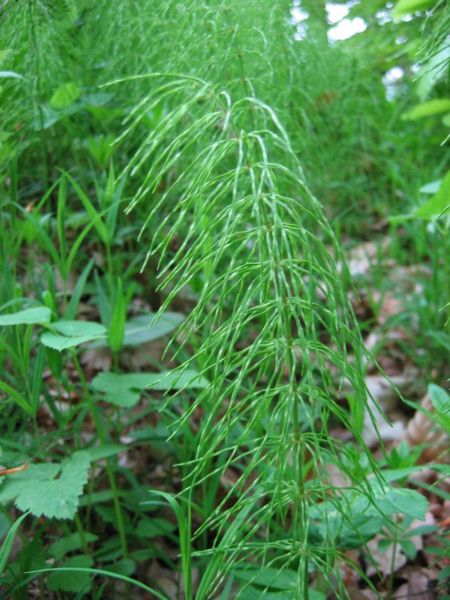
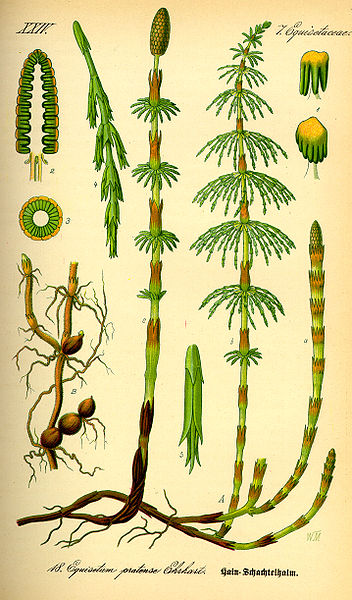
Equisetum species - horsetail family are Creeping, perenial, Branching rootstocks, rooted at the nodes. The Arial stems may be annual or Perennial, are cylindrical, fluted, simple or with whorled branches at the jointed nodes. The internodes are usually hollow. The Surfaces of the stems are covered with Silica. The Cones are terminal.
Physical Characteristics

 Equisetum pratense is a PERENNIAL growing to 0.6 m (2ft).
See above for USDA hardiness. It is hardy to UK zone 5. The seeds ripen in April.
Suitable for: light (sandy), medium (loamy) and heavy (clay) soils. Suitable pH: mildly acid, neutral and basic (mildly alkaline) soils. It can grow in semi-shade (light woodland) or no shade. It prefers moist soil.
UK Hardiness Map
US Hardiness Map
Synonyms
Plant Habitats
Bog Garden; Cultivated Beds;
Edible Uses
Edible Parts: Root
Edible Uses:
Roots - raw or cooked[46, 61, 85, 161, 257]. Caution is advised, see the notes above on toxicity. A further report says that the peeled stems, base of the plant, root and tubers were eaten raw by the N. American Indians, the report went on to say that this may be inadvisable[85].
References More on Edible Uses
Medicinal Uses
Plants For A Future can not take any responsibility for any adverse effects from the use of plants. Always seek advice from a professional before using a plant medicinally.
Horsetails have an unusual chemistry compared to most other plants[238]. They are rich in silica, contain several alkaloids (including nicotine) and various minerals[238].
References More on Medicinal Uses
The Bookshop: Edible Plant Books
Our Latest books on Perennial Plants For Food Forests and Permaculture Gardens in paperback or digital formats.

Edible Tropical Plants
Food Forest Plants for Hotter Conditions: 250+ Plants For Tropical Food Forests & Permaculture Gardens.
More

Edible Temperate Plants
Plants for Your Food Forest: 500 Plants for Temperate Food Forests & Permaculture Gardens.
More

More Books
PFAF have eight books available in paperback and digital formats. Browse the shop for more information.
Shop Now
Other Uses
References More on Other Uses
Cultivation details
Prefers a moist soil with a pH between 6.5 and 7.5[200]. Plants are hardy to about -30°c[200]. Plants have a deep and penetrating root system and can be invasive. If grown in the garden they are best kept in bounds by planting them in a large container which can be sunk into the ground[200].
References Carbon Farming Information and Carbon Sequestration Information
Temperature Converter
Type a value in the Celsius field to convert the value to Fahrenheit:
Fahrenheit:
The PFAF Bookshop
Plants For A Future have a number of books available in paperback and digital form. Book titles include Edible Plants, Edible Perennials, Edible Trees,Edible Shrubs, Woodland Gardening, and Temperate Food Forest Plants. Our new book is Food Forest Plants For Hotter Conditions (Tropical and Sub-Tropical).
Shop Now
Plant Propagation
Spores - best collected as soon as they are ripe in the spring and surface-sown immediately on a sterile compost. Keep moist and pot up as soon as the plants are large enough to handle. Very difficult[200]. Division. The plants usually spread very freely when well sited and should not really need any assistance.
Other Names
If available other names are mentioned here
Native Plant Search
Search over 900 plants ideal for food forests and permaculture gardens. Filter to search native plants to your area. The plants selected are the plants in our book 'Plants For Your Food Forest: 500 Plants for Temperate Food Forests and Permaculture Gardens, as well as plants chosen for our forthcoming related books for Tropical/Hot Wet Climates and Mediterranean/Hot Dry Climates. Native Plant Search
Found In
Countries where the plant has been found are listed here if the information is available
Weed Potential
Right plant wrong place. We are currently updating this section.
Please note that a plant may be invasive in one area but may not in your area so it’s worth checking.
Conservation Status
IUCN Red List of Threatened Plants Status :

Growth: S = slow M = medium F = fast. Soil: L = light (sandy) M = medium H = heavy (clay). pH: A = acid N = neutral B = basic (alkaline). Shade: F = full shade S = semi-shade N = no shade. Moisture: D = dry M = Moist We = wet Wa = water.

Expert comment
Author
Ehrh.
Botanical References
17
Links / References
For a list of references used on this page please go here
Readers comment