 |
|
http://commons.wikimedia.org/wiki/User:KENPEI |
 |
| http://commons.wikimedia.org/wiki/User:Sphl |
Translate this page:
Summary
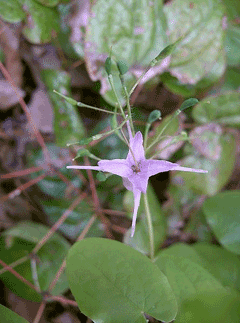
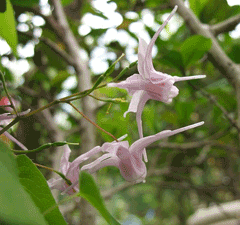
Bloom Color: Lavender, Pink, White. Main Bloom Time: Early spring. Form: Spreading or horizontal.
Physical Characteristics

 Epimedium grandiflorum is a PERENNIAL growing to 0.4 m (1ft 4in) by 0.3 m (1ft) at a medium rate.
See above for USDA hardiness. It is hardy to UK zone 5 and is not frost tender. It is in flower from May to June. The species is hermaphrodite (has both male and female organs) and is pollinated by Bees. The plant is not self-fertile.
Suitable for: light (sandy), medium (loamy) and heavy (clay) soils. Suitable pH: mildly acid and neutral soils. It can grow in semi-shade (light woodland). It prefers dry or moist soil.
UK Hardiness Map
US Hardiness Map
Synonyms
E. macranthum. E. violaceum.
Plant Habitats
Woodland Garden Dappled Shade; Shady Edge; Ground Cover;
Edible Uses
Edible Parts: Leaves
Edible Uses:
Young plant and young leaves - cooked[105, 179]. Soaked and then boiled[177]. (This suggests that the leaves are bitter and need to be soaked in order to remove the bitterness.)
References More on Edible Uses
Medicinal Uses
Plants For A Future can not take any responsibility for any adverse effects from the use of plants. Always seek advice from a professional before using a plant medicinally.
Antiasthmatic Antibacterial Antirheumatic Antitussive Aphrodisiac Hypoglycaemic Tonic Vasodilator
The aerial parts of the plant are antiasthmatic, antibacterial, antirheumatic, antitussive, aphrodisiac, hypoglycaemic, tonic and vasodilator. Its use lowers blood sugar levels[116, 176]. It is used in the treatment of impotence, seminal emissions, lumbago, arthritis, numbness and weakness of the limbs, hypertension and chronic bronchitis[176]. It has an action on the genitals similar to the male sex hormone and can increase the weight of the prostate gland and seminal vesicle, it has increased copulation in animals and increases the secretion of semens[176]. The leaves are used as an aphrodisiac[218]. Administered orally, the leaf extract increases the frequency of copulation in animals[218].
References More on Medicinal Uses
The Bookshop: Edible Plant Books
Our Latest books on Perennial Plants For Food Forests and Permaculture Gardens in paperback or digital formats.

Edible Tropical Plants
Food Forest Plants for Hotter Conditions: 250+ Plants For Tropical Food Forests & Permaculture Gardens.
More

Edible Temperate Plants
Plants for Your Food Forest: 500 Plants for Temperate Food Forests & Permaculture Gardens.
More

More Books
PFAF have eight books available in paperback and digital formats. Browse the shop for more information.
Shop Now
Other Uses
References More on Other Uses
Cultivation details
Landscape Uses:Border, Container, Ground cover, Rock garden, Woodland garden. Succeeds in any fertile humus-rich soil[200], preferring a moist but well-drained peaty loam[1, 280]. Requires a lime-free soil[280]. Grows best in the light dappled shade of a woodland[200, 280]. Plants can succeed in the dry shade of trees[233]. A shallow-rooting plant, the rhizomes creeping just below the soil and the finer roots occupying the top 30cm of the soil[280]. A clump-forming species, the rhizomes making only short new growth each year, it needs to be divided every 3 - 4 years in order to maintain vigour[280]. Plants are hardy to about -20°c[187], though the flowers in spring can be damaged by late frosts[233]. A very ornamental plant[1], there are several named varieties[187]. It grows well in the rock garden or wild garden[1]. Plants are self-sterile and so more than one clone is required for cross-fertilization in order for seed to be produced. Plants will often hybridise with other species growing nearby[280]. Members of this genus are rarely if ever troubled by browsing deer or rabbits[233]. Special Features:
Attractive foliage, Naturalizing.
References Carbon Farming Information and Carbon Sequestration Information
Temperature Converter
Type a value in the Celsius field to convert the value to Fahrenheit:
Fahrenheit:
The PFAF Bookshop
Plants For A Future have a number of books available in paperback and digital form. Book titles include Edible Plants, Edible Perennials, Edible Trees,Edible Shrubs, Woodland Gardening, and Temperate Food Forest Plants. Our new book is Food Forest Plants For Hotter Conditions (Tropical and Sub-Tropical).
Shop Now
Plant Propagation
Seed - best sown in a cold frame as soon as it is ripe in late summer[200, 280]. Sow stored seed as early as possible in the year in a cold frame. Prick out the seedlings into individual pots when they are large enough to handle and grow them on in light shade in the cold frame or greenhouse for at least their first winter[K]. Plant them out in mid to late summer[K]. Division, best carried out in August to September according to one report[280], in late spring according to another[200]. Larger clumps can be replanted direct into their permanent positions, though it is best to pot up smaller clumps and grow them on in a cold frame until they are rooting well. Plant them out in the spring. Cuttings in late summer[200].
Other Names
If available other names are mentioned here
Native Plant Search
Search over 900 plants ideal for food forests and permaculture gardens. Filter to search native plants to your area. The plants selected are the plants in our book 'Plants For Your Food Forest: 500 Plants for Temperate Food Forests and Permaculture Gardens, as well as plants chosen for our forthcoming related books for Tropical/Hot Wet Climates and Mediterranean/Hot Dry Climates. Native Plant Search
Found In
Countries where the plant has been found are listed here if the information is available
Weed Potential
Right plant wrong place. We are currently updating this section.
Please note that a plant may be invasive in one area but may not in your area so it’s worth checking.
Conservation Status
IUCN Red List of Threatened Plants Status :

Growth: S = slow M = medium F = fast. Soil: L = light (sandy) M = medium H = heavy (clay). pH: A = acid N = neutral B = basic (alkaline). Shade: F = full shade S = semi-shade N = no shade. Moisture: D = dry M = Moist We = wet Wa = water.

Expert comment
Author
C.Morren.
Botanical References
58200280
Links / References
For a list of references used on this page please go here
Readers comment