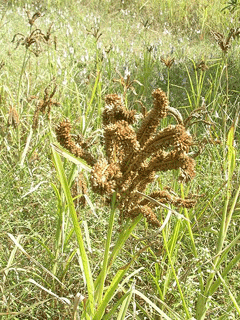
S.E. Asia. It probably arose through cultivation from E. indica.
Habitat
Savannah and upland grassland[200].
Edibility Rating
4 (1-5)
Medicinal Rating
2 (1-5)
Physical Characteristics
Annual growing to 0.3m.
It is hardy to zone 9. It is in flower from July to August, and the seeds ripen from August to October. The flowers are monoecious (individual flowers are either male or female, but both sexes can be found on the same plant) and are pollinated by Wind.
The plant is self-fertile.
The plant prefers light (sandy), medium (loamy) and heavy (clay) soils, requires well-drained soil and can grow in nutritionally poor soil.
The plant prefers acid, neutral and basic (alkaline) soils and can grow in saline soil.
It cannot grow in the shade.
It requires moist soil.
Seed - cooked. Used as a millet, the seed can be cooked whole or ground and used as a flour[183]. It is used in cakes, puddings, porridge etc[1, 2, 46, 171, 183]. The flour makes a very fair unleavened bread if it is first soaked overnight in water[2]. It is often used in making fermented foods[183]. Finger millet is the main food grain for many peoples, especially in dry areas of India, Nepal and Sri Lanka[269, 272]. The grain is higher in protein, fat and minerals than rice, corn, or sorghum[269]. When consumed as food it provides a sustaining diet, especially for people doing hard work[269]. The grain may also be malted and a flour of the malted grain used as a nourishing food for infants and invalids[269]. Finger millet is considered an especially wholesome food for diabetics[269]. The seed is about 2mm in diameter[2]. A nutritional analysis is available[218].
Seed yield is about 5 Tonnes per hectare[269]. Ragi grain possesses excellent storage properties and is said to improve in quality with storage. Seed can be stored without damage for as long as 50 years[269]. They are highly valued as a reserve food in times of famine. Yield depends on variety and is directly related to duration, height and tillering capacity of type grown. Types with straight spikes give better yields than those with curved spikes[269].
Composition
Figures in grams (g) or miligrams (mg) per 100g of food.
Notes: The figures given here are the median of a range given in the report.
Medicinal Uses
Plants For A Future can not take any responsibility for any adverse effects from the use of plants.
Always seek advice from a professional before using a plant medicinally.
The seed is astringent, tonic and cooling[240]. It is used in the treatment of fevers, biliousness and hepatitis[218, 240].
The leaf juice has been given to women in childbirth, and the plant is reported to be diaphoretic, diuretic, and vermifuge[269]. The plant is a folk remedy for treating leprosy, liver disease, measles, pleurisy, pneumonia, and small pox[269].
Other Uses
None known
Cultivation details
An easily grown plant, it succeeds in ordinary garden soil in a sunny position[200]. Tolerates moderately moist conditions[57]. Finger millet is reported to tolerate an annual precipitation of 29 to 429cm, an annual temperature range of 11.1 to 27.4°C and a pH in the range of 5.0 to 8.2[269]. Typically a tropical crop, one of the best suited for dry farming, generally grown rainfed. It thrives under a medium rainfall, on porous soils that do not get waterlogged. With rainfall of 53-75 cm, it is cultivated rainfed; with less, it is irrigated[269]. Finger millet is very adaptable and thrives at higher elevations than most other tropical cereals[269]. Cultivated on soils ranging from rich loams to poor shallow upland soils. In India, grown on black cotton soils, but thrives on red lateritic loams. Ragi stands salinity better than most cereals[269].
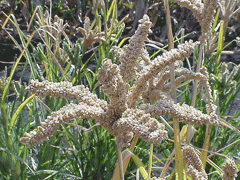
Finger millet is much cultivated in tropical countries for its edible seed[1, 2, 162]. Over 20 varieties of ragi are cultivated in India[183, 269]. The numerous races under cultivation are primarily divided into purple and green types; those with straight or open spikes, encurved or closed spikes, or branched spikes; length of earheads (5-10 cm long); colour of seeds (deep brown to shade of orange-red to almost white or black); dwarf in habit (45 cm tall) to up to 1.3 m tall; poor tillering to profuse tillering; early or late maturing; suitable for growing under irrigation to growing in dry areas. Many named cultivars are involved in breeding trials in India. Most improvement is sought in increasing yields, resistance to lodging, even maturity and loose panicle[269].
The plant requires a good summer if it is to do well in Britain[K], though in warmer climes it is heavy yielding, even on poor soils[57, 171].
Plants are seldom troubled by insect pests[61, 171]. The seed stores well[171].
Plants are mainly self-fertile[269].
Propagation
Seed - sow early spring in a greenhouse and only just cover the seed. Germination should take place within 2 weeks. Prick out the seedlings into individual pots as soon as they are large enough to handle and plant them out in late spring after the last expected frosts[162, 200].
The seed can also be sown in mid to late spring in situ[200], though if the summer is cool it might not ripen its seed[K].
Cultivars
'AKP-2'
This fast-growing form is green throughout, with incurved panicle, maturing in 85-90 days[269].
'Candlestick'
The heads are borne on tall stalks and are shaped like candlesticks[183]. The plants tiller heavily[183].
'Dragon's Claw'
The seeds are smaller than some millets and are difficult to thresh[183]. The plant is trouble-free and yields well, the seed are highly resistant to storage pests[183]. This is a good crop for natural agriculture enthusiasts[183].
Plants grow to 1 metre tall, maturing their crop in 130 days from sowing[183]. The stalks are stiff and resistant to lodging[183].
'EC 1540'
A form of white ragi, the plant gives superior nutritive value, up to 14% protein, compared to pigmented types, which range from 6-11%[269].
'Relluchodi'
A hill type, it is green throughout, with long open type panicle and maturing in 115-120 days[269].
Links
References
[K] Ken Fern Notes from observations, tasting etc at Plants For A Future and on field trips.
[1] F. Chittendon.RHS Dictionary of Plants plus Supplement. 1956 Oxford University Press 1951 Comprehensive listing of species and how to grow them. Somewhat outdated, it has been replaces in 1992 by a new dictionary (see [200]).
[2] Hedrick. U. P.Sturtevant's Edible Plants of the World. Dover Publications 1972 ISBN 0-486-20459-6 Lots of entries, quite a lot of information in most entries and references.
[46] Uphof. J. C. Th.Dictionary of Economic Plants. Weinheim 1959 An excellent and very comprehensive guide but it only gives very short descriptions of the uses without any details of how to utilize the plants. Not for the casual reader.
[57] Schery. R. W.Plants for Man. 0 Fairly readable but not very comprehensive. Deals with plants from around the world.
[61] Usher. G.A Dictionary of Plants Used by Man. Constable 1974 ISBN 0094579202 Forget the sexist title, this is one of the best books on the subject. Lists a very extensive range of useful plants from around the world with very brief details of the uses. Not for the casual reader.
[162] Grounds. R.Ornamental Grasses. Christopher Helm 1989 ISBN 0-7470-1219-9 Cultivation details of many of the grasses and bamboos. Well illustrated.
[171] Hill. A. F.Economic Botany. The Maple Press 1952 Not very comprehensive, but it is quite readable and goes into some a bit of detail about the plants it does cover.
[183] Facciola. S.Cornucopia - A Source Book of Edible Plants. Kampong Publications 1990 ISBN 0-9628087-0-9 Excellent. Contains a very wide range of conventional and unconventional food plants (including tropical) and where they can be obtained (mainly N. American nurseries but also research institutes and a lot of other nurseries from around the world.
[200] Huxley. A.The New RHS Dictionary of Gardening. 1992. MacMillan Press 1992 ISBN 0-333-47494-5 Excellent and very comprehensive, though it contains a number of silly mistakes. Readable yet also very detailed.
[218] Duke. J. A. and Ayensu. E. S.Medicinal Plants of China Reference Publications, Inc. 1985 ISBN 0-917256-20-4 Details of over 1,200 medicinal plants of China and brief details of their uses. Often includes an analysis, or at least a list of constituents. Heavy going if you are not into the subject.
[240] Chopra. R. N., Nayar. S. L. and Chopra. I. C.Glossary of Indian Medicinal Plants (Including the Supplement). Council of Scientific and Industrial Research, New Delhi. 1986 Very terse details of medicinal uses of plants with a wide range of references and details of research into the plants chemistry. Not for the casual reader.
[269] Duke. J.Handbook of Energy Crops - 1983 Published only on the Internet, excellent information on a wide range of plants.
[272] Manandhar. N. P.Plants and People of Nepal Timber Press. Oregon. 2002 ISBN 0-88192-527-6 Excellent book, covering over 1,500 species of useful plants from Nepal together with information on the geography and peoples of Nepal. Good descriptions of the plants with terse notes on their uses.
Readers Comments
Plants for a Future does not verify the accuracy of reader comments,
use at your own risk. In particular
Plants For A Future can not take any responsibility for any adverse effects from the use of plants.
You should always consult a professional before using plants medicinally.
Eleusine coracana
arvind
Tue Jul 20 16:02:56 2004
WE ARE PRODUCERS/EXPORTERS OF FOOD GRAINS/MEDICINAL HERBS FROM INDIA.
Archaeological excavations show that improved forms of finger millet
were once the staple grain diet of southern Africa. In India it is
still an important grain today. In east Africa, where it is cultivated
as a cereal, five races are distinguished on the inflorescence
morphology (Gibbs-Russell et al. 1989). It is the principal cereal
grain of Uganda and is planted on more than 0.4 million hectares there.
It has been successfully grown in the United States as far north as
Davis, California, but with considerable problems of photoperiod
sensitivity (National Research Council 1996).
It is a versatile grain that can be used in many different types of
food. It is eaten by grinding the grains up for porridge or, as in
Indonesia, eaten as a vegetable. Sometimes it is ground into flour and
used for bread or various other baked products. The sprouted seeds are
a nutritious and easily digested food that is recommended for infants
and the elderly (National Research Council 1996).
The grain may be left to germinate to make malt, which is very popular
in southern Africa due to the sweetness of the malt (Van Wyk & Gericke
2000). Its ability to convert starch to sugar is surpassed only by
barley (National Research Council 1996). In Ethiopia a powerful
distilled liquor called arake is made from finger millet.
In India finger millet is widely enjoyed as a popped grain.
Finger millet straw makes good fodder and contains up to 61% total
digestible nutrients (National Research Council 1996).
It is used in traditional medicine as an internal remedy for leprosy or
liver disease (Van Wyk & Gericke 2000).
Parts of the plant (the leaves and culms) are used to plait bracelets
(Gibbs-Russell et al. 1989).
Chemicals can be obtained from the plant, namely hydrocyanic acid.
E. coracana is probably the most important weed in cultivated lands in
southern Africa due to its exceptionally strong root system that makes
it difficult to control mechanically. It is also a weed in many other
parts of the world, namely North America, where it is listed as a weed.
In Africa, the wild form (E. coracana subsp. africana) is considered to
be a weed where the cultivated form (E. coracana subsp. coracana) is
grown and is especially problematic since they are so similar in
appearance.
Cytology:
Chromosome base number, x = 9. E. coracana subspecies coracana is a
tetraploid that derives from the wild diploid subspecies africana
(National Research Council 1996).
Leaf blade anatomy:
C4 photosynthetic pathway.
Toxicity:
Not toxic.
Ecology:
the cultivated form more commonly requires 500-1000 mm of rainfall per
year. This should be well-distributed throughout the growing season and
with an absence of prolonged droughts (National Research Council 1996).
The altitude limits of the species are unknown, but most of the
cultivated finger millet in the world is found from 500-2400 m
elevation (National Research Council 1996). It tolerates cool climates,
but thrives under hot conditions and can grow where temperatures are as
high as 35oC (National Research Council 1996). E. coracana appears to
be photoperiod sensitive, the optimum photoperiod being 12 hours, which
is considered to be relatively short.
Drought tolerance:
It tolerates dry spells in the early stages of growth and then grows
rapidly.
Tolerance to flooding:
It will not tolerate flooding.
Soil requirements:
It can be grown in any soil type as long as the rainfall is higher than
800 mm per annum (Van Wyk & Gericke 2000). Cultivated crops of E.
coracana are frequently produced on reddish-brown lateritic soils with
good drainage but reasonable water holding capacity (National Research
Council 1996). It has greater ability to utilize rock posphate than
other cereals do (Flack et al. 1987).
Propagation and planting:
E. coracana is much hardier and less susceptible to pests and diseases
than other grain crops.
Growth and development:
From germination cultivated plants take 2.5-6 months to mature. In
southern Africa the wild form flowers any time from October to May.
Diseases and pests:
Suffers little from diseases and insects. However, it is subject to
bird predators, most notably the quelea. A fungal disease called
"blast" can devastate whole fields of finger millet. The seeds can be
stored for years without insect damage, which makes them perfect for
famine-prone areas (National Research Council 1996).
Performance:
The cultivated form is considered to be a highly productive crop
(National Research Council 1996). Yields vary tremendously from
600-5000 kilograms per hectare and are not affected much by bird
damage. However, yield per unit labour is considered to be more
important in rural areas and also that there is at least some yield
during times of drought (Van Wyk & Gericke 2000). Cereal from this
species is considered to be more nutritious than any other major cereal
species. It has high levels of methionine, an amino acid which is
lacking in the diets of poor people who live on starchy foods such as
cassava and plantain (National Research Council 1996). This may be the
major reason why people of central Africa are so physically healthy
despite a limited diet.
Palatability:
The straw is used as low-quality roughage in India and Uganda.
Nutritive value:
Finger millet has variable nutritive value; protein contents ranging
from 6?14% have been reported, fat 1?1.4%, iron 5mg per 100g and food
energy 323?350 Kc. These are the more frequently given levels but in
some samples they are much higher. For the essential amino acids, the
most noteworthy is methionine which is reported to be 3%, an
exceptional figure for a cereal grain (National Research Council 1996).
100gms of millet consists:
344mg of calcium
283mg of phosphorous
7.3gms of protein
3.9gms of iron
1.3gms of fat
Main attributes:
It can be stored as grain for long periods without insecticides. The
seeds are small, they dry out quickly, and insects cannot live inside
them. This is important in humid Uganda where maize is difficult to
store. Called a "famine" crop because it could be stored for lean
years. Used as a first crop in new land in Kenya and Tanzania.
WE CAN SUPPLY YOU THIS CROP IN BULK QUANTITY AT LOWEST PACKAGE.
Eleusine coracana
Dr. Vijay Kumar Yadav
Fri Nov 2 2007
Finger Millet or Madua or Ragi is a traditional staple food of people of India. In different states like Karnatka, Tamilnadu, Andhra Pradesh, Uttarakhand, Maharashtra and Chhatishgarh finger millet is grown in those rainfed areas where rice cultivation is not possible. In our state of Uttarakhand finger millet is second most important crop after rice in kharif crops. Crop is cultivated from 600 m amsl to 2200 m amsl. People use finger millet for making of Chapties and othe products. Traditionally it is also used for prevention from cold, cough and indigestion related problems. Two different research organization working on improvement of this crop one is VPKAS, Almora a ICAR research institution and another one Hill Campus of G B Pant University of Agriculture & Technology, located at Tehri disrict of Uttarakhand. Later has taken an intiative in the development varieties by hybridization between African and India type. A male sterile african type was introduced from ICRISAT, Hyderabad and used in hybridization. The lines evolved through hybridization resulted increase protein (11.26 %) and high calcium (421 mg/100g) and high iron (9.10 mg/100 g). This indicated the possibilties for African X Indian types crosses for development of nutritionally rich lines.
Eleusine coracana
Salvador Garza
Sun Jun 8 2008
Sirs:
We are interested in cultivating Ragi white seed EC 1540 or any similar with high protein (more of 14%)
please let us know where we could buy the seed.
Wishing to thank you in advance, we remain, truly yours. SGB
Eleusine coracana
Mon Apr 20 2009
need of research article on fingermillet genotype by environment interaction and stability study.
m..sc student from Ethiopia.
Eleusine coracana
Dr. S.G. Auti
Fri Jul 3 2009
Dear Sir,
Information on Eleusine is very useful to understand various aspects.
I am working on antioxidants properties of Eleusine.
Looking forward for your guidance and help.
Thanks
Dr. Sanjay Auti
Add a comment/link:
Discussion Monitor
To have posts to this page mailed to you enter your email address here:
(Your email address will not appear on the webpage or be passed on to third parties).
All the information contained in these pages is Copyright
(C) Plants For A Future, 1996-2008.
Plants For A Future is a charitable company limited by guarantee, registered in England and Wales.
Charity No. 1057719, Company No. 3204567,
This work is licensed under a
Creative Commons License. You
can copy, distribute, display this works and to make derivative works but: Attribution is required, and it's Share Alike (GNUish/copyleft)
i.e. has an identical license. We also ask that you let us know (webmaster@pfaf.org) if
you link to, redistribute, make a derived work or do anything groovy with this information.