 |
|
http://commons.wikimedia.org/wiki/User:Abrahami |
 |
|
Translate this page:
Summary
Physical Characteristics

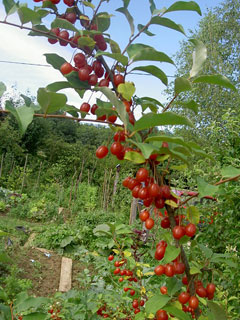
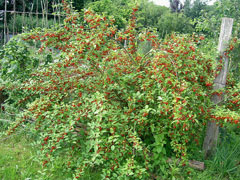
 Elaeagnus multiflora is a deciduous Shrub growing to 3 m (9ft) by 2 m (6ft) at a medium rate.
See above for USDA hardiness. It is hardy to UK zone 6 and is not frost tender. It is in flower from April to May, and the seeds ripen in July. The species is hermaphrodite (has both male and female organs) and is pollinated by Bees.
It can fix Nitrogen.
Suitable for: light (sandy), medium (loamy) and heavy (clay) soils, prefers well-drained soil and can grow in nutritionally poor soil. Suitable pH: mildly acid, neutral and basic (mildly alkaline) soils. It can grow in semi-shade (light woodland) or no shade. It prefers dry or moist soil and can tolerate drought. The plant can tolerate maritime exposure.
It can tolerate atmospheric pollution.
UK Hardiness Map
US Hardiness Map
Synonyms
E. longipes.
Plant Habitats
Woodland Garden Sunny Edge; Dappled Shade; Hedge;
Edible Uses
Edible Parts: Fruit Seed
Edible Uses:
Fruit - raw or cooked[1, 3, 11, 15, 46, 177]. Pleasantly acid when ripe, they make a very good dessert fruit[K] though they are usually made into pies, preserves etc[183]. Quite fiddly and difficult to pick without breaking the young shoots[200]. The fruit must be fully ripe before it can be enjoyed raw, if even slightly under-ripe it will be quite astringent[K]. The fruit contains a single large seed[K]. Seed - raw or cooked. It can be eaten with the fruit though the seed case is rather fibrous[K].
References More on Edible Uses
Medicinal Uses
Plants For A Future can not take any responsibility for any adverse effects from the use of plants. Always seek advice from a professional before using a plant medicinally.
Antitussive Astringent Cancer
The fruit of many members of this genus is a very rich source of vitamins and minerals, especially in vitamins A, C and E, flavanoids and other bio-active compounds. It is also a fairly good source of essential fatty acids, which is fairly unusual for a fruit. It is being investigated as a food that is capable of reducing the incidence of cancer and also as a means of halting or reversing the growth of cancers[214]. The leaves are used in the treatment of coughs[218]. The fruit is prescribed in the treatment of watery diarrhoea[218]. The root is astringent, a decoction is used to treat itch and foul sores[218].
References More on Medicinal Uses
The Bookshop: Edible Plant Books
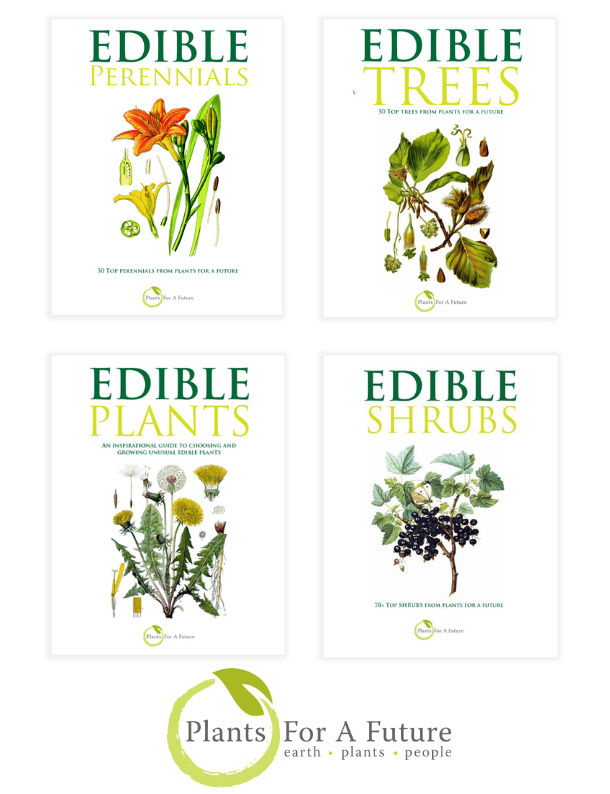
Our Latest books on Perennial Plants For Food Forests and Permaculture Gardens in paperback or digital formats.
Edible Tropical Plants
Food Forest Plants for Hotter Conditions: 250+ Plants For Tropical Food Forests & Permaculture Gardens.
More
Edible Temperate Plants
Plants for Your Food Forest: 500 Plants for Temperate Food Forests & Permaculture Gardens.
More
More Books
PFAF have eight books available in paperback and digital formats. Browse the shop for more information.
Shop Now
Other Uses
Companion Hedge Hedge Rootstock
Plants can be grown as a hedge in exposed positions, tolerating maritime exposure. Reasonably fast growing and providing a good screen in the summer, though much more open in the winter. It is a good companion hedge to grow, the plants enriching the soil and improving the growth of neighbouring plants[K]. A hedge in a very exposed position at Rosewarne in N. Cornwall was 3.5 metres tall in 1989[K]. Often used as a rootstock for evergreen species that are hard to grow from cuttings. It frequently sprouts from the base and can out-compete the scion[182].
Special Uses
Food Forest Hedge Hedge Nitrogen Fixer Scented Plants
References More on Other Uses
Cultivation details
An easily grown plant[184], it succeeds in most soils that are well-drained[11, 200]. Prefers a soil that is only moderately fertile, succeeding in poor soils and in dry soils[11, 200]. Prefers a light sandy loam and a sunny position but succeeds in light shade[11, 200]. Very drought and wind resistant[1, 11, 200]. Tolerates atmospheric pollution[160]. Plants are hardy to about -20°c[184], but the roots are hardy to -30°c (although top growth will be killed at this temperature). A very variable species[266], it is often cultivated for its edible fruit in Japan, there are some named varieties[3, 11, 183]. Plants can crop in 4 years from cuttings[160]. They bear heavily in Britain[11]. The synonym E. longipes is sometimes accepted as a distinct species, differing mainly in having very long peduncles about 2.5cm in length[214]. The fruit is well hidden in the shrub and is quite difficult to harvest without damaging the plant[K]. The ssp. E. multiflora ovata. (Maxim.)Servettaz. produces brown fruits on long stalks[200], would this be any easier to harvest?[K]. This species is notably resistant to honey fungus[88, 200]. Birds love the fruits[160]. This species has a symbiotic relationship with certain soil bacteria, these bacteria form nodules on the roots and fix atmospheric nitrogen. Some of this nitrogen is utilized by the growing plant but some can also be used by other plants growing nearby[200]. An excellent companion plant, when grown in orchards it can increase yields from the fruit trees by up to 10%. The small flowers are deliciously scented with a lilac-like smell, their aroma pervading the garden on calm days[K]. For polyculture design as well as the above-ground architecture (form - tree, shrub etc. and size shown above) information on the habit and root pattern is also useful and given here if available. The plant growth habit is multistemmed with multiple stems from the crown [1-2]. In garden design, as well as the above-ground architecture of a plant, root structure considerations help in choosing plants that work together for their optimal soil requirements including nutrients and water. The root pattern is branching: a heart root, dividing from the crown into several primary roots going down and out [2-1].
References Carbon Farming Information and Carbon Sequestration Information
Temperature Converter
Type a value in the Celsius field to convert the value to Fahrenheit:
Fahrenheit:
The PFAF Bookshop
Plants For A Future have a number of books available in paperback and digital form. Book titles include Edible Plants, Edible Perennials, Edible Trees,Edible Shrubs, Woodland Gardening, and Temperate Food Forest Plants. Our new book is Food Forest Plants For Hotter Conditions (Tropical and Sub-Tropical).
Shop Now
Plant Propagation
Seed - best sown as soon as it is ripe in a cold frame[78]. It should germinate in late winter or early spring, though it may take 18 months[K]. Stored seed can be very slow to germinate, often taking more than 18 months. A warm stratification for 4 weeks followed by 12 weeks cold stratification can help[98]. The seed usually (eventually) germinates quite well[78]. Prick out the seedlings into individual pot as soon as they are large enough to handle and plant out when they are at least 15cm tall. Cuttings of half-ripe wood, 7 - 10cm with a heel, July/August in a frame. Good percentage[78]. Cuttings of mature wood of the current year's growth, 10 - 12cm with a heel, November in a frame. Leave for 12 months. Fair to good percentage[78]. Layering in September/October. Takes 12 months[78].
Other Names
If available other names are mentioned here
Cibie, Goumi, Gumi, Longipe bush, Mupan-hsia, Natsu-gumi,
Native Plant Search
Search over 900 plants ideal for food forests and permaculture gardens. Filter to search native plants to your area. The plants selected are the plants in our book 'Plants For Your Food Forest: 500 Plants for Temperate Food Forests and Permaculture Gardens, as well as plants chosen for our forthcoming related books for Tropical/Hot Wet Climates and Mediterranean/Hot Dry Climates. Native Plant Search
Found In
Countries where the plant has been found are listed here if the information is available
Africa, Asia, Australia, Britain, China*, Europe, Japan, Korea, North Africa, North America, Pacific, Philippines, SE Asia, Tibet, USA,
Weed Potential
Right plant wrong place. We are currently updating this section.
Please note that a plant may be invasive in one area but may not in your area so it’s worth checking.
Conservation Status
IUCN Red List of Threatened Plants Status :

Growth: S = slow M = medium F = fast. Soil: L = light (sandy) M = medium H = heavy (clay). pH: A = acid N = neutral B = basic (alkaline). Shade: F = full shade S = semi-shade N = no shade. Moisture: D = dry M = Moist We = wet Wa = water.

Expert comment
Author
Thunb.
Botanical References
1158200
Links / References
For a list of references used on this page please go here
Readers comment