 |
|
http://www.biolib.de/ |
 |
| http://commons.wikimedia.org/wiki/User:Dalgial |
Translate this page:
Summary
Physical Characteristics

 Duchesnea indica is an evergreen Perennial growing to 0.1 m (0ft 4in) by 1 m (3ft 3in) at a fast rate.
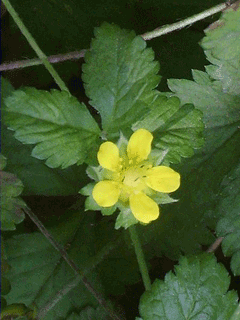
See above for USDA hardiness. It is hardy to UK zone 6 and is not frost tender. It is in leaf all year, in flower from May to October, and the seeds ripen from July to October. The species is hermaphrodite (has both male and female organs) and is pollinated by Insects. The plant is self-fertile.
Suitable for: light (sandy), medium (loamy) and heavy (clay) soils and prefers well-drained soil. Suitable pH: mildly acid, neutral and basic (mildly alkaline) soils. It can grow in semi-shade (light woodland) or no shade. It prefers moist soil.
UK Hardiness Map
US Hardiness Map
Synonyms
D. fragarioides. Fragaria indica.
Plant Habitats
Woodland Garden Dappled Shade; Shady Edge; Ground Cover;
Edible Uses
Edible Parts: Fruit Leaves
Edible Uses:
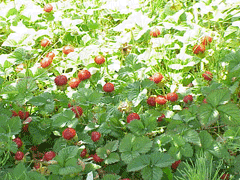
Fruit - raw[105, 177]. Dry and insipid[17]. Certainly rather tasteless, but it is not dry[K]. A flavour somewhat like a water melon according to some people, but this is possibly the product of a strained imagination[K].The fruit contains about 3.4% sugar, 1.5% protein, 1.6% ash[194]. Vitamin C is 6.3mg per 100ml of juice[194]. The fruit is about 10mm in diameter with the appearance and texture of a strawberry but very little flavour[K]. A clump 2.5m² yields about 150g of fruit annually[194]. Leaves - cooked[179].
References More on Edible Uses
Medicinal Uses
Plants For A Future can not take any responsibility for any adverse effects from the use of plants. Always seek advice from a professional before using a plant medicinally.
Anticoagulant Antiphlogistic Antiseptic Depurative Eczema Febrifuge Poultice Skin
Vitamin C
The whole plant is anticoagulant, antiseptic, depurative and febrifuge[147, 178]. It can be used in decoction or the fresh leaves can be crushed and applied externally as a poultice[147]. It is used in the treatment of boils and abscesses, weeping eczema, ringworm, stomatitis, laryngitis, acute tonsillitis, snake and insect bites and traumatic injuries[147]. A decoction of the leaves is used in the treatment of swellings[147, 178, 218]. An infusion of the flowers is used to activate the blood circulation[218]. The fruit is used to cure skin diseases[218]. A decoction of the plant is used as a poultice for abscesses, boils, burns etc[218].
References More on Medicinal Uses
The Bookshop: Edible Plant Books
Our Latest books on Perennial Plants For Food Forests and Permaculture Gardens in paperback or digital formats.

Edible Tropical Plants
Food Forest Plants for Hotter Conditions: 250+ Plants For Tropical Food Forests & Permaculture Gardens.
More

Edible Temperate Plants
Plants for Your Food Forest: 500 Plants for Temperate Food Forests & Permaculture Gardens.
More

More Books
PFAF have eight books available in paperback and digital formats. Browse the shop for more information.
Shop Now
Other Uses
A good ground cover plant, spreading quickly[197] by means of runners[214]. It is rather bare in winter though[K] and should not be grown with small plants since it will drown them out[208]. A good cover for bulbous plants[214]. Perennial groundcover for zone 2 firebreaks. The US government has created a system of firebreaks for areas prone to wildfires, theses are separated into concentric zones surrounding buildings. Zone 2 is the second away from the house. These low-level groundcovers provide little fuel.
Special Uses
Food Forest Ground cover
References More on Other Uses
Cultivation details
Prefers a moist but well-drained soil in a sunny position[175]. Plants are at their best in semi-shade, though they are not too fussy[214] and can succeed in quite dense shade[208, 214]. They also grow well in a rock garden[1]. Plants are hardy to about -20°c[200]. A very ornamental plant[1] but it can be invasive, spreading freely by means of runners[187]. Plants are more or less evergreen, though they can be browned by severe frosts[214]. Plants sometimes self-sow in British gardens[214]. In garden design, as well as the above-ground architecture of a plant, root structure considerations help in choosing plants that work together for their optimal soil requirements including nutrients and water. The root pattern is suckering with new plants from runners away from the plant [2-1]. Heat Zone: 8-6.
References Carbon Farming Information and Carbon Sequestration Information
Temperature Converter
Type a value in the Celsius field to convert the value to Fahrenheit:
Fahrenheit:
The PFAF Bookshop
Plants For A Future have a number of books available in paperback and digital form. Book titles include Edible Plants, Edible Perennials, Edible Trees,Edible Shrubs, Woodland Gardening, and Temperate Food Forest Plants. Our new book is Food Forest Plants For Hotter Conditions (Tropical and Sub-Tropical).
Shop Now
Plant Propagation
Seed - sow spring in a sunny position in a greenhouse. Germination usually takes place within 1 - 6 weeks or more at 15°c. A period of cold stratification may speed up germination. When large enough to handle, prick the seedlings out into individual pots and plant them out in the summer. Division of runners in spring or late summer. Very easy, they can be planted out straight into their permanent positions.
Other Names
If available other names are mentioned here
Native Plant Search
Search over 900 plants ideal for food forests and permaculture gardens. Filter to search native plants to your area. The plants selected are the plants in our book 'Plants For Your Food Forest: 500 Plants for Temperate Food Forests and Permaculture Gardens, as well as plants chosen for our forthcoming related books for Tropical/Hot Wet Climates and Mediterranean/Hot Dry Climates. Native Plant Search
Found In
Countries where the plant has been found are listed here if the information is available
Weed Potential
Right plant wrong place. We are currently updating this section.
Please note that a plant may be invasive in one area but may not in your area so it’s worth checking.
Conservation Status
IUCN Red List of Threatened Plants Status :

Growth: S = slow M = medium F = fast. Soil: L = light (sandy) M = medium H = heavy (clay). pH: A = acid N = neutral B = basic (alkaline). Shade: F = full shade S = semi-shade N = no shade. Moisture: D = dry M = Moist We = wet Wa = water.

Expert comment
Author
(Andrews.)Focke.
Botanical References
58200266
Links / References
For a list of references used on this page please go here
Readers comment