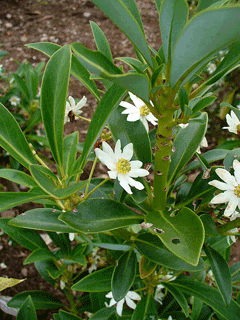
Drimys aromatica - Murray. non (R.Br.)Muell. Wintera aromatica - Murray. non (R.Br.)Muell.
Known Hazards
The sap of this plant can cause serious inflammation if it comes into contact with the eyes[139].
Range
Southern S. America - Chile, Argentina.
Habitat
The dominant tree in moister lowland sites to Tierra Del Fuego[69]. Boggy sites by streams etc in rich soils[139].
Edibility Rating
3 (1-5)
Medicinal Rating
2 (1-5)
Physical Characteristics
An evergreen Shrub growing to 7.5m by 6m at a medium rate.
It is hardy to zone 8. It is in leaf all year, in flower from January to June. The flowers are hermaphrodite (have both male and female organs)
The plant prefers light (sandy) and medium (loamy) soils and requires well-drained soil.
The plant prefers acid and neutral soils.
It can grow in semi-shade (light woodland).
It requires moist soil.
The plant can tolerates strong winds but not maritime exposure.
The aromatic pungent bark is powdered and used as a pepper substitute in Brazil, Chile and Argentina[2, 46, 69, 183]. It is rich in vitamin C[22].
Medicinal Uses
Plants For A Future can not take any responsibility for any adverse effects from the use of plants.
Always seek advice from a professional before using a plant medicinally.
The bark is a pungent bitter tonic herb that relieves indigestion[238]. It is antiscorbutic, aromatic, febrifuge, skin, stimulant and stomachic. An infusion of the bark is used in the treatment of indigestion, colic, dandruff and scurvy[4, 46, 69, 139, 238]. It is also used as a parasiticide[4, 46, 69, 139]. The bark is harvested in the autumn and winter and is dried for later use[238].
The powerfully aromatic bark contains resinous matter and 0.64% of aromatic essential oil[245].
Wood - not durable, heavy (it sinks in water) - interior of houses, boxes etc. It burns badly with a smell[46, 61, 69, 139].
Scented Plants
Flowers: Fresh
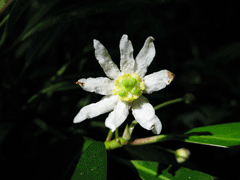
The flowers have a delicate fragrance of jasmine.
Stem: Crushed Dried
The bark has a powerful aromatic smell.
Cultivation details
Requires a light lime-free soil in semi-shade[202]. Tolerates chalk in the soil[11]. Requires a deep moist soil[11]. Dislikes dry conditions[139]. Prefers a warm sandy loam with some shelter[1]. Fairly wind resistant[49, 166]. Another report says that the plant resents severe wind-chill[202].
Succeeds against a wall at Kew[K] and it thrives in an open position in S.W. England[11, 49, 59]. Tolerates temperatures down to about -10°c[184]. This species is less hardy than D. lanceolata but it usually recovers from damage[120]. Another report says that it is hardier than D. lanceolata[200].
A very ornamental plant[11]. The sub-species D. winteri andina. Reiche. is a slow growing dwarf form seldom exceeding 1 metre in height[182]. It usually commences flowering when about 30cm tall[238].
A polymorphic species[139].
The flowers have a delicate fragrance of jasmine, whilst the bark has a powerful aromatic smell[245].
This plant was a symbol of peace to the indigenous Indian tribes of S. America in much the same way as an olive branch was used in Greece[139].
Plants in this genus are notably resistant to honey fungus[200].
Propagation
Seed - best sown as soon as it is ripe in the autumn in a greenhouse[200]. Prick out the seedlings into individual pots when they are large enough to handle and grow on the plants for at least their first winter in a cold frame. Plant them out in late spring or early summer, after the last expected frosts.
Layering in March/April. Takes 12 months[78].
Cuttings of half-ripe wood, 10 - 15 cm with a heel, July/August in a frame. Approximately 60% take[78].
Cuttings of mature wood of the current year's growth with a heel of older wood, November in a cold frame[78].
Cultivars
There are some named forms for this species, but these have been developed for their ornamental value and not for their other uses. Unless you particularly require the special characteristics of any of these cultivars, we would generally recommend that you grow the natural species for its useful properties. We have, therefore, not listed the cultivars in this database[K].
[K] Ken Fern Notes from observations, tasting etc at Plants For A Future and on field trips.
[1] F. Chittendon.RHS Dictionary of Plants plus Supplement. 1956 Oxford University Press 1951 Comprehensive listing of species and how to grow them. Somewhat outdated, it has been replaces in 1992 by a new dictionary (see [200]).
[2] Hedrick. U. P.Sturtevant's Edible Plants of the World. Dover Publications 1972 ISBN 0-486-20459-6 Lots of entries, quite a lot of information in most entries and references.
[4] Grieve.A Modern Herbal. Penguin 1984 ISBN 0-14-046-440-9 Not so modern (1930's?) but lots of information, mainly temperate plants.
[11] Bean. W.Trees and Shrubs Hardy in Great Britain. Vol 1 - 4 and Supplement. Murray 1981 A classic with a wealth of information on the plants, but poor on pictures.
[22] Sholto-Douglas. J.Alternative Foods. 0 Not very comprehensive, it seems more or less like a copy of earlier writings with little added.
[46] Uphof. J. C. Th.Dictionary of Economic Plants. Weinheim 1959 An excellent and very comprehensive guide but it only gives very short descriptions of the uses without any details of how to utilize the plants. Not for the casual reader.
[49] Arnold-Forster.Shrubs for the Milder Counties. 0 Trees and shrubs that grow well in Cornwall and other mild areas of Britain. Fairly good, a standard reference book.
[59] Thurston.Trees and Shrubs in Cornwall. 0 Trees and shrubs that succeed in Cornwall based on the authors own observations. Good but rather dated.
[61] Usher. G.A Dictionary of Plants Used by Man. Constable 1974 ISBN 0094579202 Forget the sexist title, this is one of the best books on the subject. Lists a very extensive range of useful plants from around the world with very brief details of the uses. Not for the casual reader.
[69] Moore. D. M.Flora of Tierra del Fuego. Anthony Nelson. 1983 ISBN 0-904614-05-0 Standard work for this part of S. America. Excellent details of habitat and a few notes on plant uses.
[78] Sheat. W. G.Propagation of Trees, Shrubs and Conifers. MacMillan and Co 1948 A bit dated but a good book on propagation techniques with specific details for a wide range of plants.
[120] ?The Plantsman. Vol. 2. 1980 - 1981. Royal Horticultural Society 1980 Excerpts from the periodical giving cultivation details and other notes on some of the useful plants including Billardiera spp, Calochortus spp, Drimys spp.
[139] ?Flora of Chile. (in Spanish) 0 Some information about the useful plants of Chile.
[166] Taylor. J.The Milder Garden. Dent 1990 A good book on plants that you didn't know could be grown outdoors in Britain.
[182] Thomas. G. S.Ornamental Shrubs, Climbers and Bamboos. Murray 1992 ISBN 0-7195-5043-2 Contains a wide range of plants with a brief description, mainly of their ornamental value but also usually of cultivation details and varieties.
[183] Facciola. S.Cornucopia - A Source Book of Edible Plants. Kampong Publications 1990 ISBN 0-9628087-0-9 Excellent. Contains a very wide range of conventional and unconventional food plants (including tropical) and where they can be obtained (mainly N. American nurseries but also research institutes and a lot of other nurseries from around the world.
[184] Phillips. R. & Rix. M.Shrubs. Pan Books 1989 ISBN 0-330-30258-2 Excellent photographs and a terse description of 1900 species and cultivars.
[200] Huxley. A.The New RHS Dictionary of Gardening. 1992. MacMillan Press 1992 ISBN 0-333-47494-5 Excellent and very comprehensive, though it contains a number of silly mistakes. Readable yet also very detailed.
[202] Davis. B.Climbers and Wall Shrubs. Viking. 1990 ISBN 0-670-82929-3 Contains information on 2,000 species and cultivars, giving details of cultivation requirements. The text is terse but informative.
[238] Bown. D.Encyclopaedia of Herbs and their Uses. Dorling Kindersley, London. 1995 ISBN 0-7513-020-31 A very well presented and informative book on herbs from around the globe. Plenty in it for both the casual reader and the serious student. Just one main quibble is the silly way of having two separate entries for each plant.
[245] Genders. R.Scented Flora of the World. Robert Hale. London. 1994 ISBN 0-7090-5440-8 An excellent, comprehensive book on scented plants giving a few other plant uses and brief cultivation details. There are no illustrations.
Readers Comments
Plants for a Future does not verify the accuracy of reader comments,
use at your own risk. In particular
Plants For A Future can not take any responsibility for any adverse effects from the use of plants.
You should always consult a professional before using plants medicinally.
Drimys winteri
Gamalieth Salazar
Fri Mar 16 2007
I’m surprised with the fact that this tree is not cold tolerant, I think that provenances planted in Britain come from central Chile; everybody who has information about Tierra del Fuego, knows that Drimys winteri grows there and that has survived temperatures down to –20°C in the town of Ushuaia!. Compare all climate statistics from any city in Britain with Ushuaia and you will confirm that Tierra del Fuego is very much colder.
Faroe Islands example: In Faroe Islands Drimys winteri has been very hardy; due to the fact that those islands are naturally devoid of trees and it was thought that no trees could grow because of strong winds and cold summers (10°c) , a commission was created in order to make an expedition to Tierra del Fuego, the collecting was carried out in tundra borders and tree-lines (colder places than Ushuaia), in crop trials trees (Drimys and Nothofagus) from Tierra del Fuego registered good growth but those from northern Europe and southern Alaska didn’t succeed because they need more heat in summer.
The usefulness of Tierra del Fuego’ trees is amazing and they could be introduced even in Iceland. If we compare climate data averages; hottest month: Ushuaia (Tierra del Fuego) 9°C, Reykjavik 11°C; coldest month Ushuaia 0°C, Reykjavik 0°C. In Iceland they could be used as wind curtains against strong winds in order to protect soil from grazing. Wood imports would be reduced. In Alaska Peninsula and Aleutian Islands (in this two regions trees from Sitka, South Alaska; were a failure because they have more than 100 years and are still shrubs; they need more heat in summer), trees from Tierra del Fuego could be planted too because the climate is practically the same.
Besides, I’m sure that if provenances of Drimys winteri from the southernmost forests of Tierra del Fuego are planted in Britain they will turn out to be very hardy ones. BIBLOGRAPHY: Højgaard, A., J. Jóhansen, and S. Ødum (eds) 1989. A century of tree planting in the Faroe Islands. Føroya Frodskaparfelag, Torshavn.
Drimys winteri
Luke Harding
Fri Jan 16 2009
It is often the combination of wet and cold which knocks plants in the UK.
We also have cooler and wetter summers too and these factors don't allow for a stable/predictable climate.
We also experience very late frosts. Some years plants will have been growing happily for a few months and then we freeze soild for a few days. The plants are still tender at that time and young tissue is easily damaged.
We end up having to find very sheltered locations for them.
Drimys winteri
Marco Vendetti
Tue Mar 3 2009
Frosts in Tierra del Fuego are present also in early Autumn and late Spring and it has snowed even in summer, Fuegian trees tolerate this cold conditions throughout the year. Many tree species have arrived to Britain from their northernmost range from Chile and/or Argentina and have not been hardy at first, later some species with provenance from different places in its natural range have been tested in cultivation in Great Britain. Trees cultivated collected from Central Chile have been the most damaged by frosts. Trees collected from Tierra del Fuego were the hardiest and proved a good frost tolerance. I think it´s worthy to try with Winter´s bark. By the way there is a Winter’s bark tree growing in Northumberland, Northeast England, I don’t know its provenance.
Add a comment/link:
Discussion Monitor
To have posts to this page mailed to you enter your email address here:
(Your email address will not appear on the webpage or be passed on to third parties).
All the information contained in these pages is Copyright
(C) Plants For A Future, 1996-2008.
Plants For A Future is a charitable company limited by guarantee, registered in England and Wales.
Charity No. 1057719, Company No. 3204567,
This work is licensed under a
Creative Commons License. You
can copy, distribute, display this works and to make derivative works but: Attribution is required, and it's Share Alike (GNUish/copyleft)
i.e. has an identical license. We also ask that you let us know (webmaster@pfaf.org) if
you link to, redistribute, make a derived work or do anything groovy with this information.