 |
|
|
 |
| http://commons.wikimedia.org/wiki/User:Jean-Pol_GRANDMONT |
Translate this page:
Summary
Bloom Color: White. Main Bloom Time: Early spring, Late spring, Mid spring. Form: Oval, Pyramidal.
Physical Characteristics

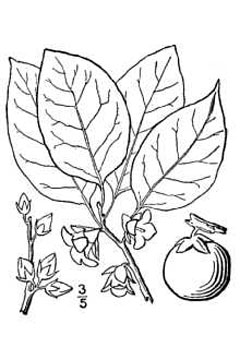
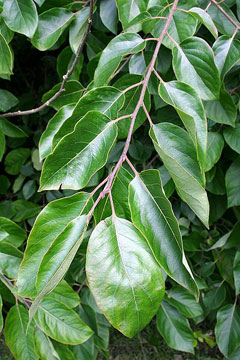
 Diospyros virginiana is a deciduous Tree growing to 20 m (65ft 7in) at a medium rate.
See above for USDA hardiness. It is hardy to UK zone 4 and is not frost tender. It is in flower in June, and the seeds ripen from October to November. The species is dioecious (individual flowers are either male or female, but only one sex is to be found on any one plant so both male and female plants must be grown if seed is required). and is pollinated by Insects, wind. The plant is not self-fertile.
Suitable for: light (sandy), medium (loamy) and heavy (clay) soils and prefers well-drained soil. Suitable pH: mildly acid, neutral and basic (mildly alkaline) soils. It can grow in semi-shade (light woodland) or no shade. It prefers moist soil.
UK Hardiness Map
US Hardiness Map
Synonyms
Plant Habitats
Woodland Garden Canopy; Secondary; Sunny Edge;
Edible Uses
Edible Parts: Fruit Oil
Edible Uses: Coffee Oil Sweetener Tea
Fruit - raw, cooked or dried and used in breads, cakes, pies, puddings etc[46, 183]. About the size of a plum, the fruit has an exquisitely rich flavour when it is fully ripe (and almost at the point of going bad) but it is very harsh and astringent before then[2, 3, 171, K]. The fruit may not ripen properly in a cool summer, though if it is frosted it normally develops a very good flavour[K]. The fruit can also be harvested in the autumn, preferably after a frost, and bletted. (This is a process where the fruit is kept in a cool place and only eaten when it is very soft and almost at the point of going rotten). Much of the fruit on trees in a relatively sunny position at Kew after a relatively warm summer in 1996 was still not fully ripe, though it was very nearly so and ripened well off the tree[K]. The fruit can also be dried and used in bread, cakes etc. The fruit is up to 4.5cm in diameter[200]. Molasses can be made from the fruit pulp[183]. An oil obtained from the seeds is said to taste like peanut oil[222]. A tea is made from the dried leaves[102]. It is high in vitamin C and has a pleasant flavour somewhat like sassafras[21, 183]. The roasted seed is used as a coffee substitute[177, 183].
References More on Edible Uses
Medicinal Uses
Plants For A Future can not take any responsibility for any adverse effects from the use of plants. Always seek advice from a professional before using a plant medicinally.
Antiscorbutic Astringent Vitamin C Warts
A decoction of the boiled fruit was used to treat bloody stools[213]. (This probably refers to the unripe fruit, which is very astringent[K]). The leaves are rich in vitamin C and are used as an antiscorbutic[213]. A decoction of the inner-bark is highly astringent[149, 222]. It has been used as a mouth rinse in the treatment of thrush and sore throats[213, 222]. Used externally as a wash for warts or cancers[222].
References More on Medicinal Uses
The Bookshop: Edible Plant Books
Our Latest books on Perennial Plants For Food Forests and Permaculture Gardens in paperback or digital formats.

Edible Tropical Plants
Food Forest Plants for Hotter Conditions: 250+ Plants For Tropical Food Forests & Permaculture Gardens.
More

Edible Temperate Plants
Plants for Your Food Forest: 500 Plants for Temperate Food Forests & Permaculture Gardens.
More

More Books
PFAF have eight books available in paperback and digital formats. Browse the shop for more information.
Shop Now
Other Uses
Oil Soil stabilization Wood
Can be used as a rootstock for D. kaki[46]. Wood - strong, hard, heavy, fine-grained, elastic, resistant to wear. A valuable wood, it is used for making wooden ware, turnery etc[46, 82, 149, 171]. It is used especially for making handles for golf clubs[149].
Special Uses
Food Forest
References More on Other Uses
Cultivation details
Requires a good deep loamy soil in sun or light shade[200]. If being grown for its fruit, the tree requires a warm, sunny, sheltered position[K]. It dislikes very acid or wet and poorly drained soils[200]. Plants are somewhat tender when young[11], though dormant mature trees are hardy to about -35°c[160]. The young growth in spring, even on mature plants, is frost-tender and so it is best to grow the plants in a position sheltered from the early morning sun[K]. Dioecious, but the female tree can produce seedless fruits in the absence of a pollinator[1]. It is likely that unfertilized fruits are more astringent than fertilized fruits since this is the case with D. kaki[K]. Trees can start producing fruit when only a few years old, a specimen seen at Kew Botanical gardens in autumn 1996 was only 1.5 metres tall and was bearing a very large crop of fruit[K]. This species is occasionally cultivated for its edible fruit, there are several named varieties[82, 183]. 'Dooley' grows well near the northern limits of persimmon culture[183]. 'Geneva Red' also grows well at the northern limits of persimmon culture. The fruit is medium to large[183]. 'Meader' grows well in cooler areas, it is self-fertile[183]. Plants have a long tap root and are difficult to transplant[149, 200], it is best to plant them out in their permanent position as soon as possible and to give protection overwinter for the first year or two[K]. The ssp. D. virginiana platycarpa has sweet succulent flesh, it grows wild from Missouri to Arkansas[82]. Special Features:
Attracts birds, North American native, Attracts butterflies, Inconspicuous flowers or blooms. The plant is heat tolerant in zones 9 through 1. (Plant Hardiness Zones show how well plants withstand cold winter temperatures.
Plant Heat Zones show when plants would start suffering from the heat.
The Plant Heat Zone map is based on the number of "heat days" experienced in a given area where the temperature climbs to over 86 degrees F (30°C).
At this temperature, many plants begin to suffer physiological damage. Heat Zones range from 1 (no heat days) to 12 (210 or more heat days).
For example Heat Zone. 11-1 indicates that the plant is heat tolerant in zones 11 through 1.) For polyculture design as well as the above-ground architecture (form - tree, shrub etc. and size shown above) information on the habit and root pattern is also useful and given here if available. A sprouting standard sending up shoots from the base [1-2]. The root pattern is a tap root similar to a carrot going directly down [1-2]. The root pattern is suckering with new plants from underground runners away from the plant [1-2].
References Carbon Farming Information and Carbon Sequestration Information
Temperature Converter
Type a value in the Celsius field to convert the value to Fahrenheit:
Fahrenheit:
The PFAF Bookshop
Plants For A Future have a number of books available in paperback and digital form. Book titles include Edible Plants, Edible Perennials, Edible Trees,Edible Shrubs, Woodland Gardening, and Temperate Food Forest Plants. Our new book is Food Forest Plants For Hotter Conditions (Tropical and Sub-Tropical).
Shop Now
Plant Propagation
Seed - best sown in a cold frame as soon as it is ripe[113, 200]. Stored seed requires cold-stratification and should be sown as early in the year as possible[78]. It usually germinates in 1 - 6 months at 15°c[175]. Pot up the young seedlings as soon as they are large enough to handle into fairly deep pots and plant them out in early summer. Give the plants some protection from winter cold for their first winter or two outdoors. Cuttings of half-ripe wood, July/August in a frame[200]. Layering in spring[200].
Other Names
If available other names are mentioned here
American seedless persimmon, Halle beth, Piakmine, Pohon eben amerika, Possumwood, Ougoufle, Simmon, Viržinski ebenovec [1-4].
Native Plant Search
Search over 900 plants ideal for food forests and permaculture gardens. Filter to search native plants to your area. The plants selected are the plants in our book 'Plants For Your Food Forest: 500 Plants for Temperate Food Forests and Permaculture Gardens, as well as plants chosen for our forthcoming related books for Tropical/Hot Wet Climates and Mediterranean/Hot Dry Climates. Native Plant Search
Found In
Countries where the plant has been found are listed here if the information is available
Asia, Australia, Britain, Himalayas, Indochina, Indonesia, Macedonia, Nepal, North America, Russia, SE Asia, Sikkim, Slovenia, Thailand, USA. Native to the Central & Eastern United States [1-4].
Weed Potential
Right plant wrong place. We are currently updating this section.
Please note that a plant may be invasive in one area but may not in your area so it’s worth checking.
Conservation Status
IUCN Red List of Threatened Plants Status :

| Related Plants
|
| Latin Name | Common Name | Habit | Height | Hardiness | Growth | Soil | Shade | Moisture | Edible | Medicinal | Other |
| Diospyros celebica | Indonesian Ebony, black ebony, makassar-ebenholts | Tree | 30.0 |
10-12
| S | LMH | N | M | 2 | 0 | 4 |
| Diospyros conzattii | Zapote negro mont's, zapotillo. | Tree | 10.0 |
10-12
| S | LMH | N | DM | 4 | 0 | 2 |
| Diospyros crassiflora | Benin Ebony | Tree | 15.0 |
10-12
| S | LMH | N | M | 0 | 2 | 4 |
| Diospyros digyna | Black Sapote, Chocolate Pudding Tree | Tree | 15.0 |
10-12
| S | LMH | SN | M | 4 | 1 | 2 |
| Diospyros ebenum | Ebony, Ceylon Ebony, Mauritius Ebony, Ebony Persimmon | Tree | 20.0 |
10-12
| S | LMH | N | M | 1 | 2 | 4 |
| Diospyros kaki | Persimmon, Japanese persimmon | Tree | 12.0 |
7-10
| M | LMH | SN | M | 4 | 3 | 3 |
| Diospyros lotus | Date Plum | Tree | 9.0 |
7-9
| M | LMH | SN | M | 5 | 1 | 2 |
| Diospyros malabarica | Indian Persimmon, Gaub, Timbiri, Mountain ebony | Tree | 35.0 |
10-12
| S | LMH | FSN | M | 1 | 3 | 4 |
| Diospyros mespiliformis | West African Ebony, Monkey guava, jackalberry | Tree | 20.0 |
10-12
| M | LMH | N | M | 4 | 3 | 4 |
| Diospyros mun | Mun Ebony, Vietnamese Ebony | Tree | 15.0 |
10-12
| S | LMH | N | DM | 0 | 0 | 4 |
| Diospyros quaesita | Calamander, kalu mediriya | Tree | 30.0 |
10-12
| S | LMH | N | DM | 0 | 2 | 4 |
| Diospyros tessellaria | Black ebony, Mauritian ebony | Tree | 15.0 |
10-12
| S | LMH | N | M | 2 | 0 | 4 |
| Diospyros texanum | Black Persimmon | Tree | 12.0 |
-
| | LMH | SN | M | 2 | 0 | 3 |
|
Growth: S = slow M = medium F = fast. Soil: L = light (sandy) M = medium H = heavy (clay). pH: A = acid N = neutral B = basic (alkaline). Shade: F = full shade S = semi-shade N = no shade. Moisture: D = dry M = Moist We = wet Wa = water.

Expert comment
Author
L.
Botanical References
1143200
Links / References
For a list of references used on this page please go here
Readers comment