 |
|
|
 |
| http://www.hear.org/starr/ |
Translate this page:
Summary
Physical Characteristics

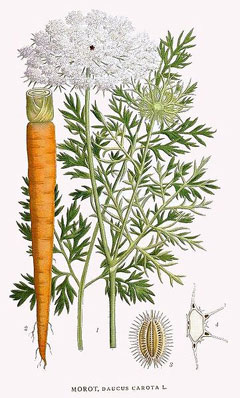
 Daucus carota sativus is a BIENNIAL growing to 1.2 m (4ft) by 0.3 m (1ft in).
See above for USDA hardiness. It is hardy to UK zone 5 and is not frost tender. It is in flower from June to August, and the seeds ripen from August to September. The species is hermaphrodite (has both male and female organs) and is pollinated by Flies, beetles. The plant is self-fertile.
Suitable for: light (sandy), medium (loamy) and heavy (clay) soils and prefers well-drained soil. Suitable pH: mildly acid, neutral and basic (mildly alkaline) soils. It cannot grow in the shade. It prefers moist soil. The plant can tolerates strong winds but not maritime exposure.
UK Hardiness Map
US Hardiness Map
Synonyms
Plant Habitats
Cultivated Beds;
Edible Uses
Edible Parts: Leaves Root
Edible Uses: Coffee Colouring Condiment
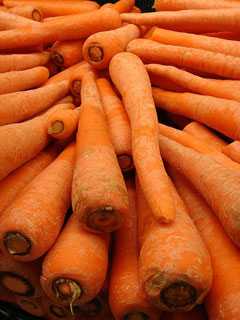
Root - raw or cooked[2, 7, 27]. The roots of well-grown plants are crisp, sweet and juicy, they are very nice raw and are also cooked as a vegetable or added to soups, stews etc[K]. The grated root is a tasty addition to the salad bowl[K]. The juice can be extracted from the root and used as a health-promoting drink[46]. The root is very rich in carotene, which is transformed by the body into vitamin A when it is eaten[7]. The root is sometimes ground into a powder and used in making cakes, bread etc[7, K]. The roasted root is a coffee substitute[21, 46]. Carotin, extracted from the roots, is used as an orange-yellow food dye[171]. Leaves - raw or cooked. A very strong flavour, they can be added in small quantities to mixed salads[K]. The leaves contain an oil that is rich in vitamin E, they are sometimes used as a flavouring in soups[7]. An essential oil from the seed is used as a food flavouring.
References More on Edible Uses
Medicinal Uses
Plants For A Future can not take any responsibility for any adverse effects from the use of plants. Always seek advice from a professional before using a plant medicinally.
Anthelmintic Carminative Deobstruent Diuretic Galactogogue Ophthalmic Stimulant
Cultivated carrot roots are a rich source of beta-carotene, which is converted to vitamin A by the liver[254]. When used as a regular item in the diet the roots improve eyesight and skin health, and also have anti-cancer effects[238]. A wonderful cleansing medicine, it supports the liver and stimulates urine flow and the removal of waste by the kidneys[254]. The root is diuretic and ophthalmic[7]. The juice of organic carrots is a delicious drink and a valuable detoxifier[254]. The raw root, grated or mashed, is a safe treatment for threadworms, especially in children[254]. The seed is carminative, galactogogue, lithontripic and stimulant[7, 240]. They are useful in the treatment of kidney diseases, dropsy and to settle the digestive system[240, 254]. They stimulate menstruation and have been used in folk medicine as a treatment for hangovers[254].
References More on Medicinal Uses
The Bookshop: Edible Plant Books
Our Latest books on Perennial Plants For Food Forests and Permaculture Gardens in paperback or digital formats.

Edible Tropical Plants
Food Forest Plants for Hotter Conditions: 250+ Plants For Tropical Food Forests & Permaculture Gardens.
More

Edible Temperate Plants
Plants for Your Food Forest: 500 Plants for Temperate Food Forests & Permaculture Gardens.
More

More Books
PFAF have eight books available in paperback and digital formats. Browse the shop for more information.
Shop Now
Other Uses
References More on Other Uses
Cultivation details
Prefers a good light warm well-drained soil and plenty of moisture[16, 27, 37, 200]. Prefers a sandy or calcareous loam[132]. Plants are extremely sensitive to soil conditions, good roots can only be produced in a soil that permits easy penetration of the root[200]. Carrots are reported to tolerate an annual precipitation in the range of 31 to 410cm, an annual temperature range of 3.6 to 28.5°C and a pH of 4.2 to 8.7[269]. They prefer a pH in the range 6.5 to 7.5[200]. Carrots are widely cultivated in most areas of the world for their edible root, which can be available all year round from successional sowings[46]. There are many named varieties, with roots varying in size and shape from short and round to long and tapering[183, 200]. World-wide, the yields of roots averages about 24 tonnes per hectare, the world low production yield was 3,125 kg/ha in Zaire, whilst the world high production yield was 62,889 kg/ha in Belgium-Luxembourg[269]. Plants grow best at a mean temperature of 16 - 18°c. At temperatures above 28°c top growth is reduced and the roots become very strongly flavoured. At temperatures below 16°c the roots become long and tapered and are pale in colour[200]. The leaves are moderately susceptible to frost but the roots are much hardier and can safely be left in the ground in the winter in most areas[200], so long as pests such as slugs or root fly are not a problem[K]. If dug up for storage, the roots can be kept for up to six months at 0 - 1°c and high relative humidity[200]. Carrots are very susceptible to a number of pests and diseases. The young seedlings are adored by slugs and so will generally need some protection. Carrot root fly is also a major problem. This creature lays its eggs near the young carrots. When they hatch, the larvae burrow into the soil and then eat their way into the root. In bad seasons almost all the crop can be heavily damaged. It is possible to reduce this damage by timing seed sowing to try and avoid the worst times of infestation, a June sowing of a fast-maturing cultivar will often be successful. There are also various companion plants that can help to reduce infestation. In general, these are strong-smelling plants such as garlic, onions and various aromatic plants such as wormwood. The idea is that these plants will mask the smell of the carrots and therefore the fly, which mainly uses scent to find the plants, will not be able to detect the smell of the carrots This method is most likely to fail when the fly comes close enough to the plants to see them and then no longer relies on scent. The most successful organic solution to date has been to erect barriers of clear polythene about 1 metre tall all around the bed of carrots. Since the fly generally flies below this height, it has proved to be quite effective, although any fly that does get in will then tend to stay inside the barrier and lay all of its eggs there. About 95% of carrot flowers are pollinated by insects, with the remaining 5% self-pollinating[269]. Carrots grow well with lettuce and chives[18] but dislike dill[20]. They also grow badly with potatoes, kohl rabi, fennel and cabbages[201]. In garden design, as well as the above-ground architecture of a plant, root structure considerations help in choosing plants that work together for their optimal soil requirements including nutrients and water. The root pattern is fleshy. Thick or swollen - fibrous or tap root [2-1].
References Carbon Farming Information and Carbon Sequestration Information
Temperature Converter
Type a value in the Celsius field to convert the value to Fahrenheit:
Fahrenheit:
The PFAF Bookshop
Plants For A Future have a number of books available in paperback and digital form. Book titles include Edible Plants, Edible Perennials, Edible Trees,Edible Shrubs, Woodland Gardening, and Temperate Food Forest Plants. Our new book is Food Forest Plants For Hotter Conditions (Tropical and Sub-Tropical).
Shop Now
Plant Propagation
Seed - sow in situ in succession from early spring to early summer. Do not transplant the seedlings, since this will usually cause damage to the roots and a good crop will not be obtained. Carrot seed needs a well-made seed bed with a fine tilth if good germination is to be achieved. The earliest sowings can be made of an early maturing variety in a cold frame or greenhouse in January or February, this will provide edible roots in late spring. The first outdoor sowings are made as the soil warms up in the spring. Successional sowings can be made until early summer if required. A September sowing in mild areas can provide an early spring supply of young roots, though the plants will often require some protection.
Other Names
If available other names are mentioned here
Native Plant Search
Search over 900 plants ideal for food forests and permaculture gardens. Filter to search native plants to your area. The plants selected are the plants in our book 'Plants For Your Food Forest: 500 Plants for Temperate Food Forests and Permaculture Gardens, as well as plants chosen for our forthcoming related books for Tropical/Hot Wet Climates and Mediterranean/Hot Dry Climates. Native Plant Search
Found In
Countries where the plant has been found are listed here if the information is available
Weed Potential
Right plant wrong place. We are currently updating this section.
Please note that a plant may be invasive in one area but may not in your area so it’s worth checking.
Conservation Status
IUCN Red List of Threatened Plants Status :

Growth: S = slow M = medium F = fast. Soil: L = light (sandy) M = medium H = heavy (clay). pH: A = acid N = neutral B = basic (alkaline). Shade: F = full shade S = semi-shade N = no shade. Moisture: D = dry M = Moist We = wet Wa = water.

Expert comment
Author
(Hoffm.)Arcang.
Botanical References
200
Links / References
For a list of references used on this page please go here
Readers comment