 |
|
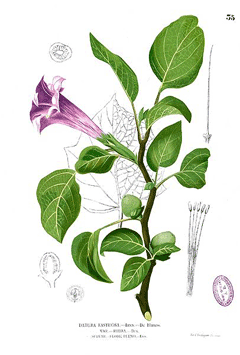
http://commons.wikimedia.org/wiki/File:Datura_metel_Blanco1.35.jpg |
 |
|
Translate this page:
Summary
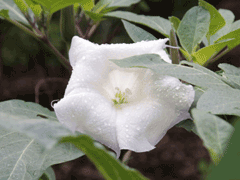
Bloom Color: White.
Main Bloom Time: Early summer, Early fall, Late summer, Mid summer. Form: Upright or erect.
Physical Characteristics

 Datura metel is a ANNUAL growing to 1.5 m (5ft) at a medium rate.
See above for USDA hardiness. It is hardy to UK zone 9 and is frost tender. It is in flower from June to July. The species is hermaphrodite (has both male and female organs) and is pollinated by Insects.
Suitable for: light (sandy) and medium (loamy) soils and prefers well-drained soil. Suitable pH: neutral and basic (mildly alkaline) soils and can grow in very alkaline soils.
It cannot grow in the shade. It prefers dry or moist soil.
UK Hardiness Map
US Hardiness Map
Synonyms
D. alba. Nees. D. fastuosa. L.
Plant Habitats
Cultivated Beds;
Edible Uses
Edible Parts:
Edible Uses: Drink
The leaves and roots are bruised, mixed with water and left to stand for several hours. The liquid is then drawn off and drunk. This is a highly narcotic drink, producing a stupefying effect that it is not easy to remove[2]. Caution is advised, see the notes above on toxicity[K].
References More on Edible Uses
Medicinal Uses
Plants For A Future can not take any responsibility for any adverse effects from the use of plants. Always seek advice from a professional before using a plant medicinally.
Anaesthetic Anodyne Antiasthmatic Antispasmodic Antitussive Epilepsy Hallucinogenic Hypnotic
Mydriatic
The whole plant, but especially the leaves and seed, is anaesthetic, anodyne, antiasthmatic, antispasmodic, antitussive, bronchodilator, hallucinogenic, hypnotic and mydriatic[147, 192, 218]. It has a wide range of applications in India, including in the treatment of epilepsy, hysteria, insanity, heart diseases, fever with catarrh, diarrhoea, skin diseases etc[192, 240]. A poultice of the crushed leaves is used to relieve pain[283]. In China, the plant is used in the treatment of asthma[218]. In Vietnam, the dried flowers and leaves are cut into small chips and used in antiasthmatic cigarettes[283]. Great caution is advised in the use of this plant since excess doses cause hallucinations, severe intoxication and death. The toxic dose is very close to the medicinal dose so this plant should only be used under the guidance of a qualified practitioner. See also the notes above on toxicity. The plant contains the alkaloids hyoscyamine, hyoscine and atropine[240]. Atropine dilates the pupils and is used in eye surgery[222]. Total alkaloid content of the leaves is 0.426%, which is mainly atropine[240]. The seeds contain 0.426% alkaloids, which is mainly hyoscyamine[240]. The roots contain 0.35% hyoscyamine[240]. An extract of the flowers is used as an anaesthetic - 3 - 5g applied orally produces a general anaesthesia within 5 minutes and lasting 5 - 6 hours[218].
References More on Medicinal Uses
The Bookshop: Edible Plant Books
Our Latest books on Perennial Plants For Food Forests and Permaculture Gardens in paperback or digital formats.

Edible Tropical Plants
Food Forest Plants for Hotter Conditions: 250+ Plants For Tropical Food Forests & Permaculture Gardens.
More

Edible Temperate Plants
Plants for Your Food Forest: 500 Plants for Temperate Food Forests & Permaculture Gardens.
More

More Books
PFAF have eight books available in paperback and digital formats. Browse the shop for more information.
Shop Now
Other Uses
References More on Other Uses
Cultivation details
Landscape Uses:Border, Container, Foundation, Specimen. Prefers a rich light sandy soil and an open sunny position[200]. Grows best in a fertile calcareous soil[200]. This species is extremely susceptible to the various viruses that afflict the potato family (Solanaceae), it can act as a centre of infection so should not be grown near potatoes or tomatoes[200]. There are a number of named varieties selected for their ornamental value[200]. The flowers have an exotic fragrance, though the bruised leaves have an unpleasant smell[245]. This species is closely related to D. innoxia[200]. Special Features:Not North American native, Naturalizing, All or parts of this plant are poisonous, Fragrant flowers.
References Carbon Farming Information and Carbon Sequestration Information
Temperature Converter
Type a value in the Celsius field to convert the value to Fahrenheit:
Fahrenheit:
The PFAF Bookshop
Plants For A Future have a number of books available in paperback and digital form. Book titles include Edible Plants, Edible Perennials, Edible Trees,Edible Shrubs, Woodland Gardening, and Temperate Food Forest Plants. Our new book is Food Forest Plants For Hotter Conditions (Tropical and Sub-Tropical).
Shop Now
Plant Propagation
Sow the seed in individual pots in early spring in a greenhouse[200]. Put 3 or 4 seeds in each pot and thin if necessary to the best plant. The seed usually germinates in 3 - 6 weeks at 15°c. Plant out in late spring or early summer, after the last expected frosts. Especially in areas with hot summers, it is worthwhile trying a sowing outdoors in situ in mid to late spring.
Other Names
If available other names are mentioned here
Native Plant Search
Search over 900 plants ideal for food forests and permaculture gardens. Filter to search native plants to your area. The plants selected are the plants in our book 'Plants For Your Food Forest: 500 Plants for Temperate Food Forests and Permaculture Gardens, as well as plants chosen for our forthcoming related books for Tropical/Hot Wet Climates and Mediterranean/Hot Dry Climates. Native Plant Search
Found In
Countries where the plant has been found are listed here if the information is available
Weed Potential
Right plant wrong place. We are currently updating this section.
Please note that a plant may be invasive in one area but may not in your area so it’s worth checking.
Conservation Status
IUCN Red List of Threatened Plants Status :

Growth: S = slow M = medium F = fast. Soil: L = light (sandy) M = medium H = heavy (clay). pH: A = acid N = neutral B = basic (alkaline). Shade: F = full shade S = semi-shade N = no shade. Moisture: D = dry M = Moist We = wet Wa = water.

Expert comment
Author
L.
Botanical References
200
Links / References
For a list of references used on this page please go here
Readers comment