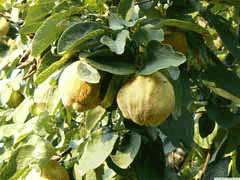
 |
|
http://imagesfrombulgaria.com |
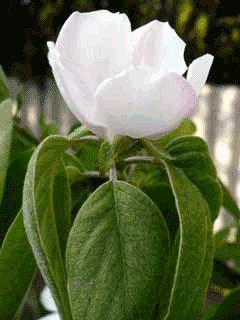 |
|
Translate this page:
Summary
Physical Characteristics

 Cydonia oblonga is a deciduous Tree growing to 7.5 m (24ft) by 7 m (23ft) at a medium rate.
See above for USDA hardiness. It is hardy to UK zone 4 and is not frost tender. It is in flower in May, and the seeds ripen in November. The species is hermaphrodite (has both male and female organs) and is pollinated by Insects.
Suitable for: light (sandy), medium (loamy) and heavy (clay) soils. Suitable pH: mildly acid, neutral and basic (mildly alkaline) soils. It can grow in full shade (deep woodland) semi-shade (light woodland) or no shade. It prefers moist soil.
UK Hardiness Map
US Hardiness Map
Synonyms
C. vulgaris. Pyrus cydonia.
Plant Habitats
Woodland Garden Secondary; Sunny Edge; Dappled Shade; Shady Edge;
Edible Uses
Edible Parts: Flowers Fruit
Edible Uses: Drink Gum Pectin Pectin
Fruit - raw or cooked[4]. When grown in warm temperate or tropical climates, the fruit can become soft and juicy and is suitable for eating raw[4]. In cooler climates such as Britain, however, it remains hard and astringent and needs to be cooked before being eaten[4]. It is used in jellies, preserves etc[9, 183]. The cooked fruit adds a delicious flavour to cooked apples[3, 37, 46, 61]. Strongly aromatic with a firm but rather gritty flesh[200]. The fruit is rich in pectin[200]. The fruit is about 10m long and 9cm wide, tapering to the stalk[200]. A nutritional analysis is available[218]. A drink can be made by adding the dried crushed seed to water, simmering for 5 minutes and sweetening to taste[183]. Flowers[183]. No further details are given.
References More on Edible Uses
| Composition
|
| Figures in grams (g) or miligrams (mg) per 100g of food.
|
|
|
Fruit (Dry weight)
|
|
- 355 Calories per 100g
- Water : 0%
- Protein: 2.7g; Fat: 1.2g; Carbohydrate: 94g; Fibre: 14g; Ash: 2.5g;
- Minerals - Calcium: 55mg; Phosphorus: 95mg; Iron: 4.3mg; Magnesium: 0mg; Sodium: 25mg; Potassium: 1216mg; Zinc: 0mg;
- Vitamins - A: 130mg; Thiamine (B1): 0.15mg; Riboflavin (B2): 0.18mg; Niacin: 1.8mg; B6: 0mg; C: 95mg;
- Reference: [ 218]
- Notes: The figures given here are the median of a range given in the report.
|
|
Medicinal Uses
Plants For A Future can not take any responsibility for any adverse effects from the use of plants. Always seek advice from a professional before using a plant medicinally.
Antiinflammatory Antivinous Astringent Cardiac Carminative Demulcent Digestive Diuretic
Emollient Expectorant Hypotensive Laxative Pectoral Refrigerant Restorative
Stimulant Tonic
The stem bark is astringent, it is used in the treatment of ulcers[218]. The seed is a mild but reliable laxative, astringent and anti-inflammatory[9]. When soaked in water, the seed swells up to form a mucilaginous mass. This has a soothing and demulcent action when taken internally[4] and is used in the treatment of respiratory diseases, especially in children[240]. This mucilage is also applied externally to minor burns etc[9]. The fruit is antivinous, astringent, cardiac, carminative, digestive, diuretic, emollient, expectorant, pectoral, peptic, refrigerant, restorative, stimulant and tonic[4, 9, 46, 218]. The unripe fruit is very astringent, a syrup made from it is used in the treatment of diarrhoea and is particularly safe for children[4, 254]. The fruit, and its juice, can be used as a mouthwash or gargle to treat mouth ulcers, gum problems and sore throats[254]. The leaves contain tannin and pectin[240]. Tannin can be used as an astringent whilst pectin has a beneficial effect on the circulatory system and helps to reduce blood pressure[K].
References More on Medicinal Uses
The Bookshop: Edible Plant Books
Our Latest books on Perennial Plants For Food Forests and Permaculture Gardens in paperback or digital formats.
Edible Tropical Plants
Food Forest Plants for Hotter Conditions: 250+ Plants For Tropical Food Forests & Permaculture Gardens.
More
Edible Temperate Plants
Plants for Your Food Forest: 500 Plants for Temperate Food Forests & Permaculture Gardens.
More
More Books
PFAF have eight books available in paperback and digital formats. Browse the shop for more information.
Shop Now
Other Uses
Gum Pectin Pectin Rootstock Size
A mucilage obtained from the seed coat is used as a gum arabic substitute to add gloss to material[61, 74]. The seed contains 20% mucilage and 15% fatty oils[74]. The fruit is rich in pectin[200]. Pectin is said to protect the body against radiation[201]. The leaves contain 11% tannin[240].
Special Uses
Food Forest
References More on Other Uses
Cultivation details
Succeeds in most soils but prefers a light moist fertile soil and a sunny position[3, 37, 200]. Dislikes very dry or waterlogged soils[202]. Succeeds in semi-shade but does not fruit so well in such a position[202]. Plants also tolerate quite deep shade[219], though they will often not fruit at all in such a position[K]. Plants are hardy to about -15°c[202], though the fruit seldom ripens in the north of Britain unless it is grown against a sunny wall[4]. The quince has been cultivated for over two thousand years for its edible fruit and its seed, though it is not a widely grown crop[4, 46, 61, 132]. It is also much used as a dwarfing rootstock for pears and some other fruits[200]. There are some named varieties[200]. Plants require warm summers in order to fully ripen their fruit[200]. The var. 'Maliformis' ripens well in cooler summers[200]. The plant is heat tolerant in zones 9 through 3. (Plant Hardiness Zones show how well plants withstand cold winter temperatures.
Plant Heat Zones show when plants would start suffering from the heat.
The Plant Heat Zone map is based on the number of "heat days" experienced in a given area where the temperature climbs to over 86 degrees F (30°C).
At this temperature, many plants begin to suffer physiological damage. Heat Zones range from 1 (no heat days) to 12 (210 or more heat days).
For example Heat Zone. 11-1 indicates that the plant is heat tolerant in zones 11 through 1.) For polyculture design as well as the above-ground architecture (form - tree, shrub etc. and size shown above) information on the habit and root pattern is also useful and given here if available. The plant growth habit is a standard with a non-suckering single trunk [1-2]. The root pattern is flat with shallow roots forming a plate near the soil surface [1-2].
References Carbon Farming Information and Carbon Sequestration Information
Temperature Converter
Type a value in the Celsius field to convert the value to Fahrenheit:
Fahrenheit:
The PFAF Bookshop
Plants For A Future have a number of books available in paperback and digital form. Book titles include Edible Plants, Edible Perennials, Edible Trees,Edible Shrubs, Woodland Gardening, and Temperate Food Forest Plants. Our new book is Food Forest Plants For Hotter Conditions (Tropical and Sub-Tropical).
Shop Now
Plant Propagation
Seed - probably best sown in a cold frame as soon as it is ripe[K], it can also be sown in February[78]. It requires stratification[98], pre-chill the seed for 18 weeks if it is fresh, whilst old seed will require 2 weeks of warm stratification first and then 18 weeks cold treatment[164]. When they are large enough to handle, prick the seedlings out into individual pots and grow them on in the cold frame for at least their first winter. Plant them out into their permanent positions in late spring or early summer, after the last expected frosts. Cuttings of mature wood, November in a cold frame[3, 37]. Layering in spring. Takes 1 year[78]. Suckers, removed in spring[200].
Other Names
If available other names are mentioned here
Native Plant Search
Search over 900 plants ideal for food forests and permaculture gardens. Filter to search native plants to your area. The plants selected are the plants in our book 'Plants For Your Food Forest: 500 Plants for Temperate Food Forests and Permaculture Gardens, as well as plants chosen for our forthcoming related books for Tropical/Hot Wet Climates and Mediterranean/Hot Dry Climates. Native Plant Search
Found In
Countries where the plant has been found are listed here if the information is available
Weed Potential
Right plant wrong place. We are currently updating this section.
Please note that a plant may be invasive in one area but may not in your area so it’s worth checking.
Conservation Status
IUCN Red List of Threatened Plants Status :

Growth: S = slow M = medium F = fast. Soil: L = light (sandy) M = medium H = heavy (clay). pH: A = acid N = neutral B = basic (alkaline). Shade: F = full shade S = semi-shade N = no shade. Moisture: D = dry M = Moist We = wet Wa = water.

Expert comment
Author
Mill.
Botanical References
1150200
Links / References
For a list of references used on this page please go here
Readers comment