 |
|
http://flickr.com/photos/13389908%40N03/2298766519 |
 |
| http://commons.wikimedia.org/wiki/User:W.Baumgartner |
Translate this page:
Summary
Form: Columnar, Oval, Pyramidal.
Physical Characteristics

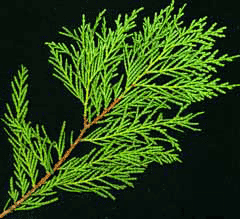
 Cupressocyparis leylandii is an evergreen Tree growing to 40 m (131ft) by 5 m (16ft) at a fast rate.
See above for USDA hardiness. It is hardy to UK zone 7 and is not frost tender. It is in leaf all year. The species is monoecious (individual flowers are either male or female, but both sexes can be found on the same plant) and is pollinated by Wind.
It is noted for attracting wildlife.
Suitable for: light (sandy), medium (loamy) and heavy (clay) soils. Suitable pH: mildly acid, neutral and basic (mildly alkaline) soils. It can grow in semi-shade (light woodland) or no shade. It prefers moist soil. The plant can tolerate maritime exposure.
UK Hardiness Map
US Hardiness Map
Synonyms
Plant Habitats
Woodland Garden Canopy; Hedge;
Edible Uses
References More on Edible Uses
Medicinal Uses
Plants For A Future can not take any responsibility for any adverse effects from the use of plants. Always seek advice from a professional before using a plant medicinally.
None known
References More on Medicinal Uses
The Bookshop: Edible Plant Books
Our Latest books on Perennial Plants For Food Forests and Permaculture Gardens in paperback or digital formats.
Edible Tropical Plants
Food Forest Plants for Hotter Conditions: 250+ Plants For Tropical Food Forests & Permaculture Gardens.
More
Edible Temperate Plants
Plants for Your Food Forest: 500 Plants for Temperate Food Forests & Permaculture Gardens.
More
More Books
PFAF have eight books available in paperback and digital formats. Browse the shop for more information.
Shop Now
Other Uses
Hedge Hedge Shelterbelt
Plants can be grown as a windbreak hedge succeeding in very exposed positions and reasonably tolerant of maritime exposure[11, 75]. They can suffer wind burn after prolonged storms but usually recover quickly[75]. Very fast growing, it can be trimmed so long as it is not cut back into old wood[11, 200]. Only young plants should be used for shelterbelts in exposed positions and these must not be pot-bound or they will never become really wind firm[11]. This species has been much used for hedging in urban gardens but it is singularly unsuitable for this purpose[200]. Although it very quickly provides a screen, it is much too vigorous for most gardens and will need constant attention to keep it within bounds[200].
Special Uses
Attracts Wildlife Hedge Hedge Scented Plants
References More on Other Uses
Cultivation details
Landscape Uses:Border, Christmas tree, Hedge, Screen, Seashore, Specimen. An easily grown plant, it prefers a moist fertile soil but also succeeds in sandy soils[188] and tolerates calcareous conditions[245]. Very wind resistant, it tolerates salt-laden winds and maritime exposure[11]. A very fast growing tree, capable of reaching 20 metres within 20 years[185]. A number of different clones are available[185, 200]. The Leyland cypress has been widely planted for hedging in recent years, though it is singularly unsuited for this purpose in all but the largest of sites[200]. The plant has gained the reputation of being very bad for wildlife since it offers native species very little in the way of food. However, it is favoured by many birds for roosting, high cover and especially for nesting because it offers such good cover. Our 12 hectare site was totally devoid of trees when we took it over in 1989, five years later we had our first birds nesting in trees on the land - in 4 metre tall Leyland cypresses![K]. Large specimens of this tree help to attract songbirds to the garden[200]. The bruised foliage has a sweet resinous scent[245]. Trees are notably susceptible to honey fungus[200]. Special Features:
Not North American native, There are no flowers or blooms.
References Carbon Farming Information and Carbon Sequestration Information
Temperature Converter
Type a value in the Celsius field to convert the value to Fahrenheit:
Fahrenheit:
The PFAF Bookshop
Plants For A Future have a number of books available in paperback and digital form. Book titles include Edible Plants, Edible Perennials, Edible Trees,Edible Shrubs, Woodland Gardening, and Temperate Food Forest Plants. Our new book is Food Forest Plants For Hotter Conditions (Tropical and Sub-Tropical).
Shop Now
Plant Propagation
Cuttings of half-ripe wood, 7cm with a heel, July/August in sandy soil in a humid frame[11]. Strikes readily. Cuttings from side growths in March[11].
Other Names
If available other names are mentioned here
Native Plant Search
Search over 900 plants ideal for food forests and permaculture gardens. Filter to search native plants to your area. The plants selected are the plants in our book 'Plants For Your Food Forest: 500 Plants for Temperate Food Forests and Permaculture Gardens, as well as plants chosen for our forthcoming related books for Tropical/Hot Wet Climates and Mediterranean/Hot Dry Climates. Native Plant Search
Found In
Countries where the plant has been found are listed here if the information is available
Weed Potential
Right plant wrong place. We are currently updating this section.
Please note that a plant may be invasive in one area but may not in your area so it’s worth checking.
Conservation Status
IUCN Red List of Threatened Plants Status :

Growth: S = slow M = medium F = fast. Soil: L = light (sandy) M = medium H = heavy (clay). pH: A = acid N = neutral B = basic (alkaline). Shade: F = full shade S = semi-shade N = no shade. Moisture: D = dry M = Moist We = wet Wa = water.

Expert comment
Author
(A.B.Jacks.&Dallim.)Dallim.
Botanical References
11200
Links / References
For a list of references used on this page please go here
Readers comment