 |
|
www.ImagesFromBulgaria.com |
 |
|
Translate this page:
Summary
Physical Characteristics

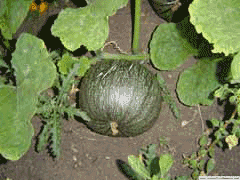
 Cucurbita pepo is a ANNUAL CLIMBER growing to 0.6 m (2ft) by 5 m (16ft 5in) at a fast rate.
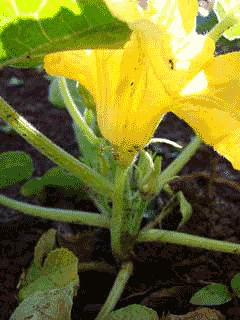
See above for USDA hardiness. It is hardy to UK zone 3 and is frost tender. It is in flower from July to September, and the seeds ripen from August to October. The species is monoecious (individual flowers are either male or female, but both sexes can be found on the same plant) and is pollinated by Insects. The plant is self-fertile.
Suitable for: light (sandy), medium (loamy) and heavy (clay) soils and prefers well-drained soil. Suitable pH: mildly acid, neutral and basic (mildly alkaline) soils. It can grow in semi-shade (light woodland) or no shade. It prefers moist soil.
UK Hardiness Map
US Hardiness Map
Synonyms
Plant Habitats
Cultivated Beds;
Edible Uses
Edible Parts: Flowers Fruit Leaves Oil Oil Root Seed
Edible Uses: Oil Oil
Fruit - cooked[2, 27, 46, 105]. Used as a vegetable, it has a very mild flavour and is very watery[K]. It is often harvested when still very young when it is called courgettes. The fruit has very little flavour of its own and so is often used as a base for making savoury dishes, the seeds being scooped out of the fruit and a filling being put in its place - this can then be baked[K]. A nutritional analysis is available[218]. Seed - raw or cooked[57, 86, 183]. The seed can also be ground into a powder and mixed with cereals for making bread etc[183]. Rich in oil with a pleasant nutty flavour but very fiddly to use because the seed is small and covered with a fibrous coat[K]. A nutritional analysis is available[218]. The seeds can also be sprouted and used in salads etc[183]. Some caution is advised here, see notes above on toxicity. An edible oil is obtained from the seed[46, 105, 117, 183]. Leaves and young stems - cooked as a potherb[135, 183]. A nutritional analysis is available[218]. Flowers and flower buds - cooked or dried for later use[135, 183]. A nutritional analysis is available[218]. Root - cooked[179]. We have some doubts on this report[K].
References More on Edible Uses
| Composition
|
| Figures in grams (g) or miligrams (mg) per 100g of food.
|
|
|
Flowers (Dry weight)
|
|
- 308 Calories per 100g
- Water : 0%
- Protein: 26.9g; Fat: 5.8g; Carbohydrate: 51.9g; Fibre: 11.5g; Ash: 15.4g;
- Minerals - Calcium: 904mg; Phosphorus: 1653mg; Iron: 19.2mg; Magnesium: 0mg; Sodium: 0mg; Potassium: 0mg; Zinc: 0mg;
- Vitamins - A: 7692mg; Thiamine (B1): 0.38mg; Riboflavin (B2): 2.12mg; Niacin: 11.54mg; B6: 0mg; C: 346mg;
- Reference: [ 218]
- Notes:
|
|
Medicinal Uses
Plants For A Future can not take any responsibility for any adverse effects from the use of plants. Always seek advice from a professional before using a plant medicinally.
Anthelmintic Miscellany Poultice Urinary
The pumpkin has been much used as a medicine in Central and North America. It is a gentle and safe remedy for a number of complaints, especially as an effective tapeworm remover for children and pregnant women for whom stronger acting and toxic remedies are unsuitable[254]. The seeds are mildly diuretic and vermifuge[7, 88, 254]. The complete seed, together with the husk, is used to remove tapeworms. The seed is ground into a fine flour, then made into an emulsion with water and eaten. It is then necessary to take a purgative afterwards in order to expel the tapeworms or other parasites from the body[7]. As a remedy for internal parasites, the seeds are less potent than the root of Dryopteris felix-mas, but they are safer for pregnant women, debilitated patients and children[238]. The seed is used to treat hypertrophy of the prostate[218]. The seed is high in zinc and has been used successfully in the early stages of prostate problems[254]. The diuretic action has been used in the treatment of nephritis and other problems of the urinary system[254]. The leaves are applied externally to burns[240]. The sap of the plant and the pulp of the fruit can also be used[254]. The fruit pulp is used as a decoction to relieve intestinal inflammation[254].
References More on Medicinal Uses
The Bookshop: Edible Plant Books
Our Latest books on Perennial Plants For Food Forests and Permaculture Gardens in paperback or digital formats.

Edible Tropical Plants
Food Forest Plants for Hotter Conditions: 250+ Plants For Tropical Food Forests & Permaculture Gardens.
More

Edible Temperate Plants
Plants for Your Food Forest: 500 Plants for Temperate Food Forests & Permaculture Gardens.
More

More Books
PFAF have eight books available in paperback and digital formats. Browse the shop for more information.
Shop Now
Other Uses
References More on Other Uses
Cultivation details
Requires a rich, well-drained moisture retentive soil and a very warm, sunny and sheltered position[1, 16, 37, 86]. Prefers a pH of 5.5 to 5.9, but tolerates up to 6.8[86]. Plants are tolerant of light shade[86] (This comment is probably more applicable to warmer climates than Britain[K].). A frost-tender annual plant, the pumpkin or marrow is widely cultivated in temperate and tropical zones for its edible fruit. It has long been grown as a domestic plant and a number of different groups have been developed. Botanists have tried to classify these groups, though there is considerable overlap and clear distinctions are not always possible. Since they are very similar in their cultivation needs, we have treated all the groups together in this entry. The botanists classification is as follows:- C. pepo pepo. This includes the vegetable marrows, zucchinis, pumpkins and ornamental gourds. There are many named varieties and these can vary considerably in size, shape and flavour[27, 183, 200]. The cultivars with larger and rounder fruits are usually called pumpkins, the fruits are harvested in the autumn and can be stored for a few months. The marrows are smaller than pumpkins and generally sausage-shaped. These can also be harvested in the autumn and stored for a few months, but it is more usual to eat them whilst they are still very small, when they are known as courgettes. Harvesting the fruits of the marrows when very small stimulates the plant into making more flowers (and hence fruits) so it can be a very productive way of using the plant. Pumpkins and marrows succeed outdoors most summers in Britain[27], in fact many of these varieties are well adapted to cool growing conditions and therefore do well in the British climate[200]. C. pepo pepo fraterna. This is the probable progenitor of the marrows and so is of potential value in any breeding programmes. C. pepo ovifera. This group includes various summer squashes including the acorn, crookneck and patty pan squashes. C. pepo ovifera ozarkana. A probable ancestor of the summer squashes, it could be of value in breeding programmes. C. pepo texana. The texas gourd, or wild marrow, is another form that could be of value in breeding programmes. Plants produce both male and female flowers. These are insect pollinated but in cool weather it is worthwhile hand pollinating[200]. Most cultivars are day-length neutral and so are able to flower and fruit throughout the British summer[200]. A fast-growing plant, trailing forms can be used to provide a summer screen[86]. This species does not hybridize naturally with other edible members of this genus[135]. Squashes and pumpkins can be differentiated from each other by their fruit stalk, it is angular and polygonal in pumpkins but thick, soft and round in squashes[132]. Pumpkins grow well with sweetcorn and thornapple but they dislike growing near potatoes[18, 20, 201]. They also grow well with nasturtiums, mint, beans and radishes[201].
References Carbon Farming Information and Carbon Sequestration Information
Temperature Converter
Type a value in the Celsius field to convert the value to Fahrenheit:
Fahrenheit:
The PFAF Bookshop
Plants For A Future have a number of books available in paperback and digital form. Book titles include Edible Plants, Edible Perennials, Edible Trees,Edible Shrubs, Woodland Gardening, and Temperate Food Forest Plants. Our new book is Food Forest Plants For Hotter Conditions (Tropical and Sub-Tropical).
Shop Now
Plant Propagation
Seed - sow April in a greenhouse in a rich soil. Germination should take place within 2 weeks. Sow 2 or 3 seeds per pot and thin out to the best plant. The seed requires a minimum temperature of 13°c to germinate[200]. Grow them on fast and plant out after the last expected frosts, giving them cloche or frame protection for at least their first few weeks outdoors until they are growing strongly.
Other Names
If available other names are mentioned here
Native Plant Search
Search over 900 plants ideal for food forests and permaculture gardens. Filter to search native plants to your area. The plants selected are the plants in our book 'Plants For Your Food Forest: 500 Plants for Temperate Food Forests and Permaculture Gardens, as well as plants chosen for our forthcoming related books for Tropical/Hot Wet Climates and Mediterranean/Hot Dry Climates. Native Plant Search
Found In
Countries where the plant has been found are listed here if the information is available
Weed Potential
Right plant wrong place. We are currently updating this section.
Please note that a plant may be invasive in one area but may not in your area so it’s worth checking.
Conservation Status
IUCN Red List of Threatened Plants Status :

| Related Plants
|
| Latin Name | Common Name | Habit | Height | Hardiness | Growth | Soil | Shade | Moisture | Edible | Medicinal | Other |
| Abobra tenuifolia | Cranberry Gourd | Perennial Climber | 3.5 |
8-11
| | LM | N | DM | 1 | 0 | |
| Acanthosicyos horridus | Naras. Butterpips | Perennial | 1.0 |
9-11
| F | LM | N | DM | 3 | 2 | 2 |
| Benincasa hispida | Wax Gourd | Annual | 6.0 |
9-11
| | LMH | N | M | 3 | 3 | 1 |
| Bryonia alba | White Bryony | Perennial Climber | 4.0 |
5-9
| F | LMH | SN | M | 1 | 2 | 0 |
| Bryonia dioica | Red Bryony, Cretan bryony | Perennial Climber | 3.5 |
5-9
| F | LMH | SN | M | 1 | 2 | |
| Citrullus colocynthis | Perennial egusi, Bitter-apple | Perennial | 3.0 |
10-12
| F | LM | N | DM | 3 | 2 | 3 |
| Citrullus lanatus | Water Melon | Annual | 0.5 |
8-11
| | LM | N | DM | 4 | 3 | 1 |
| Coccinia grandis | Ivy Gourd | Perennial | 3.0 |
8-11
| | LMH | N | M | 2 | 2 | 0 |
| Cucumis anguria | Gherkin, West Indian gherkin | Annual Climber | 2.4 |
9-11
| | LMH | N | M | 3 | 1 | 0 |
| Cucumis melo | Melon, Cantaloupe | Annual Climber | 1.5 |
9-11
| | LMH | N | M | 4 | 2 | 0 |
| Cucumis melo agrestis | Wild Melon | Annual Climber | 1.5 |
9-11
| | LMH | N | M | 3 | 2 | |
| Cucumis melo cantalupensis | Cantaloupe Melon | Annual Climber | 1.5 |
9-11
| | LMH | N | M | 4 | 2 | |
| Cucumis melo chito | Orange Melon | Annual Climber | 1.5 |
9-11
| | LMH | N | M | 3 | 2 | |
| Cucumis melo conomon | Pickling Melon | Annual Climber | 1.5 |
9-11
| | LMH | N | M | 4 | 2 | |
| Cucumis melo flexuosus | Serpent Melon | Annual Climber | 1.5 |
9-11
| | LMH | N | M | 4 | 2 | |
| Cucumis melo inodorus | Honeydew Melon | Annual Climber | 1.5 |
9-11
| | LMH | N | M | 4 | 2 | |
| Cucumis melo momordica | Snap Melon | Annual Climber | 1.5 |
9-11
| | LMH | N | M | 4 | 2 | |
| Cucumis metuliferus | Horned Cucumber, African horned cucumber | Annual Climber | 1.5 |
9-11
| | LMH | N | M | 2 | 2 | 1 |
| Cucumis sativus | Cucumber, Garden cucumber | Annual Climber | 2.0 |
9-11
| | LMH | N | M | 4 | 2 | 2 |
| Cucurbita argyrosperma | Cushaw Pumpkin | Annual Climber | 0.5 |
2-11
| | LMH | SN | M | 4 | 2 | 1 |
| Cucurbita digitata | Coyote Gourd | Perennial | 5.0 |
10-12
| M | LMH | N | DM | 3 | 0 | 3 |
| Cucurbita ficifolia | Malabar Gourd, Figleaf gourd | Perennial Climber | 0.0 |
9-11
| F | LMH | SN | MWe | 3 | 2 | 1 |
| Cucurbita foetidissima | Buffalo Gourd, Missouri gourd | Perennial Climber | 6.0 |
6-11
| F | LMH | SN | DM | 3 | 2 | 2 |
| Cucurbita maxima | Winter Squash | Annual Climber | 0.6 |
2-11
| F | LMH | SN | M | 5 | 3 | 2 |
| Cucurbita moschata | Squash, Crookneck squash | Annual Climber | 0.6 |
2-11
| F | LMH | SN | M | 5 | 3 | 1 |
| Cyclanthera brachystachya | Cuchinito | Annual | 3.0 |
9-11
| | LMH | S | M | 1 | 0 | |
| Cyclanthera pedata | Achocha, Caihua, Caygua, Cayua, Korila, Wild Cucumber | Annual | 4.5 |
9-11
| F | LMH | SN | M | 3 | 4 | 1 |
| Ecballium elaterium | Squirting Cucumber | Perennial | 0.3 |
8-11
| | LMH | N | DM | 0 | 2 | |
| Echinocystis lobata | Wild Cucumber | Annual | 8.0 |
0-0
| F | LMH | N | M | 0 | 1 | 1 |
|
|
Growth: S = slow M = medium F = fast. Soil: L = light (sandy) M = medium H = heavy (clay). pH: A = acid N = neutral B = basic (alkaline). Shade: F = full shade S = semi-shade N = no shade. Moisture: D = dry M = Moist We = wet Wa = water.

Expert comment
Author
L.
Botanical References
200
Links / References
For a list of references used on this page please go here
Readers comment