 |
|
http://commons.wikimedia.org/wiki/File:Cucumis_sativus_Blanco2.299-cropped.jpg |
 |
| http://commons.wikimedia.org/wiki/User:BotMultichill |
Translate this page:
Summary
Physical Characteristics

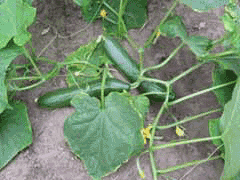
 Cucumis sativus is a ANNUAL CLIMBER growing to 2 m (6ft 7in).
See above for USDA hardiness. It is hardy to UK zone 10 and is frost tender. It is in flower from July to September, and the seeds ripen from August to October. The species is monoecious (individual flowers are either male or female, but both sexes can be found on the same plant) and is pollinated by Insects. The plant is self-fertile.
Suitable for: light (sandy), medium (loamy) and heavy (clay) soils and prefers well-drained soil. Suitable pH: mildly acid, neutral and basic (mildly alkaline) soils. It cannot grow in the shade. It prefers moist soil.
UK Hardiness Map
US Hardiness Map
Synonyms
Plant Habitats
Cultivated Beds;
Edible Uses
Edible Parts: Fruit Leaves Oil Seed
Edible Uses: Oil
Fruit - raw or cooked. The cucumber is a common ingredient of salads, being valued mainly for its crisp texture and juiciness[1, 2, 7, 46]. However, it is very watery, with little flavour and is not very nutritious[K]. Many people find the fruit to be indigestible, this is due to the high cellulose content[7]. The fruit varies widely in size between cultivars but can be up to 1 metre long. It can be available from mid summer until early autumn from outdoor grown plants. Seed - raw[57, 86]. Rich in oil with a nutty flavour but very fiddly to use because the seed is small and covered with a fibrous coat[K]. Young leaves and stems - cooked as a potherb. Oil from seed[61]. Said to resemble olive oil, it is used in salad dressings and French cooking[183]. The oil contains 22.3% linoleic acid, 58.5% oleic acid, 6.8% palmitic acid and 3.7% stearic acid[218].
References More on Edible Uses
Medicinal Uses
Plants For A Future can not take any responsibility for any adverse effects from the use of plants. Always seek advice from a professional before using a plant medicinally.
Aperient Diuretic Skin Tonic Vermifuge
The leaf juice is emetic, it is used to treat dyspepsia in children[218]. The fruit is depurative, diuretic, emollient, purgative and resolvent[7, 21, 201, 218]. The fresh fruit is used internally in the treatment of blemished skin, heat rash etc, whilst it is used externally as a poultice for burns, sores etc and also as a cosmetic for softening the skin[218, 238]. The seed is cooling, diuretic, tonic and vermifuge[4, 218]. 25 - 50 grams of the thoroughly ground seeds (including the seed coat) is a standard dose as a vermifuge and usually needs to be followed by a purgative to expel the worms from the body[4]. A decoction of the root is diuretic[218].
References More on Medicinal Uses
The Bookshop: Edible Plant Books
Our Latest books on Perennial Plants For Food Forests and Permaculture Gardens in paperback or digital formats.

Edible Tropical Plants
Food Forest Plants for Hotter Conditions: 250+ Plants For Tropical Food Forests & Permaculture Gardens.
More

Edible Temperate Plants
Plants for Your Food Forest: 500 Plants for Temperate Food Forests & Permaculture Gardens.
More

More Books
PFAF have eight books available in paperback and digital formats. Browse the shop for more information.
Shop Now
Other Uses
Cosmetic Oil Repellent
Cucumber skins have been shown to repel cockroaches in laboratory experiments[218]. The fruit is applied to the skin as a cleansing cosmetic to soften and whiten it[4, 7, 238]. The juice is used in many beauty products[4, 7].
Special Uses
References More on Other Uses
Cultivation details
Requires a rich, well-drained moisture retentive soil and a warm very sunny position[200]. A frost-tender plant, the cucumber is commonly cultivated for its edible fruit, there are many named varieties[46, 183]. Many of these varieties are only suitable for protected cropping in Britain though there are a number that have been specifically bred for cool temperate areas and these succeed outdoors in most summers[200]. Many of the cultivars, especially the greenhouse forms, should have their male flowers removed in order to prevent fertilization, since the fertilized fruits have a bitter taste. A number of cultivars have been developed that only produce female flowers[142]. Cucumbers make good companion plants for sweet corn, beans and sunflowers[18], but they dislike growing with potatoes and aromatic herbs[20]. The roots of cucumber plants secrete a substance that inhibits the growth of most weeds[201].
References Carbon Farming Information and Carbon Sequestration Information
Temperature Converter
Type a value in the Celsius field to convert the value to Fahrenheit:
Fahrenheit:
The PFAF Bookshop
Plants For A Future have a number of books available in paperback and digital form. Book titles include Edible Plants, Edible Perennials, Edible Trees,Edible Shrubs, Woodland Gardening, and Temperate Food Forest Plants. Our new book is Food Forest Plants For Hotter Conditions (Tropical and Sub-Tropical).
Shop Now
Plant Propagation
Seed - sow early to mid spring in a greenhouse in a rich soil. Germination should take place within 2 weeks. Sow 2 or 3 seeds per pot and thin out to the best plant. Grow them on fast and plant out after the last expected frosts, giving them cloche or frame protection for at least their first few weeks if you are trying them outdoors.
Other Names
If available other names are mentioned here
Native Plant Search
Search over 900 plants ideal for food forests and permaculture gardens. Filter to search native plants to your area. The plants selected are the plants in our book 'Plants For Your Food Forest: 500 Plants for Temperate Food Forests and Permaculture Gardens, as well as plants chosen for our forthcoming related books for Tropical/Hot Wet Climates and Mediterranean/Hot Dry Climates. Native Plant Search
Found In
Countries where the plant has been found are listed here if the information is available
Weed Potential
Right plant wrong place. We are currently updating this section.
Please note that a plant may be invasive in one area but may not in your area so it’s worth checking.
Conservation Status
IUCN Red List of Threatened Plants Status :

Growth: S = slow M = medium F = fast. Soil: L = light (sandy) M = medium H = heavy (clay). pH: A = acid N = neutral B = basic (alkaline). Shade: F = full shade S = semi-shade N = no shade. Moisture: D = dry M = Moist We = wet Wa = water.

Expert comment
Author
L.
Botanical References
Links / References
For a list of references used on this page please go here
Readers comment