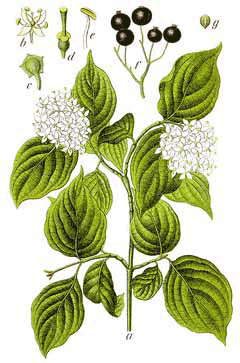
 |
|
http://commons.wikimedia.org/wiki/File:Cornus_sanguinea_Sturm39.jpg |
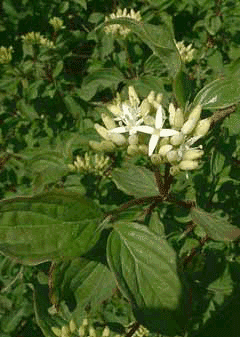 |
| http://commons.wikimedia.org/wiki/User:Poulos |
Translate this page:
Summary
Physical Characteristics

 Cornus sanguinea is a deciduous Shrub growing to 3 m (9ft 10in).
See above for USDA hardiness. It is hardy to UK zone 5 and is not frost tender. It is in flower from June to July, and the seeds ripen in September. The species is hermaphrodite (has both male and female organs) and is pollinated by Insects.
Suitable for: light (sandy), medium (loamy) and heavy (clay) soils and can grow in heavy clay soil. Suitable pH: mildly acid, neutral and basic (mildly alkaline) soils and can grow in very alkaline soils.
It can grow in semi-shade (light woodland) or no shade. It prefers moist soil.
UK Hardiness Map
US Hardiness Map
Synonyms
Swida sanguinea. Thelycrania sanguinea.
Plant Habitats
Woodland Garden Sunny Edge; Dappled Shade; Shady Edge; Hedge;
Edible Uses
Edible Parts: Fruit Oil Oil
Edible Uses: Oil Oil
Fruit - raw or cooked[105]. A bitter flavour, it can also have an emetic effect on the body[1, 7, 11]. It is not worthwhile[115]. The fruit is about 8mm in diameter[200]. An oil is obtained from the seed[2], it is edible when refined[75].
References More on Edible Uses
Medicinal Uses
Plants For A Future can not take any responsibility for any adverse effects from the use of plants. Always seek advice from a professional before using a plant medicinally.
Astringent Emetic Febrifuge
The bark is astringent and febrifuge[7]. It is used to treat fevers[254]. The leaves are sometimes used externally as an astringent[7]. The fruit is emetic[7].
References More on Medicinal Uses
The Bookshop: Edible Plant Books
Our Latest books on Perennial Plants For Food Forests and Permaculture Gardens in paperback or digital formats.

Edible Tropical Plants
Food Forest Plants for Hotter Conditions: 250+ Plants For Tropical Food Forests & Permaculture Gardens.
More

Edible Temperate Plants
Plants for Your Food Forest: 500 Plants for Temperate Food Forests & Permaculture Gardens.
More

More Books
PFAF have eight books available in paperback and digital formats. Browse the shop for more information.
Shop Now
Other Uses
Basketry Charcoal Dye Fuel Hedge Hedge Oil Oil Wood
The seed contains 45% of a non-drying oil[74], it is used in soap making and lighting[7, 13, 100, 115, 177]. A non-drying oil is also obtained from the pericarp, it is used for lighting[74]. The pericarp contains 19 - 35% oil[74]. A greenish-blue dye is obtained from the fruit[13, 74]. The young stems are very flexible and are used in basketry[7, 13, 74, 100]. Wood - tough, hard. Used for small items such as tool handles, turnery etc[11, 61, 115]. A good quality charcoal is obtained from the wood[115], the wood also makes an excellent fuel[115].
Special Uses
Hedge Hedge Scented Plants
References More on Other Uses
Cultivation details
An easily grown plant, it succeeds in any soil of good or moderate fertility[1], ranging from acid to shallow chalk[200]. Grows well in heavy clay soils. Plants are relatively shade tolerant, though they are not happy when growing in dense shade[186]. They grow badly when exposed to strong cold winds[186]. Plants are hardy to about -25°c[184]. The flowers have a rather unpleasant smell to most people, though they are attractive to insects[186]. Plants have a suckering habit and can quickly form dense thickets[186]. They can be coppiced regularly and will throw up long straight stems after being cut back[186]. Plants in this genus are notably resistant to honey fungus[200].
References Carbon Farming Information and Carbon Sequestration Information
Temperature Converter
Type a value in the Celsius field to convert the value to Fahrenheit:
Fahrenheit:
The PFAF Bookshop
Plants For A Future have a number of books available in paperback and digital form. Book titles include Edible Plants, Edible Perennials, Edible Trees,Edible Shrubs, Woodland Gardening, and Temperate Food Forest Plants. Our new book is Food Forest Plants For Hotter Conditions (Tropical and Sub-Tropical).
Shop Now
Plant Propagation
Seed - best sown as soon as it is ripe in a cold frame or in an outdoors seedbed if there is sufficient seed[80, 113]. The seed must be separated from the fruit flesh since this contains germination inhibitors[80, 164]. Stored seed should be cold stratified for 3 - 4 months and sown as early as possible in the year[164]. Scarification may also help as may a period of warm stratification before the cold stratification[80, 164]. Germination, especially of stored seed, can be very slow, taking 18 months or more[164]. Prick out the seedlings of cold-frame sown seeds into individual pots as soon as they are large enough to handle and grow the plants on for their first winter in a greenhouse, planting out in the spring after the last expected frosts. Cuttings of half-ripe side shoots, July/August in a frame. Cuttings of mature wood of the current year's growth, taken with a heel if possible, autumn in a cold frame. High percentage[78]. Layering of new growth in June/July. Takes 9 months[78].
Other Names
If available other names are mentioned here
Native Plant Search
Search over 900 plants ideal for food forests and permaculture gardens. Filter to search native plants to your area. The plants selected are the plants in our book 'Plants For Your Food Forest: 500 Plants for Temperate Food Forests and Permaculture Gardens, as well as plants chosen for our forthcoming related books for Tropical/Hot Wet Climates and Mediterranean/Hot Dry Climates. Native Plant Search
Found In
Countries where the plant has been found are listed here if the information is available
Weed Potential
Right plant wrong place. We are currently updating this section.
Please note that a plant may be invasive in one area but may not in your area so it’s worth checking.
Conservation Status
IUCN Red List of Threatened Plants Status :

| Related Plants
|
| Latin Name | Common Name | Habit | Height | Hardiness | Growth | Soil | Shade | Moisture | Edible | Medicinal | Other |
| Cornus alba | Tartarian Dogwood | Shrub | 3.0 |
3-7
| F | LMH | SN | Mwe | 0 | 0 | 1 |
| Cornus alternifolia | Green Osier, Alternateleaf dogwood, Alternate Leaf Dogwood, Golden Shadows Pagoda Dogwood, Green Osi | Shrub | 6.0 |
3-8
| F | LMH | N | DM | 0 | 2 | 2 |
| Cornus amomum | Silky Dogwood | Shrub | 3.0 |
4-8
| M | LMH | SN | M | 1 | 2 | 1 |
| Cornus asperifolia drummondii | Roughleaf Dogwood | Shrub | 4.0 |
5-9
| F | LMH | N | M | 0 | 0 | 3 |
| Cornus australis | | Shrub | 4.0 |
6-9
| | LMH | SN | M | 1 | 0 | 3 |
| Cornus canadensis | Creeping Dogwood, Bunchberry dogwood, Bunchberry | Perennial | 0.3 |
2-7
| F | LMH | SN | M | 4 | 2 | 2 |
| Cornus capitata | Bentham's Cornel | Tree | 12.0 |
7-10
| M | LMH | SN | M | 4 | 1 | 3 |
| Cornus chinensis | | Tree | 10.0 |
7-10
| | LMH | SN | M | 2 | 3 | |
| Cornus controversa | Giant Dogwood, Wedding Cake Tree, | Tree | 15.0 |
5-8
| F | LMH | SN | M | 2 | 1 | 2 |
| Cornus coreana | | Tree | 20.0 |
5-9
| | LMH | SN | M | 0 | 0 | 2 |
| Cornus elliptica | | Tree | 10.0 |
7-10
| M | LMH | SN | M | 4 | 1 | 2 |
| Cornus florida | Flowering Dogwood | Shrub | 6.0 |
5-9
| M | LMH | SN | M | 2 | 2 | 3 |
| Cornus hemsleyi | | Shrub | 4.0 |
-
| | LMH | SN | M | 0 | 0 | 2 |
| Cornus hongkongensis | | Shrub | 15.0 |
-
| | LMH | SN | M | 1 | 0 | 2 |
| Cornus iberica | | Shrub | 4.0 |
-
| | LMH | SN | M | 2 | 0 | 3 |
| Cornus kousa | Japanese Dogwood, Kousa dogwood, Chinese Dogwood, | Tree | 10.0 |
5-8
| S | LMH | SN | M | 5 | 0 | 2 |
| Cornus kousa chinensis | Japanese Dogwood | Tree | 10.0 |
5-8
| | LMH | SN | M | 5 | 0 | 2 |
| Cornus macrophylla | Large-Leaf Dogwood | Tree | 15.0 |
5-9
| | LMH | SN | M | 2 | 2 | 2 |
| Cornus mas | Cornelian Cherry, Cornelian Cherry Dogwood | Shrub | 5.0 |
4-8
| M | LMH | SN | M | 4 | 2 | 3 |
| Cornus monbeigii | | Shrub | 5.0 |
6-9
| | LMH | SN | M | 1 | 2 | 2 |
| Cornus multinervosa | | Tree | 8.0 |
-
| | LMH | SN | M | 2 | 0 | 2 |
| Cornus nuttallii | Mountain Dogwood, Pacific dogwood, Western Dogwood | Tree | 10.0 |
6-8
| M | LMH | SN | DM | 1 | 2 | 3 |
| Cornus oblonga | Oblong-Petal Dogwood | Tree | 6.0 |
8-11
| | LMH | SN | M | 0 | 3 | 2 |
| Cornus occidentalis | Western Dogwood | Shrub | 6.0 |
5-9
| | LMH | SN | M | 1 | 1 | |
| Cornus officinalis | Shan Zhu Yu, Asiatic dogwood, Japanese Cornel Dogwood | Shrub | 10.0 |
5-8
| M | LMH | SN | M | 4 | 3 | 0 |
| Cornus poliophylla | | Shrub | 4.0 |
6-9
| | LMH | SN | M | 1 | 2 | 2 |
| Cornus quinquenervis | | Shrub | 3.0 |
4-8
| | LMH | SN | M | 2 | 0 | |
| Cornus rugosa | Round-Leaved Dogwood | Shrub | 3.0 |
4-8
| | LMH | SN | DM | 0 | 1 | |
| Cornus sericea | Red Osier Dogwood, Western dogwood | Shrub | 2.5 |
2-7
| F | LMH | SN | MWe | 2 | 2 | 4 |
|
|
Growth: S = slow M = medium F = fast. Soil: L = light (sandy) M = medium H = heavy (clay). pH: A = acid N = neutral B = basic (alkaline). Shade: F = full shade S = semi-shade N = no shade. Moisture: D = dry M = Moist We = wet Wa = water.

Expert comment
Author
L.
Botanical References
1117200
Links / References
For a list of references used on this page please go here
Readers comment
| Add a comment |
|
If you have important information about this plant that may help other users please add a comment or link below. Only comments or links that are felt to be directly relevant to a plant will be included. If you think a comment/link or information contained on this page is inaccurate or misleading we would welcome your feedback at [email protected]. If you have questions about a plant please use the Forum on this website as we do not have the resources to answer questions ourselves.
* Please note: the comments by website users are not necessarily those held by PFAF and may give misleading or inaccurate information.
To leave a comment please Register or login here All comments need to be approved so will not appear immediately.
|
Subject : Cornus sanguinea
|
|
|
|