 |
|
http://commons.wikimedia.org/wiki/User:Sten |
 |
| http://commons.wikimedia.org/wiki/User:Sten |
Translate this page:
Summary
Bloom Color: Green, Yellow.
Main Bloom Time: Early summer, Early spring, Late spring, Mid summer, Mid spring. Form: Rounded.
Physical Characteristics

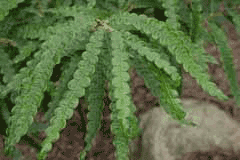
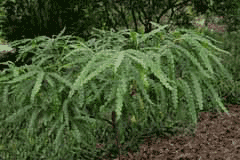
 Comptonia peregrina is a deciduous Shrub growing to 1.5 m (5ft) by 1 m (3ft 3in) at a medium rate.
See above for USDA hardiness. It is hardy to UK zone 4. It is in flower from March to April. The species is monoecious (individual flowers are either male or female, but both sexes can be found on the same plant).
It can fix Nitrogen.
Suitable for: light (sandy) and medium (loamy) soils, prefers well-drained soil and can grow in nutritionally poor soil. Suitable pH: mildly acid soils and can grow in very acid soils.
It can grow in semi-shade (light woodland) or no shade. It prefers dry or moist soil and can tolerate drought.
UK Hardiness Map
US Hardiness Map
Synonyms
Plant Habitats
Woodland Garden Sunny Edge; Dappled Shade;
Edible Uses
Edible Parts: Fruit Leaves
Edible Uses: Condiment Tea
The young fruits are eaten as a pleasant nibble[55, 62, 183]. The aromatic leaves, fresh or dried, are used to make a palatable tea[55, 62, 102, 183]. The leaves are also used as a seasoning[183]. The bristly burr that contains one to four edible nutlets (Peter Alden and Brian Cassie (1999). National Audubon Society Field Guide to the Mid-Atlantic States.)
References More on Edible Uses
Medicinal Uses
Plants For A Future can not take any responsibility for any adverse effects from the use of plants. Always seek advice from a professional before using a plant medicinally.
Astringent Blood purifier Expectorant Febrifuge Odontalgic Parasiticide Poultice Tonic
Sweet fern was employed medicinally by several native North American Indian tribes who used it especially as a poultice to treat a variety of complaints[257]. It is still used for most of the same purposes in modern herbalism. The leaves are astringent, blood purifier, expectorant and tonic[21, 62, 222, 257]. A tea made from the leaves and flowering tops is used as a remedy for diarrhoea, headache, fevers, catarrh, vomiting of blood, rheumatism etc[213, 222, 257]. The infusion has also been used to treat ringworm[257]. The leaves have also been used as a poultice for toothaches, sprains etc[238, 257]. A cold water infusion of the leaves has been used externally to counter the effect of poison ivy[213, 222, 257] and to bathe stings, minor haemorrhages etc[238]. The leaves are harvested in early summer and dried for later use[238].
References More on Medicinal Uses
The Bookshop: Edible Plant Books
Our Latest books on Perennial Plants For Food Forests and Permaculture Gardens in paperback or digital formats.

Edible Tropical Plants
Food Forest Plants for Hotter Conditions: 250+ Plants For Tropical Food Forests & Permaculture Gardens.
More

Edible Temperate Plants
Plants for Your Food Forest: 500 Plants for Temperate Food Forests & Permaculture Gardens.
More

More Books
PFAF have eight books available in paperback and digital formats. Browse the shop for more information.
Shop Now
Other Uses
References More on Other Uses
Cultivation details
Landscape Uses:Arbor, Border, Container, Erosion control, Foundation, Ground cover, Massing, Rock garden, Specimen. Requires a peaty or light loam lime-free soil[11, 182, 200]. Requires an acid well-drained soil of low to medium fertility in partial shade but tolerates full sun if the soil does not dry out in the summer[200]. Tolerates dry sandy soils when grown in the shade[200]. A very ornamental plant[1], it is hardy to at least -25°c[184, 200]. The crushed leaves are very aromatic[182], their scent is most noticeable in the early morning and the evening[238]. The scent increases when the leaves are dried[245]. This species is somewhat intolerant of root disturbance and should be planted out into its permanent position whilst small[238]. Suckering freely[184], this plant is well suited to clothing banks on soils of low fertility[200]. It has a symbiotic relationship with certain soil micro-organisms, these form nodules on the roots of the plants and fix atmospheric nitrogen. Some of this nitrogen is utilized by the growing plant but some can also be used by other plants growing nearby[200]. Special Features:North American native, Fragrant foliage, Inconspicuous flowers or blooms. The plant is heat tolerant in zones 8 through 3. (Plant Hardiness Zones show how well plants withstand cold winter temperatures.
Plant Heat Zones show when plants would start suffering from the heat.
The Plant Heat Zone map is based on the number of "heat days" experienced in a given area where the temperature climbs to over 86 degrees F (30°C).
At this temperature, many plants begin to suffer physiological damage. Heat Zones range from 1 (no heat days) to 12 (210 or more heat days).
For example Heat Zone. 11-1 indicates that the plant is heat tolerant in zones 11 through 1.) For polyculture design as well as the above-ground architecture (form - tree, shrub etc. and size shown above) information on the habit and root pattern is also useful and given here if available. A clumping plant, forming a colony from shoots away from the crown but with a limited spread [1-2]. The root pattern is flat with shallow roots forming a plate near the soil surface [1-2]. The root pattern is suckering with new plants from underground runners away from the plant [1-2].
References Carbon Farming Information and Carbon Sequestration Information
Temperature Converter
Type a value in the Celsius field to convert the value to Fahrenheit:
Fahrenheit:
The PFAF Bookshop
Plants For A Future have a number of books available in paperback and digital form. Book titles include Edible Plants, Edible Perennials, Edible Trees,Edible Shrubs, Woodland Gardening, and Temperate Food Forest Plants. Our new book is Food Forest Plants For Hotter Conditions (Tropical and Sub-Tropical).
Shop Now
Plant Propagation
Seed - it has a very tough seed coat and also contains germination inhibitors and so is very difficult to germinate[113]. It is probably best to harvest the seed 'green' (after the seed has fully developed but before it dries on the plant) and sow immediately in a cold frame. If the seed has been stored then soaking in hot water for 24 hours will leach out some of the inhibitors and also help to soften the seed coat. Scarification will also help as will a period of cold stratification. Prick out the seedlings into individual pots as soon as they are large enough to handle. Grow them on in a greenhouse or cold frame for their first winter and plant them out into their permanent positions in late spring or early summer[K]. Root cuttings, 4cm long December in a frame[78, 113]. Plant the root horizontally. High percentage[78]. Suckers removed in the dormant season and potted up or planted into their permanent positions[200]. Plants can be difficult to move successfully[238]. Layering in spring[238].
Other Names
If available other names are mentioned here
Sugar fern,
Native Plant Search
Search over 900 plants ideal for food forests and permaculture gardens. Filter to search native plants to your area. The plants selected are the plants in our book 'Plants For Your Food Forest: 500 Plants for Temperate Food Forests and Permaculture Gardens, as well as plants chosen for our forthcoming related books for Tropical/Hot Wet Climates and Mediterranean/Hot Dry Climates. Native Plant Search
Found In
Countries where the plant has been found are listed here if the information is available
Australia, Canada, North America, USA,
Weed Potential
Right plant wrong place. We are currently updating this section.
Please note that a plant may be invasive in one area but may not in your area so it’s worth checking.
Conservation Status
IUCN Red List of Threatened Plants Status :

Growth: S = slow M = medium F = fast. Soil: L = light (sandy) M = medium H = heavy (clay). pH: A = acid N = neutral B = basic (alkaline). Shade: F = full shade S = semi-shade N = no shade. Moisture: D = dry M = Moist We = wet Wa = water.
Expert comment
Author
(L.)J.M.Coult.
Botanical References
43200270
Links / References
For a list of references used on this page please go here
Readers comment