 |
|
http://commons.wikimedia.org/wiki/File:Koeh-044.jpg |
 |
|
Translate this page:
Summary
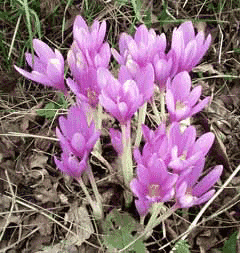
Bloom Color: Lavender, Pink, White. Main Bloom Time: Early fall, Late summer, Mid fall. Form: Upright or erect.
Physical Characteristics

 Colchicum autumnale is a BULB growing to 0.2 m (0ft 8in) by 0.2 m (0ft 8in) at a medium rate.
See above for USDA hardiness. It is hardy to UK zone 5 and is not frost tender. It is in leaf from February to July, in flower from August to October, and the seeds ripen from April to June. The species is hermaphrodite (has both male and female organs) and is pollinated by Bees, flies. The plant is self-fertile.
It is noted for attracting wildlife.
Suitable for: light (sandy), medium (loamy) and heavy (clay) soils and prefers well-drained soil. Suitable pH: mildly acid, neutral and basic (mildly alkaline) soils. It can grow in semi-shade (light woodland) or no shade. It prefers moist soil.
UK Hardiness Map
US Hardiness Map
Synonyms
Plant Habitats
Woodland Garden Sunny Edge; Dappled Shade; Lawn; Meadow;
Edible Uses
References More on Edible Uses
Medicinal Uses
Plants For A Future can not take any responsibility for any adverse effects from the use of plants. Always seek advice from a professional before using a plant medicinally.
Analgesic Antirheumatic Cathartic Emetic Homeopathy
Though known since at least the time of the ancient Greeks, autumn crocus was considered too poisonous to use medicinally and it was not until research in the Eighteenth century that the plant was discovered to be of value in the treatment of gout[268]. In modern herbalism it is still used to relieve the pain and inflammation of acute gout and rheumatism, although frequent use has been known to encourage more frequent attacks of the complaint[232, 268]. Both the corm and the seeds are analgesic, antirheumatic, cathartic and emetic[4, 7, 13, 21, 235]. They are used mainly in the treatment of gouty and rheumatic complaints, usually accompanied with an alkaline diuretic[4]. Leukaemia has been successfully treated with autumn crocus, and the plant has also been used with some success to treat Bechet's syndrome, a chronic disease marked by recurring ulcers and leukaemia[254]. A very toxic plant, it should not be prescribed for pregnant women or patients with kidney disease, and should only be used under the supervision of a qualified practitioner[238]. See also the notes above on toxicity. The seeds are harvested in early summer, the corms in mid to late summer when the plant has fully died down. They are dried for later use[238]. The fresh bulb is used to make a homeopathic remedy[232]. It is used in the treatment of nausea, diarrhoea and rheumatism[232].
References More on Medicinal Uses
The Bookshop: Edible Plant Books
Our Latest books on Perennial Plants For Food Forests and Permaculture Gardens in paperback or digital formats.

Edible Tropical Plants
Food Forest Plants for Hotter Conditions: 250+ Plants For Tropical Food Forests & Permaculture Gardens.
More

Edible Temperate Plants
Plants for Your Food Forest: 500 Plants for Temperate Food Forests & Permaculture Gardens.
More

More Books
PFAF have eight books available in paperback and digital formats. Browse the shop for more information.
Shop Now
Other Uses
Plant breeding
The poisonous alkaloid 'colchicine' is extracted from this plant and used to alter the genetic make-up of plants in an attempt to find new, improved varieties[9, 13, 19, 46, 100, 171]. It works by doubling the chromosome number[89].
Special Uses
Attracts Wildlife
References More on Other Uses
Cultivation details
Landscape Uses:Alpine garden, Border, Foundation, Massing, Rock garden, Specimen. Prefers a rich well-drained loam in a sunny position[1, 188]. Tolerates partial shade but dislikes dry soils[1]. Tolerates a pH in the range 4.5 to 7.5. Plants are hardy to about -20°c[200]. The dormant bulbs are fairly hardy and will withstand soil temperatures down to at least -5°c[214]. The autumn crocus is easily grown in grass[90] and can be naturalized there[200]. It also grows well amongst shrubs and by woodland edges[28]. Plant the corms about 7 - 10cm deep in July[1]. Plants seem to be immune to the predations of rabbits[233], though slugs may attack the corms[238]. The flowers are very attractive to bees and butterflies[201]. Special Features:Not North American native, Naturalizing, Suitable for cut flowers.
References Carbon Farming Information and Carbon Sequestration Information
Temperature Converter
Type a value in the Celsius field to convert the value to Fahrenheit:
Fahrenheit:
The PFAF Bookshop
Plants For A Future have a number of books available in paperback and digital form. Book titles include Edible Plants, Edible Perennials, Edible Trees,Edible Shrubs, Woodland Gardening, and Temperate Food Forest Plants. Our new book is Food Forest Plants For Hotter Conditions (Tropical and Sub-Tropical).
Shop Now
Plant Propagation
Seed - best sown as soon as it is ripe in early summer in a seed bed or a cold frame[1, 164]. Germination can be very slow, taking up to 18 months at 15°c[164]. It is best to sow the seed thinly so that it is not necessary to transplant the seedlings for their first year of growth. Apply a liquid fertilizer during their first summer, however, to ensure they get sufficient nourishment. Prick out the seedlings once they are dormant, putting perhaps 2 plants per pot, and grow them on in a greenhouse or frame for at least a couple of years. Plant them out into their permanent positions when they are dormant[K]. The seedlings take 4 - 5 years to reach flowering size[1]. Division of the bulbs in June/July when the leaves have died down[1]. Larger bulbs can be planted out direct into their permanent positions, though it is best to pot up the smaller bulbs and grow them on in a cold frame for a year before planting them out. The plant can be divided every other year if a quick increase is required[1].
Other Names
If available other names are mentioned here
Native Plant Search
Search over 900 plants ideal for food forests and permaculture gardens. Filter to search native plants to your area. The plants selected are the plants in our book 'Plants For Your Food Forest: 500 Plants for Temperate Food Forests and Permaculture Gardens, as well as plants chosen for our forthcoming related books for Tropical/Hot Wet Climates and Mediterranean/Hot Dry Climates. Native Plant Search
Found In
Countries where the plant has been found are listed here if the information is available
Weed Potential
Right plant wrong place. We are currently updating this section.
Please note that a plant may be invasive in one area but may not in your area so it’s worth checking.
Conservation Status
IUCN Red List of Threatened Plants Status :

Growth: S = slow M = medium F = fast. Soil: L = light (sandy) M = medium H = heavy (clay). pH: A = acid N = neutral B = basic (alkaline). Shade: F = full shade S = semi-shade N = no shade. Moisture: D = dry M = Moist We = wet Wa = water.

Expert comment
Author
L.
Botanical References
17200
Links / References
For a list of references used on this page please go here
Readers comment