 |
|
http://commons.wikimedia.org/wiki/File:Coix_lacryma-jobi_Blanco1.188-cropped.jpg |
 |
| http://www.biolib.de/ |
Translate this page:
Summary
Physical Characteristics

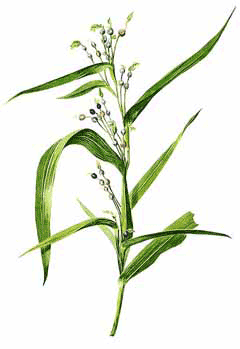
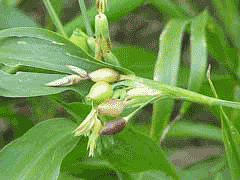
 Coix lacryma-jobi is a PERENNIAL growing to 1 m (3ft 3in) by 0.2 m (0ft 8in).
See above for USDA hardiness. It is hardy to UK zone 9. It is in leaf from May to October, in flower from July to October, and the seeds ripen from September to November. The species is monoecious (individual flowers are either male or female, but both sexes can be found on the same plant) and is pollinated by Wind.
Suitable for: light (sandy), medium (loamy) and heavy (clay) soils. Suitable pH: mildly acid, neutral and basic (mildly alkaline) soils and can grow in very acid soils.
It cannot grow in the shade. It prefers moist soil.
UK Hardiness Map
US Hardiness Map
Synonyms
Plant Habitats
Cultivated Beds;
Edible Uses
Edible Parts: Seed
Edible Uses: Coffee Tea
Seed - cooked. A pleasant mild flavour, it can be used in soups and broths[269].. It can be ground into a flour and used to make bread or used in any of the ways that rice is used[1, 2, 57, 100, 183]. The pounded flour is sometimes mixed with water like barley for barley water[269]. The pounded kernel is also made into a sweet dish by frying and coating with sugar[269]. It is also husked and eaten out of hand like a peanut[269]. The seed contains about 52% starch, 18% protein, 7% fat[114, 174]. It is higher in protein and fat than rice but low in minerals[114]. This is a potentially very useful grain, it has a higher protein to carbohydrate ratio than any other cereal[57], though the hard seedcoat makes extraction of the flour rather difficult. A tea can be made from the parched seeds[46, 61, 105, 183], whilst beers and wines are made from the fermented grain[269]. A coffee is made from the roasted seed[183]. (This report refers to the ssp. ma-yuen)
References More on Edible Uses
| Composition
|
| Figures in grams (g) or miligrams (mg) per 100g of food.
|
|
|
Seed (Fresh weight)
|
|
- 380 Calories per 100g
- Water : 11.2%
- Protein: 15.4g; Fat: 6.2g; Carbohydrate: 65.3g; Fibre: 0.8g; Ash: 1.9g;
- Minerals - Calcium: 25mg; Phosphorus: 435mg; Iron: 5mg; Magnesium: 0mg; Sodium: 0mg; Potassium: 0mg; Zinc: 0mg;
- Vitamins - A: 0mg; Thiamine (B1): 0.28mg; Riboflavin (B2): 0.19mg; Niacin: 4.3mg; B6: 0mg; C: 0mg;
- Reference: [ 218]
- Notes:
|
|
Medicinal Uses
Plants For A Future can not take any responsibility for any adverse effects from the use of plants. Always seek advice from a professional before using a plant medicinally.
Anodyne Anthelmintic Antiinflammatory Antipyretic Antirheumatic Antispasmodic Cancer Diuretic
Hypoglycaemic Pectoral Refrigerant Sedative Tonic Warts
The fruits are anodyne, anti-inflammatory, antipyretic, antiseptic, antispasmodic, hypoglycaemic, hypotensive, sedative and vermifuge[218, 238]. The fruits are used in folk remedies for abdominal tumours, oesophageal, gastrointestinal, and lung cancers, various tumours, as well as excrescences, warts, and whitlows. This folk reputation is all the more interesting when reading that one of the active constituents of the plant, coixenolide, has antitumor activity[269]. The seed, with the husk removed, is antirheumatic, diuretic, pectoral, refrigerant and tonic[176, 218, 240]. A tea from the boiled seeds is drunk as part of a treatment to cure warts[116, 174]. It is also used in the treatment of lung abscess, lobar pneumonia, appendicitis, rheumatoid arthritis, beriberi, diarrhoea, oedema and difficult urination[147, 176]. The plant has been used in the treatment of cancer[218]. The roots have been used in the treatment of menstrual disorders[240]. A decoction of the root has been used as an anthelmintic[272]. The fruit is harvested when ripe in the autumn and the husks are removed before using fresh, roasted or fermented[238].
References More on Medicinal Uses
The Bookshop: Edible Plant Books
Our Latest books on Perennial Plants For Food Forests and Permaculture Gardens in paperback or digital formats.

Edible Tropical Plants
Food Forest Plants for Hotter Conditions: 250+ Plants For Tropical Food Forests & Permaculture Gardens.
More

Edible Temperate Plants
Plants for Your Food Forest: 500 Plants for Temperate Food Forests & Permaculture Gardens.
More

More Books
PFAF have eight books available in paperback and digital formats. Browse the shop for more information.
Shop Now
Other Uses
References More on Other Uses
Cultivation details
Fodder: Bank Hypothetical Crop Management: Standard Staple Crop: Balanced carb
Succeeds in ordinary garden soil[162]. Best grown in an open sunny border[1, 162]. Prefers a little shelter from the wind. Job's Tears is reported to tolerate an annual precipitation in the range of 61 to 429cm, an average annual temperature of 9.6 to 27.8°C and a pH in the range of 4.5 to 8.4[269]. Weed to some, necklace to others, staff-of-life to others, job's tear is a very useful and productive grass increasingly viewed as a potential energy source[269]. Before corn (Zea mays) became popular in Southern Asia, Job's tears was rather widely cultivated as a cereal in India[158, 269]. It is a potentially very useful grain having a higher protein to carbohydrate ratio than any other cereal[57]. The seed has a very tough shell however making it rather difficult to extract the grain. The ssp. ma-yuen. (Roman.)Stapf. is grown for its edible seed and medicinal virtues in China, the seedcoat is said to be soft and easily removed[57, 183]. This form is widely used in macrobiotic diets and cuisine[183]. The ssp. stenocarpa is used for beads[57]. Whilst usually grown as an annual, the plant is perennial in essentially frost-free areas[269]. Plants have survived temperatures down to about -35°c[160]. (This report needs verifying, it seems rather dubious[K].) Plants have often overwintered when growing in a polyhouse with us, they have then gone on to produce another crop of seed in their second year[K]. We have not as yet (1995) tried growing them on for a third year in a polyhouse[K].
Carbon Farming
-
Fodder: Bank
Fodder banks are plantings of high-quality fodder species. Their goal is to maintain healthy productive animals. They can be utilized all year, but are designed to bridge the forage scarcity of annual dry seasons. Fodder bank plants are usually trees or shrubs, and often legumes. The relatively deep roots of these woody perennials allow them to reach soil nutrients and moisture not available to grasses and herbaceous plants.
-
Hypothetical Crop
These are perennial plants that could potentially be developed for cultivation. Some, such as cycads (for industrial starch), as simply neglected; others, such as buckwheat and soybeans, are annual crops that could potentially be perennialised by crossing and relatives.
-
Management: Standard
Plants grow to their standard height. Harvest fruit, seeds, or other products. Non-Destructive management systems.
-
Staple Crop: Balanced carb
(0-15 percent protein, 0-15 percent oil, with at least one over 5 percent). The carbohydrates are from either starch or sugar. Annuals include maize, wheat, rice, and potato. Perennials include chestnuts, carob, perennial fruits, nuts, cereals, pseudocereals, woody pods, and acorns.
References Carbon Farming Information and Carbon Sequestration Information
Temperature Converter
Type a value in the Celsius field to convert the value to Fahrenheit:
Fahrenheit:
The PFAF Bookshop
Plants For A Future have a number of books available in paperback and digital form. Book titles include Edible Plants, Edible Perennials, Edible Trees,Edible Shrubs, Woodland Gardening, and Temperate Food Forest Plants. Our new book is Food Forest Plants For Hotter Conditions (Tropical and Sub-Tropical).
Shop Now
Plant Propagation
Seed - pre-soak for 2 hours in warm water and sow February/March in a greenhouse[164]. The seed usually germinates in 3 - 4 weeks at 25°c. When they are large enough to handle, prick the seedlings out into individual pots. Grow them on in cool conditions and plant out in late spring after the last expected frosts[1, 164]. Seed can also be sown in situ in May[1] though it would be unlikely to ripen its seed in an average British summer. In a suitable climate, it takes about 4 - 5 months from seed to produce new seed[269]. Division of root offshoots[272]. This is probably best done in the spring as plants come into fresh growth[272].
Other Names
If available other names are mentioned here
Native Plant Search
Search over 900 plants ideal for food forests and permaculture gardens. Filter to search native plants to your area. The plants selected are the plants in our book 'Plants For Your Food Forest: 500 Plants for Temperate Food Forests and Permaculture Gardens, as well as plants chosen for our forthcoming related books for Tropical/Hot Wet Climates and Mediterranean/Hot Dry Climates. Native Plant Search
Found In
Countries where the plant has been found are listed here if the information is available
Weed Potential
Right plant wrong place. We are currently updating this section.
Please note that a plant may be invasive in one area but may not in your area so it’s worth checking.
Conservation Status
IUCN Red List of Threatened Plants Status :

Growth: S = slow M = medium F = fast. Soil: L = light (sandy) M = medium H = heavy (clay). pH: A = acid N = neutral B = basic (alkaline). Shade: F = full shade S = semi-shade N = no shade. Moisture: D = dry M = Moist We = wet Wa = water.

Expert comment
Author
L.
Botanical References
200
Links / References
For a list of references used on this page please go here
Readers comment