 |
|
http://commons.wikimedia.org/wiki/User:Doronenko |
 |
| http://commons.wikimedia.org/wiki/User:Doronenko |
Translate this page:
Summary
Physical Characteristics

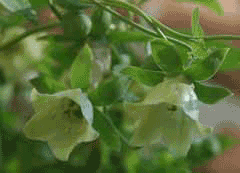
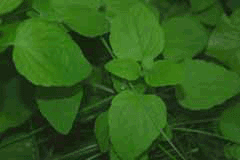
 Codonopsis pilosula is a PERENNIAL CLIMBER growing to 1.7 m (5ft 7in).
See above for USDA hardiness. It is hardy to UK zone 6 and is not frost tender. It is in flower from June to August, and the seeds ripen from August to September. The species is hermaphrodite (has both male and female organs) and is pollinated by Insects.
Suitable for: light (sandy) and medium (loamy) soils and prefers well-drained soil. Suitable pH: mildly acid and neutral soils. It can grow in semi-shade (light woodland) or no shade. It prefers moist soil.
UK Hardiness Map
US Hardiness Map
Synonyms
Campanumoea pilosula. Franch.
Plant Habitats
Woodland Garden Sunny Edge; Dappled Shade; Shady Edge;
Edible Uses
Edible Parts: Root
Edible Uses:
Root - raw or cooked[105, 177].
References More on Edible Uses
Medicinal Uses
Plants For A Future can not take any responsibility for any adverse effects from the use of plants. Always seek advice from a professional before using a plant medicinally.
Adaptogen Appetizer Digestive Galactogogue Sialagogue Stomachic Tonic
Dang Shun is an important herb in Chinese medicine, it is a gentle tonic that increases energy levels and helps the body adapt to stress[254]. The root contains saponins, triterpenes and steroids[279], it is similar in action to ginseng (Panax species), but it is milder and has a shorter-lasting effect[4, 116, 174, 176, 218, 238, 254]. It is a sweet, warm, soothing herb that is taken as an energy tonic[238]. It acts mainly on the spleen, lungs and stomach, raising secretion of body fluids and blood sugar levels, and stimulating the immune system[238]. Research has shown that it increases haemoglobin and red blood cell levels and lowers the blood pressure. It also helps increase endurance to stress and promotes alertness[254]. The root and the whole plant are adaptogen, appetizer, digestive, galactogogue, sialagogue, stomachic and tonic[116, 147, 174, 176, 238, 254]. It is taken internally in the treatment of low energy, poor appetite and digestion, anaemia, shallow breathing and debility after illness[238, 254]. It is often cooked with rice until it is glutinous and used as a tonic food[238]. The dried root is decocted with other herbs and used to treat a wide range of ailments[218]. The roots of plants at least three years old are harvested in the autumn and can be used fresh or dried[238].
References More on Medicinal Uses
The Bookshop: Edible Plant Books
Our Latest books on Perennial Plants For Food Forests and Permaculture Gardens in paperback or digital formats.

Edible Tropical Plants
Food Forest Plants for Hotter Conditions: 250+ Plants For Tropical Food Forests & Permaculture Gardens.
More

Edible Temperate Plants
Plants for Your Food Forest: 500 Plants for Temperate Food Forests & Permaculture Gardens.
More

More Books
PFAF have eight books available in paperback and digital formats. Browse the shop for more information.
Shop Now
Other Uses
References More on Other Uses
Cultivation details
Prefers a well-drained fertile light soil in full sun or semi shade[1, 200]. Plants only succeed in full sun if the soil remains moist during the growing season[200]. Prefers a slightly acid soil[164]. Although quite cold-hardy when dormant, the young growth in spring, even on mature plants, is frost-tender and so it is best to grow the plants in a position sheltered from the early morning sun[K]. A climbing plant, supporting itself by twining and scrambling over other plants[219]. The plant resents root disturbance and should be planted out into its permanent position as soon as possible[164]. It is best grown on a high bank in order to give a good view of the flowers[1]. Plants are very susceptible to the ravages of slugs. The young shoots in spring are particularly at risk, though older growth is also eaten[K].
References Carbon Farming Information and Carbon Sequestration Information
Temperature Converter
Type a value in the Celsius field to convert the value to Fahrenheit:
Fahrenheit:
The PFAF Bookshop
Plants For A Future have a number of books available in paperback and digital form. Book titles include Edible Plants, Edible Perennials, Edible Trees,Edible Shrubs, Woodland Gardening, and Temperate Food Forest Plants. Our new book is Food Forest Plants For Hotter Conditions (Tropical and Sub-Tropical).
Shop Now
Plant Propagation
Seed - surface sow in spring to early summer in an ericaceous compost in a greenhouse. Do not allow the compost to dry out. The seed usually germinates in 1 - 6 weeks at 20°c[164]. Prick out the seedlings into individual pots as soon as they are large enough to handle and grow them on in a greenhouse for their first winter. Plant out in late spring or early summer and protect them from slugs until the plants are well established[K]. Division in spring, with care, since the plant resents root disturbance[200]. We have found it best to take small divisions that are teased out from the sides of the main clump so as to cause the least possible disturbance to the plants and to avoid having to dig up the clump. These small divisions need to be potted up and placed in light shade in a greenhouse until they are rooting well. They can be planted out into their permanent positions in the summer if they are large enough, otherwise in the following spring[K].
Other Names
If available other names are mentioned here
Native Plant Search
Search over 900 plants ideal for food forests and permaculture gardens. Filter to search native plants to your area. The plants selected are the plants in our book 'Plants For Your Food Forest: 500 Plants for Temperate Food Forests and Permaculture Gardens, as well as plants chosen for our forthcoming related books for Tropical/Hot Wet Climates and Mediterranean/Hot Dry Climates. Native Plant Search
Found In
Countries where the plant has been found are listed here if the information is available
Weed Potential
Right plant wrong place. We are currently updating this section.
Please note that a plant may be invasive in one area but may not in your area so it’s worth checking.
Conservation Status
IUCN Red List of Threatened Plants Status :

Growth: S = slow M = medium F = fast. Soil: L = light (sandy) M = medium H = heavy (clay). pH: A = acid N = neutral B = basic (alkaline). Shade: F = full shade S = semi-shade N = no shade. Moisture: D = dry M = Moist We = wet Wa = water.

Expert comment
Author
(Franch.)Nannf.
Botanical References
74200
Links / References
For a list of references used on this page please go here
Readers comment
© 2010, Plants For A Future. Plants For A Future is a charitable company limited by guarantee, registered in England and Wales. Charity No. 1057719, Company No. 3204567.