 |
|
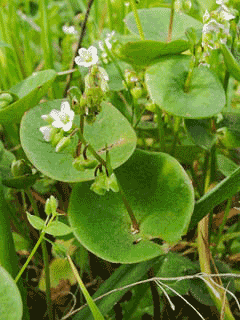
http://www.flickr.com/photos/miguelvieira/4474996637/ |
 |
|
Translate this page:
Summary
Physical Characteristics

 Claytonia perfoliata is a ANNUAL growing to 0.2 m (0ft 8in).
It is not frost tender. It is in leaf all year, in flower from May to July. The species is hermaphrodite (has both male and female organs) and is pollinated by Flies. The plant is self-fertile.
Suitable for: light (sandy), medium (loamy) and heavy (clay) soils, prefers well-drained soil and can grow in nutritionally poor soil. Suitable pH: mildly acid, neutral and basic (mildly alkaline) soils. It can grow in full shade (deep woodland) semi-shade (light woodland) or no shade. It prefers dry or moist soil.
UK Hardiness Map
US Hardiness Map
Synonyms
Claytonia perfoliata. Montia perfoliata (Donn ex Willd.)
Plant Habitats
Woodland Garden Sunny Edge; Dappled Shade; Shady Edge; not Deep Shade; Ground Cover;
Edible Uses
Edible Parts: Flowers Leaves Root
Edible Uses:
Leaves - raw or cooked[2, 5, 12, 27, 52, 62]. A fairly bland flavour with a mucilaginous texture, it is quite nice in a salad[183, K]. The young leaves are best[85], older leaves can turn bitter especially in the summer and if the plant is growing in a hot dry position[K]. Although individual leaves are fairly small, they are produced in abundance and are easily picked[K]. Stalks and flowers - raw[52]. A nice addition to the salad bowl[K]. Bulb - raw[5, 53, 62]. Although very small and labour-intensive to harvest, the boiled and peeled root has the flavour of chestnuts[244]. Another report says that the plant has a fibrous root system[62] so this report seems to be erroneous[K].
References More on Edible Uses
Medicinal Uses
Plants For A Future can not take any responsibility for any adverse effects from the use of plants. Always seek advice from a professional before using a plant medicinally.
Antirheumatic Laxative Vitamin C
The leaves are gently laxative[94]. Apart from its value as a nourishing vegetable that is rich in vitamin C, it can also be taken as an invigorating spring tonic and an effective diuretic[254]. A poultice of the mashed plants has been applied to rheumatic joints[257].
References More on Medicinal Uses
The Bookshop: Edible Plant Books
Our Latest books on Perennial Plants For Food Forests and Permaculture Gardens in paperback or digital formats.

Edible Tropical Plants
Food Forest Plants for Hotter Conditions: 250+ Plants For Tropical Food Forests & Permaculture Gardens.
More

Edible Temperate Plants
Plants for Your Food Forest: 500 Plants for Temperate Food Forests & Permaculture Gardens.
More

More Books
PFAF have eight books available in paperback and digital formats. Browse the shop for more information.
Shop Now
Other Uses
Although only an annual, this species makes an excellent ground cover in a cool acid soil under trees. In such a position it usually self-sows freely[208] and grows all year round[K].
Special Uses
Food Forest Ground cover
References More on Other Uses
Cultivation details
Prefers a moist peaty soil[1, 60]. It is often found growing wild on sandy soils[264]. An easily grown plant, it can succeed on very poor and dry soils[52, 60]. Plants grow well the dappled shade of trees, producing a better quality crop in such a situation[52, 60, 264]. Although only an annual[208], it usually self-sows when well sited. A very hardy plant, tolerating temperatures down to at least -15°c. Miner's lettuce is occasionally cultivated as a salad plant[1, 46]. It's main value is as a reliable producer of leaves in the winter, though it can provide leaves all year round[141, 200, 264]. It can be grown as a cut and come again crop[183]. For polyculture design as well as the above-ground architecture (form - tree, shrub etc. and size shown above) information on the habit and root pattern is also useful and given here if available. A self-seeding annual [1-2]. A clumping mat former. Forming a dense prostrate carpet spreading indefinitely [1-2]. The root pattern is fibrous dividing into a large number of fine roots [1-2].
References Carbon Farming Information and Carbon Sequestration Information
Temperature Converter
Type a value in the Celsius field to convert the value to Fahrenheit:
Fahrenheit:
The PFAF Bookshop
Plants For A Future have a number of books available in paperback and digital form. Book titles include Edible Plants, Edible Perennials, Edible Trees,Edible Shrubs, Woodland Gardening, and Temperate Food Forest Plants. Our new book is Food Forest Plants For Hotter Conditions (Tropical and Sub-Tropical).
Shop Now
Plant Propagation
Seed - sow spring or autumn in situ. The seed usually germinates rapidly.
Other Names
If available other names are mentioned here
Native Plant Search
Search over 900 plants ideal for food forests and permaculture gardens. Filter to search native plants to your area. The plants selected are the plants in our book 'Plants For Your Food Forest: 500 Plants for Temperate Food Forests and Permaculture Gardens, as well as plants chosen for our forthcoming related books for Tropical/Hot Wet Climates and Mediterranean/Hot Dry Climates. Native Plant Search
Found In
Countries where the plant has been found are listed here if the information is available
Weed Potential
Right plant wrong place. We are currently updating this section.
Please note that a plant may be invasive in one area but may not in your area so it’s worth checking.
May be weedy or invasive.
Conservation Status
IUCN Red List of Threatened Plants Status :

| Related Plants
|
| Latin Name | Common Name | Habit | Height | Hardiness | Growth | Soil | Shade | Moisture | Edible | Medicinal | Other |
| Claytonia acutifolia | Bering Sea Spring Beauty | Perennial | 0.2 |
-
| | LM | N | M | 3 | 0 | |
| Claytonia caroliniana | Broad-Leaved Spring Beauty, Carolina springbeauty | Perennial | 0.1 |
5-9
| | LM | N | M | 3 | 0 | 1 |
| Claytonia exigua | Pale Spring Beauty, Serpentine springbeauty | Annual | 0.1 |
0-0
| | LMH | FSN | DM | 2 | 0 | |
| Claytonia lanceolata | Lanceleaf Spring Beauty, Idaho springbeauty, Pacific springbeauty, Peirson's springbeauty | Perennial | 0.2 |
4-8
| | LM | N | M | 3 | 0 | |
| Claytonia megarhiza | Alpine Spring Beauty | Perennial | 0.2 |
4-8
| | LM | N | M | 3 | 0 | |
| Claytonia scammaniana | Scamman's Claytonia, Scamman's springbeauty | Perennial | 0.2 |
0-0
| | LM | N | M | 2 | 0 | |
| Claytonia sibirica | Pink Purslane, Siberian springbeauty | Annual/Perennial | 0.2 |
3-7
| | LMH | FSN | DM | 4 | 1 | 3 |
| Claytonia tuberosa | Tuberous Spring Beauty | Perennial | 0.2 |
4-8
| | LM | N | M | 3 | 0 | |
| Claytonia umbellata | Great Basin Spring Beauty | Perennial | 0.2 |
-
| | LM | N | M | 2 | 0 | |
| Claytonia virginica | Spring Beauty, Virginia springbeauty, Hammond's claytonia, Yellow Virginia springbeauty | Perennial | 0.2 |
5-7
| M | LM | S | M | 3 | 1 | |
| Osmunda claytoniana | Interrupted Fern | Fern | 0.5 |
3-7
| | LMH | SN | MWe | 2 | 1 | |
|
Growth: S = slow M = medium F = fast. Soil: L = light (sandy) M = medium H = heavy (clay). pH: A = acid N = neutral B = basic (alkaline). Shade: F = full shade S = semi-shade N = no shade. Moisture: D = dry M = Moist We = wet Wa = water.

Expert comment
Author
Donn. ex Willd.
Botanical References
1760270
Links / References
For a list of references used on this page please go here
Readers comment