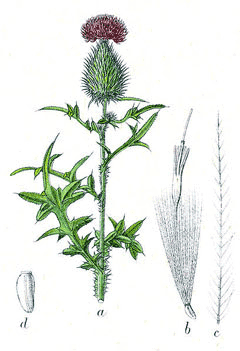
 |
|
http://commons.wikimedia.org/wiki/File:Cirsium_vulgare_Sturm1.jpg |
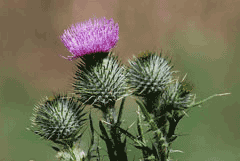 |
| http://commons.wikimedia.org/wiki/User:Peripitus |
Translate this page:
Summary
Bloom Color: Purple. Main:Bloom Time: Early summer, Late summer, Mid summer.
Physical Characteristics

 Cirsium vulgare is a BIENNIAL growing to 2 m (6ft 7in) at a fast rate.
See above for USDA hardiness. It is hardy to UK zone 2 and is not frost tender. The species is hermaphrodite (has both male and female organs) and is pollinated by Bees, flies, Lepidoptera (Moths & Butterflies), beetles. The plant is self-fertile.
It is noted for attracting wildlife.
Suitable for: light (sandy), medium (loamy) and heavy (clay) soils. Suitable pH: mildly acid, neutral and basic (mildly alkaline) soils. It cannot grow in the shade. It prefers moist soil.
UK Hardiness Map
US Hardiness Map
Synonyms
C. lanceolatum. non Hill. Carduus lanceolatus.
Plant Habitats
Meadow; Cultivated Beds;
Edible Uses
Edible Parts: Flowers Leaves Oil Root Seed Stem
Edible Uses: Curdling agent Oil
Root - cooked[183]. A taste somewhat like a Jerusalem artichoke, but not as nice[K]. A rather bland flavour, the root is best used mixed with other vegetables[9]. The root can be dried and stored for later use[257]. The root is rich in inulin, a starch that cannot be digested by humans. This starch thus passes straight through the digestive system and, in some people, ferments to produce flatulence[K]. Young flower stems - cooked and used as a vegetable[177, 183]. Young leaves can be soaked overnight in salt water and then cooked and eaten[183]. Another report says that they can be used in salads[9]. The taste is rather bland but the prickles need to be removed from the leaves before the leaves can be eaten - not only is this a rather fiddly operation but very little edible matter remains[K]. Flower buds - cooked. Used like globe artichokes[177, 183], but smaller and even more fiddly. The dried flowers are a rennet substitute for curdling plant milks[183]. Seed - occasionally eaten roasted[183].
References More on Edible Uses
Medicinal Uses
Plants For A Future can not take any responsibility for any adverse effects from the use of plants. Always seek advice from a professional before using a plant medicinally.
Antihaemorrhoidal Antirheumatic Poultice
The roots have been used as a poultice and a decoction of the plant used as a poultice on sore jaws[257]. A hot infusion of the whole plant has been used as a herbal steam for treating rheumatic joints[257]. A decoction of the whole plant has been used both internally and externally to treat bleeding piles[257].
References More on Medicinal Uses
The Bookshop: Edible Plant Books
Our Latest books on Perennial Plants For Food Forests and Permaculture Gardens in paperback or digital formats.
Edible Tropical Plants
Food Forest Plants for Hotter Conditions: 250+ Plants For Tropical Food Forests & Permaculture Gardens.
More
Edible Temperate Plants
Plants for Your Food Forest: 500 Plants for Temperate Food Forests & Permaculture Gardens.
More
More Books
PFAF have eight books available in paperback and digital formats. Browse the shop for more information.
Shop Now
Other Uses
Oil Paper Tinder
A fibre obtained from the inner bark is used in making paper. The fibre is about 0.9mm long[189]. The stems are harvested in late summer, the leaves removed and the stems steamed until the fibres can be stripped off. The fibres are cooked with lye for two hours and then put in a ball mill for 3 hours. The resulting paper is a light brown tan[189]. The seed of all species of thistles yields a good oil by expression[4]. No details of potential yields etc are given[K]. The down makes an excellent tinder that is easily lit by a spark from a flint[212].
Special Uses
Attracts Wildlife Food Forest
References More on Other Uses
Cultivation details
The common thistle is a pernicious weed that spreads freely by means of its seed which can be dispersed by the wind over a large area. The seedlings are capable of establishing themselves in grassland. This plant should not be encouraged, and if growing on your land should be cut down before it sets seed. What better way of discouraging it is there than eating it? An easily grown plant, succeeding in any ordinary garden soil in a sunny position[200]. Special Features:North American native, Fragrant foliage. In garden design, as well as the above-ground architecture of a plant, root structure considerations help in choosing plants that work together for their optimal soil requirements including nutrients and water. The root pattern is fleshy. Thick or swollen - fibrous or tap root [2-1].
References Carbon Farming Information and Carbon Sequestration Information
Temperature Converter
Type a value in the Celsius field to convert the value to Fahrenheit:
Fahrenheit:
The PFAF Bookshop
Plants For A Future have a number of books available in paperback and digital form. Book titles include Edible Plants, Edible Perennials, Edible Trees,Edible Shrubs, Woodland Gardening, and Temperate Food Forest Plants. Our new book is Food Forest Plants For Hotter Conditions (Tropical and Sub-Tropical).
Shop Now
Plant Propagation
Seed - sow early spring or autumn in situ. Germination usually takes place within 2 - 8 weeks at 20°c[164]. A pernicious weed, it really needs no encouragement from us.
Other Names
If available other names are mentioned here
Black thistle, Bull thistle, Bur thistle, Cardo de toro, Cardo negro, Pareira brava, Spear thistle, Common thistle, Scots, Scottish, or Scotch thistle,
Native Plant Search
Search over 900 plants ideal for food forests and permaculture gardens. Filter to search native plants to your area. The plants selected are the plants in our book 'Plants For Your Food Forest: 500 Plants for Temperate Food Forests and Permaculture Gardens, as well as plants chosen for our forthcoming related books for Tropical/Hot Wet Climates and Mediterranean/Hot Dry Climates. Native Plant Search
Found In
Countries where the plant has been found are listed here if the information is available
Afghanistan, Africa, Argentina, Asia, Australia, Bolivia, Brazil, Britain, Canada, Chile, Europe, France, Greece, Italy, Kazakhstan, Kyrgyzstan, Lord Howe Island, Mediterranean, New Zealand, North Africa, North America, Pakistan, Paraguay, Portugal, Russia, South America, Spain, Tasmania, Turkey, Turkmenistan, Uruguay, USA.
Weed Potential
Right plant wrong place. We are currently updating this section.
Please note that a plant may be invasive in one area but may not in your area so it’s worth checking.
Naturalised in North America, Africa, and Australia and is an invasive weed in some areas.
Conservation Status
IUCN Red List of Threatened Plants Status : This taxon has not yet been assessed.

Growth: S = slow M = medium F = fast. Soil: L = light (sandy) M = medium H = heavy (clay). pH: A = acid N = neutral B = basic (alkaline). Shade: F = full shade S = semi-shade N = no shade. Moisture: D = dry M = Moist We = wet Wa = water.

Expert comment
Author
(Savi.)Ten.
Botanical References
17200
Links / References
For a list of references used on this page please go here
Readers comment