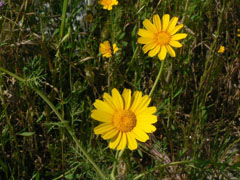
 |
|
http://commons.wikimedia.org/wiki/User:MathKnight |
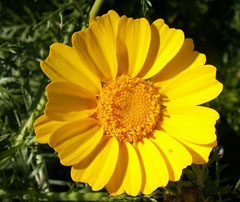 |
| http://commons.wikimedia.org/wiki/User:Eitan_f |
Translate this page:
Summary
Physical Characteristics

 Chrysanthemum coronarium is a ANNUAL growing to 1.2 m (4ft).
It is not frost tender. It is in flower from July to September, and the seeds ripen from August to October. The species is hermaphrodite (has both male and female organs) and is pollinated by Bees, flies, beetles, Lepidoptera (Moths & Butterflies). The plant is self-fertile.
Suitable for: light (sandy), medium (loamy) and heavy (clay) soils and prefers well-drained soil. Suitable pH: mildly acid, neutral and basic (mildly alkaline) soils. It can grow in semi-shade (light woodland) or no shade. It prefers moist soil.
UK Hardiness Map
US Hardiness Map
Synonyms
Plant Habitats
Cultivated Beds;
Edible Uses
Edible Parts: Flowers Leaves Shoots
Edible Uses:
Young shoots and stems - raw or cooked[34, 46, 61, 105, 116]. Strongly aromatic[183, 200]. Flowers - raw[116]. Blanched briefly and added to salads[183]. The centre of the flower is bitter so only the petals are normally used[206].
References More on Edible Uses
| Composition
|
| Figures in grams (g) or miligrams (mg) per 100g of food.
|
|
|
Leaves (Dry weight)
|
|
- 292 Calories per 100g
- Water : 0%
- Protein: 27.7g; Fat: 4.6g; Carbohydrate: 50.8g; Fibre: 13.8g; Ash: 16.9g;
- Minerals - Calcium: 969mg; Phosphorus: 523mg; Iron: 38.5mg; Magnesium: 0mg; Sodium: 1631mg; Potassium: 3938mg; Zinc: 0mg;
- Vitamins - A: 49mg; Thiamine (B1): 1.38mg; Riboflavin (B2): 2.92mg; Niacin: 9.23mg; B6: 0mg; C: 415mg;
- Reference: [ ]
- Notes:
|
|
Medicinal Uses
Plants For A Future can not take any responsibility for any adverse effects from the use of plants. Always seek advice from a professional before using a plant medicinally.
Aromatic Bitter Expectorant Purgative Stomachic VD
The leaves are expectorant and stomachic[218]. In conjunction with black pepper it is used in the treatment of gonorrhoea[240]. The flowers are aromatic, bitter and stomachic[240]. They are used as a substitute for camomile (Chamaemelum nobile)[240]. The bark is purgative, it is used in the treatment of syphilis[240].
References More on Medicinal Uses
The Bookshop: Edible Plant Books
Our Latest books on Perennial Plants For Food Forests and Permaculture Gardens in paperback or digital formats.

Edible Tropical Plants
Food Forest Plants for Hotter Conditions: 250+ Plants For Tropical Food Forests & Permaculture Gardens.
More

Edible Temperate Plants
Plants for Your Food Forest: 500 Plants for Temperate Food Forests & Permaculture Gardens.
More

More Books
PFAF have eight books available in paperback and digital formats. Browse the shop for more information.
Shop Now
Other Uses
Companion Repellent
Possibly a good companion plant, protecting neighbouring plants from caterpillars etc. There is a report that secretions from the roots can be effective in controlling nematodes in the soil, but this has not been substantiated[206].
Special Uses
References More on Other Uses
Cultivation details
Succeeds in ordinary garden soil[1], but it prefers a well-drained fertile soil in full sun[200, 206]. It will tolerate light shade in the summer[206]. Tolerates a pH in the range 5.2 to 7.5. Plants do not grow well at temperatures above 25°c, tending to become bitter in hot weather[206]. Plants withstand light frosts[206]. Whilst this species is often grown as an ornamental in the West, in the Orient the variety C. coronarium spatiosum L.H.Bailey is comonly cultivated as a vegetable[200]. This variety is treated separately. There are many named varieties[183]. It takes 4 - 5 weeks from sowing the seed to the first harvest when plants are grown on the cut and come again principle[206]. Plants often self-sow when they are well-sited and the soil is disturbed by hoeing etc[K].
References Carbon Farming Information and Carbon Sequestration Information
Temperature Converter
Type a value in the Celsius field to convert the value to Fahrenheit:
Fahrenheit:
The PFAF Bookshop
Plants For A Future have a number of books available in paperback and digital form. Book titles include Edible Plants, Edible Perennials, Edible Trees,Edible Shrubs, Woodland Gardening, and Temperate Food Forest Plants. Our new book is Food Forest Plants For Hotter Conditions (Tropical and Sub-Tropical).
Shop Now
Plant Propagation
Seed - surface-sow in spring to early autumn in situ. The seed usually germinates within 10 - 18 days at 15°c[206]. Successional sowings can be made at intervals of a few weeks in order to ensure a constant supply of young plants[206]. Autumn sowings succeed in mild areas[164]. An autumn sowing under cover will often supply leaves all winter[206].
Other Names
If available other names are mentioned here
Native Plant Search
Search over 900 plants ideal for food forests and permaculture gardens. Filter to search native plants to your area. The plants selected are the plants in our book 'Plants For Your Food Forest: 500 Plants for Temperate Food Forests and Permaculture Gardens, as well as plants chosen for our forthcoming related books for Tropical/Hot Wet Climates and Mediterranean/Hot Dry Climates. Native Plant Search
Found In
Countries where the plant has been found are listed here if the information is available
Weed Potential
Right plant wrong place. We are currently updating this section.
Please note that a plant may be invasive in one area but may not in your area so it’s worth checking.
Conservation Status
IUCN Red List of Threatened Plants Status :

| Related Plants
|
| Latin Name | Common Name | Habit | Height | Hardiness | Growth | Soil | Shade | Moisture | Edible | Medicinal | Other |
| Artemisia vulgaris | Mugwort, Common wormwood, Felon Herb, Chrysanthemum Weed, Wild Wormwood | Perennial | 1.2 |
3-9
| F | LMH | SN | DM | 2 | 3 | 1 |
| Chrysanthemum carinatum | Tricolor Chrysanthemum, Painted Daisy, Summer Chrysanthemum | Annual | 0.6 |
0-0
| F | LMH | SN | M | 2 | 0 | |
| Chrysanthemum coronarium spatiosum | Chop-Suey Greens | Annual | 1.2 |
0-0
| | LMH | SN | M | 3 | 2 | 2 |
| Chrysanthemum marshallii | | Perennial | 0.0 |
-
| | LMH | SN | M | 0 | 0 | 3 |
| Chrysanthemum segetum | Corn Marigold | Annual | 0.5 |
-
| | LMH | SN | M | 1 | 0 | |
| Dendranthema indicum | Chrysanthemum | Perennial | 0.6 |
5-9
| | LMH | N | M | 2 | 3 | 1 |
| Dendranthema x grandiflorum | Chrysanthemum, Cut Mum, Garden Mum, Pot Mum, Florist's Chrysanthemum | Perennial | 1.5 |
5-10
| M | LMH | N | M | 2 | 3 | 2 |
| Leucanthemum maximum | Shasta Daisy, Max chrysanthemum | Perennial | 0.8 |
5-9
| | LMH | N | M | 0 | 0 | |
|
Growth: S = slow M = medium F = fast. Soil: L = light (sandy) M = medium H = heavy (clay). pH: A = acid N = neutral B = basic (alkaline). Shade: F = full shade S = semi-shade N = no shade. Moisture: D = dry M = Moist We = wet Wa = water.

Expert comment
Author
L.
Botanical References
50200
Links / References
For a list of references used on this page please go here
Readers comment
© 2010, Plants For A Future. Plants For A Future is a charitable company limited by guarantee, registered in England and Wales. Charity No. 1057719, Company No. 3204567.