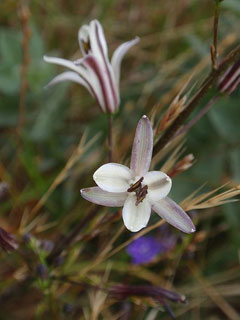
 |
|
http://www.flickr.com/photos/tomhilton/ |
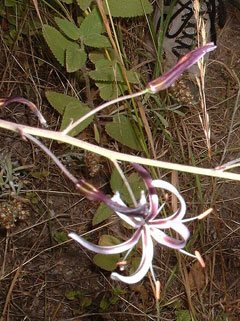 |
| http://en.wikipedia.org/wiki/User:Seglea |
Translate this page:
Summary
Physical Characteristics

 Chlorogalum pomeridianum is a BULB growing to 2 m (6ft) by 0.3 m (1ft in).
See above for USDA hardiness. It is hardy to UK zone 8 and is not frost tender. It is in flower from May to June. The species is hermaphrodite (has both male and female organs).
Suitable for: light (sandy), medium (loamy) and heavy (clay) soils and prefers well-drained soil. Suitable pH: mildly acid, neutral and basic (mildly alkaline) soils. It can grow in semi-shade (light woodland) or no shade. It prefers moist soil.
UK Hardiness Map
US Hardiness Map
Synonyms
Loathoe pomeridiana.
Plant Habitats
Cultivated Beds; East Wall. By. South Wall. By. West Wall. By.
Edible Uses
Edible Parts: Leaves Root
Edible Uses:
Bulb - cooked[2, 71, 94, 105]. A slow baking in its skin will remove any soapiness in the taste[92]. The bulb should be peeled before being eaten since the skin is fibrous[183]. The bulb can also be peeled and then boiled, though the water it is cooked in should be thrown away[94]. Although wholesome and nutritious when thoroughly cooked, the raw bulb should not be eaten because it contains saponins[K]. The bulb is very large and can be up to 15cm in diameter[200]. Young leaves - raw or cooked[105]. Used as a potherb when harvested in the spring, they are very sweet when slowly baked[92, 183, 257].
References More on Edible Uses
Medicinal Uses
Plants For A Future can not take any responsibility for any adverse effects from the use of plants. Always seek advice from a professional before using a plant medicinally.
Antidandruff Antirheumatic Antiseptic Diuretic Laxative Poultice Skin
Soap lily bulbs contain saponins, a medicinally active ingredient that is of particular value as an antiseptic wash. Saponins are somewhat toxic (see the notes above on toxicity) and so any internal use of this plant should be carried out with great care[K]. The bulb is antiseptic, carminative, diuretic and laxative[94, 257]. A decoction has been used to treat wind in the stomach[257]. Externally, the bulbs have been rubbed on rheumatic joints[257]. The pounded bulbs were mixed with water and used as a hair wash in the treatment of dandruff, to prevent lice and also to treat skin irritations including that caused by poison oak[213, 257]. A poultice of the baked bulbs has been used as an antiseptic on skin sores[257].
References More on Medicinal Uses
The Bookshop: Edible Plant Books
Our Latest books on Perennial Plants For Food Forests and Permaculture Gardens in paperback or digital formats.

Edible Tropical Plants
Food Forest Plants for Hotter Conditions: 250+ Plants For Tropical Food Forests & Permaculture Gardens.
More

Edible Temperate Plants
Plants for Your Food Forest: 500 Plants for Temperate Food Forests & Permaculture Gardens.
More

More Books
PFAF have eight books available in paperback and digital formats. Browse the shop for more information.
Shop Now
Other Uses
Adhesive Fibre Soap
A glue can be made from the sap that is expressed from baking bulbs[92, 94, 257]. The bulbs can be boiled into a liquid starch which can then be used to twined baskets to close the interstices so that seeds do not fall through[257]. A soap is obtained from the bulb[21, 46, 61, 169]. The bulb is stripped of its outer fibrous covering and rubbed on clothes or hands in water to produce a lather[92, 95]. It is very good for delicate fabrics and has a gentle affect upon the skin[92, K]. The bulb can also be dried for later use, it can then be grated as required and used as soap flakes[92]. A fibre obtained from the outer covering of the bulb is used to make small brushes or as a filling for mattresses etc[92, 94, 169, 257].
Special Uses
References More on Other Uses
Cultivation details
Succeeds in any reasonably good well-drained soil[1, 42]. Prefers a rich well-drained moisture retentive soil[164]. Tolerates partial shade[164]. Dislikes dry soils according to one report[200] but plants grow in dry soils in the wild[71]. Plants are frost hardy but they come into new growth in the autumn and so need to be grown in a warm sheltered position, especially in colder areas of the country[188]. The bulbs can be damaged by heavy frosts[169]. The roots are brittle so any transplanting should be done with care[169].
References Carbon Farming Information and Carbon Sequestration Information
Temperature Converter
Type a value in the Celsius field to convert the value to Fahrenheit:
Fahrenheit:
The PFAF Bookshop
Plants For A Future have a number of books available in paperback and digital form. Book titles include Edible Plants, Edible Perennials, Edible Trees,Edible Shrubs, Woodland Gardening, and Temperate Food Forest Plants. Our new book is Food Forest Plants For Hotter Conditions (Tropical and Sub-Tropical).
Shop Now
Plant Propagation
Seed - sow spring or summer 2mm deep in a peat/sand mix. Germination usually takes place within 1 - 6 months at 15°c, but it can be slow and erratic. Sow the seed thinly so that the seedlings do not need to be thinned and grow them on in the pot for their first year of growth, giving an occasional liquid feed o ensure that they do not become mineral deficient. When dormant, pot up 3 young bulbs per pot and grow them on for at least another 2 years before planting them out into their permanent positions in the spring[164]. Division of offsets when the bulb dies down in late summer. Larger offsets can be planted out direct into their permanent positions but it is best to pot up the smaller bulbs and grow them on for at least a year in the greenhouse.
Other Names
If available other names are mentioned here
Native Plant Search
Search over 900 plants ideal for food forests and permaculture gardens. Filter to search native plants to your area. The plants selected are the plants in our book 'Plants For Your Food Forest: 500 Plants for Temperate Food Forests and Permaculture Gardens, as well as plants chosen for our forthcoming related books for Tropical/Hot Wet Climates and Mediterranean/Hot Dry Climates. Native Plant Search
Found In
Countries where the plant has been found are listed here if the information is available
Weed Potential
Right plant wrong place. We are currently updating this section.
Please note that a plant may be invasive in one area but may not in your area so it’s worth checking.
See reader comment later
Conservation Status
IUCN Red List of Threatened Plants Status :

Growth: S = slow M = medium F = fast. Soil: L = light (sandy) M = medium H = heavy (clay). pH: A = acid N = neutral B = basic (alkaline). Shade: F = full shade S = semi-shade N = no shade. Moisture: D = dry M = Moist We = wet Wa = water.

Expert comment
Author
(DC.)Kunth.
Botanical References
71200
Links / References
For a list of references used on this page please go here
Readers comment