 |
|
|
 |
| http://www.flickr.com/photos/60364452@N00 |
Translate this page:
Summary
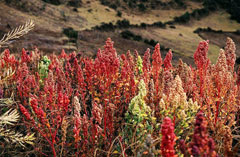
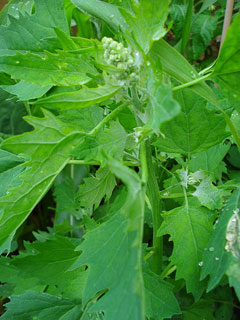
Quinoa or Chenopodium quinoa, also known as Goosefoot, Pigweed, or Inca wheat, is an erect annual plant of up to 3 m in height that is widely cultivated in Chile and Peru as a grain crop. It is drought resistant when fully established. The taproot is branched. The leaves are toothed, grey-green in colour, and vary in shape. The small flowers are arranged in clusters at the top of the plant. The seeds are cooked but have to be soaked and rinsed first to remove a coating of saponins on the surface. It is used for soups and stews. It can also be powdered for porridge, or sprouted and used in salads. The leaves are cooked or consumed raw as well. Young leaves are cooked like spinach. Further, the whole plant yields gold or green dye.
Physical Characteristics

 Chenopodium quinoa is a ANNUAL growing to 1.5 m (5ft) by 0.3 m (1ft in) at a fast rate.
See above for USDA hardiness. It is hardy to UK zone 10 and is not frost tender. It is in flower from July to August, and the seeds ripen from August to September. The species is hermaphrodite (has both male and female organs) and is pollinated by Wind. The plant is self-fertile.
Suitable for: light (sandy), medium (loamy) and heavy (clay) soils, prefers well-drained soil and can grow in nutritionally poor soil. Suitable pH: mildly acid, neutral and basic (mildly alkaline) soils and can grow in very acid, very alkaline and saline soils.
It cannot grow in the shade. It prefers moist soil and can tolerate drought. The plant can tolerates strong winds but not maritime exposure.
UK Hardiness Map
US Hardiness Map
Synonyms
Chenopodium album leucospermum (Schrad.) Kuntze Chenopodium canihua Cook Chenopodium hircinum millea
Plant Habitats
Cultivated Beds;
Edible Uses
Edible Parts: Leaves Seed
Edible Uses:
Edible portion: Leaves, Seeds, Vegetable. Seed - cooked[ 1 , 2 , 4 , 27 , 57 , 97 ]. A pleasant mild flavour, the seed can absorb the flavour of other foods that are cooked with it and so it can be used in a wide variety of ways[ K ]. The protein is good quality because of its amino acid balance. It has 2-6% more protein and better amino acid balance than wheat. It should be thoroughly soaked and rinsed to remove a coating of saponins on the seed surface. The seed can be used in all the ways that rice is used, as a savoury or sweet dish. It can also be ground into a powder and used as a porridge[ 37 , 183 ]. The seed can also be sprouted and used in salads[ 183 ] though many people find the sprouted seed unpleasant[ K ]. The seed contains a very high quality protein that is rich in the amino acids lysine, methionine and cystine, it has the same biological value as milk[ 196 ]. The seed contains about 38% carbohydrate, 19% protein, 5% fat, 5% sugar[ 171 ]. Leaves - raw or cooked[ 2 , 4 , 37 , 57 ]. The young leaves are cooked like spinach[ 183 ]. It is best not to eat large quantities of the raw leaves, see the notes above on toxicity.
References More on Edible Uses
Medicinal Uses
Plants For A Future can not take any responsibility for any adverse effects from the use of plants. Always seek advice from a professional before using a plant medicinally.
None known
References More on Medicinal Uses
The Bookshop: Edible Plant Books
Our Latest books on Perennial Plants For Food Forests and Permaculture Gardens in paperback or digital formats.
Edible Tropical Plants
Food Forest Plants for Hotter Conditions: 250+ Plants For Tropical Food Forests & Permaculture Gardens.
More
Edible Temperate Plants
Plants for Your Food Forest: 500 Plants for Temperate Food Forests & Permaculture Gardens.
More
More Books
PFAF have eight books available in paperback and digital formats. Browse the shop for more information.
Shop Now
Other Uses
Dye Repellent Soap
Other uses rating: Low (2/5). Other Uses: Gold/green dyes can be obtained from the whole plant[ 168 ]. Saponins on the seed can be used as a bird and insect deterrent by spraying them on growing plants[ 141 ]. The saponins are obtained by saving the soak-water used when preparing the seed for eating. The spray remains effective for a few weeks or until washed off by rain[ K ].
Special Uses
Food Forest
References More on Other Uses
Cultivation details
a cultivated food crop. A plant of higher elevations in the tropics, it has also been successfully grown in the temperate and subtropical zones. Plants tolerate light frosts at any stage in their development except when flowering[ 57 , 196 ]. An easily grown plant, it requires a rich moist well-drained soil and a warm position if it is to do really well, but it also succeeds in less than optimum conditions[ 27 , 37 ]. Tolerates a pH range from 6 to 8.5 and moderate soil salinity[ 196 ]. Plants are quite wind resistant[ K ]. Plants are drought tolerant once they are established[ 196 ]. The plant is day-length sensitive and many varieties fail to flower properly away from equatorial regions, however those varieties coming from the south of its range in Chile are more likely to do well in Britain[ 196 ]. Different cultivars take from 90 - 220 days from seed sowing to harvest[ 196 ]. Yields as high as 5 tonnes per hectare have been recorded in the Andes, which compares favourably with wheat in that area[ 196 ]. Young plants look remarkably like the common garden weed fat hen (Chenopodium album). Be careful not to weed the seedlings out in error[ K ]. The seed is not attacked by birds because it has a coating of bitter tasting saponins[ 141 , K ]. These saponins are very easily removed by soaking the seed overnight and then thoroughly rinsing it until there is no sign of any soapiness in the water. The seed itself is very easy to harvest by hand on a small scale and is usually ripe in August. Cut down the plants when the first ripe seeds are falling easily from the flower head, lay out the stems on a sheet in a warm dry position for a few days and then simply beat the stems against a wall or some other surface, the seed will fall out easily if it is fully ripe and then merely requires winnowing to get rid of the chaff.
References Carbon Farming Information and Carbon Sequestration Information
Temperature Converter
Type a value in the Celsius field to convert the value to Fahrenheit:
Fahrenheit:
The PFAF Bookshop
Plants For A Future have a number of books available in paperback and digital form. Book titles include Edible Plants, Edible Perennials, Edible Trees,Edible Shrubs, Woodland Gardening, and Temperate Food Forest Plants. Our new book is Food Forest Plants For Hotter Conditions (Tropical and Sub-Tropical).
Shop Now
Plant Propagation
Seed - sow April in situ. The seed can either be sown broadcast or in rows about 25cm apart, thinning the plants to about every 10cm. Germination is rapid, even in fairly dry conditions. Be careful not to weed out the seedlings because they look very similar to some common garden weeds[ K ].
Other Names
If available other names are mentioned here
Suba, Quinua, Kiuna, Inca rice, Petty rice, Inca wheat, Huauzontle.
Native Plant Search
Search over 900 plants ideal for food forests and permaculture gardens. Filter to search native plants to your area. The plants selected are the plants in our book 'Plants For Your Food Forest: 500 Plants for Temperate Food Forests and Permaculture Gardens, as well as plants chosen for our forthcoming related books for Tropical/Hot Wet Climates and Mediterranean/Hot Dry Climates. Native Plant Search
Found In
Countries where the plant has been found are listed here if the information is available
Found In: Andes, Argentina, Australia, Bolivia, Canada, Central America, Chile, Colombia, Ecuador, France, Iran, Mexico, North America, Peru, South America, Tasmania, USA.
Weed Potential
Right plant wrong place. We are currently updating this section.
Please note that a plant may be invasive in one area but may not in your area so it’s worth checking.
May be a noxious weed or invasive in the wrong place.
Conservation Status
IUCN Red List of Threatened Plants Status : This taxon has not yet been assessed.

| Related Plants
|
| Latin Name | Common Name | Habit | Height | Hardiness | Growth | Soil | Shade | Moisture | Edible | Medicinal | Other |
| Chenopodium acuminatum | | Annual | 0.6 |
-
| | LMH | N | M | 2 | 0 | 1 |
| Chenopodium album | Fat Hen, Lambsquarters | Annual | 0.9 |
0-0
| | LMH | N | M | 3 | 2 | 1 |
| Chenopodium ambrosioides | Mexican Tea | Annual/Perennial | 1.0 |
7-10
| | LMH | N | M | 2 | 3 | 3 |
| Chenopodium ambrosioides anthelminticum | Wormseed | Annual/Perennial | 1.0 |
7-10
| | LMH | N | M | 2 | 3 | 2 |
| Chenopodium auricomum | Queensland Bluebush | Annual | 1.8 |
-
| | LMH | N | M | 2 | 0 | 1 |
| Chenopodium berlandieri | Southern Huauzontle, Pitseed goosefoot, Nuttall's goosefoot, Bush's goosefoot, Zschack's goosefoot | Annual | 1.2 |
0-0
| | LMH | N | M | 2 | 0 | 1 |
| Chenopodium bonus-henricus | Good King Henry | Perennial | 0.3 |
4-8
| | LMH | N | M | 4 | 2 | 1 |
| Chenopodium botrys | Jerusalem Oak, Jerusalem oak goosefoot | Annual | 0.6 |
0-0
| | LMH | N | M | 2 | 2 | 2 |
| Chenopodium bushianum | Bush's goosefoot | Annual | 0.6 |
0-0
| | LMH | N | M | 2 | 0 | 1 |
| Chenopodium californicum | California Goosefoot | Annual | 0.6 |
-
| | LMH | N | DM | 2 | 1 | 2 |
| Chenopodium canihua | | Annual | 0.0 |
-
| | LMH | N | M | 2 | 0 | 1 |
| Chenopodium capitatum | Strawberry Blite, Blite goosefoot | Annual | 0.6 |
4-8
| | LMH | N | M | 3 | 1 | 1 |
| Chenopodium cristatum | Crested Goosefoot | Annual | 0.6 |
-
| | LMH | N | M | 2 | 1 | 1 |
| Chenopodium ficifolium | Fig-Leaved Goosefoot | Annual | 0.9 |
4-8
| | LMH | N | M | 2 | 0 | 1 |
| Chenopodium foliosum | Leafy goosefoot | Annual | 0.6 |
4-8
| | LMH | N | M | 3 | 0 | 1 |
| Chenopodium fremontii | Goosefoot, Fremont's goosefoot, Pringle's goosefoot | Annual | 0.6 |
0-0
| | LMH | N | M | 2 | 0 | 1 |
| Chenopodium giganteum | Tree Spinach | Annual | 2.4 |
4-8
| | LMH | N | M | 3 | 0 | 2 |
| Chenopodium glaucum | Oak-Leaved Goosefoot | Annual | 0.3 |
-
| | LMH | N | M | 2 | 0 | 1 |
| Chenopodium graveolens | Foetid Goosefoot | Annual | 0.9 |
-
| | LMH | N | M | 2 | 1 | 1 |
| Chenopodium hybridum | | Annual | 1.5 |
-
| | LMH | N | M | 2 | 1 | 1 |
| Chenopodium incanum | Mealy Goosefoot | Annual | 0.5 |
-
| | LMH | N | M | 2 | 0 | 1 |
| Chenopodium leptophyllum | Narrow Leaved Goosefoot | Annual | 0.6 |
0-0
| | LMH | N | M | 2 | 0 | 1 |
| Chenopodium murale | Nettleleaf Goosefoot | Annual | 0.6 |
0-0
| | LMH | N | M | 2 | 0 | 1 |
| Chenopodium nuttalliae | Huauzontle, Nuttall's goosefoot | Annual | 0.6 |
0-0
| | LMH | N | M | 4 | 0 | 1 |
| Chenopodium opulifolium | Seaport goosefoot | Annual | 0.8 |
0-0
| | LMH | SN | M | 2 | 0 | 1 |
| Chenopodium overi | Over's goosefoot | Annual | 0.8 |
0-0
| | LMH | N | M | 2 | 0 | 1 |
| Chenopodium pallidicaule | Cañihua | Annual | 0.6 |
-
| | LMH | N | DM | 3 | 0 | 1 |
| Chenopodium polyspermum | All-Seed, Manyseed goosefoot | Annual | 0.9 |
0-0
| | LMH | N | M | 2 | 0 | 1 |
| Chenopodium pratericola | Desert Goosefoot | Annual | 1.0 |
-
| | LMH | N | M | 2 | 0 | 1 |
|
|
Growth: S = slow M = medium F = fast. Soil: L = light (sandy) M = medium H = heavy (clay). pH: A = acid N = neutral B = basic (alkaline). Shade: F = full shade S = semi-shade N = no shade. Moisture: D = dry M = Moist We = wet Wa = water.

Expert comment
Author
Willd.
Botanical References
200
Links / References
For a list of references used on this page please go here
Readers comment