 |
|
http://commons.wikimedia.org/wiki/File:Koeh-032.jpg |
 |
| http://commons.wikimedia.org/wiki/User:Tigerente |
Translate this page:
Summary
Physical Characteristics

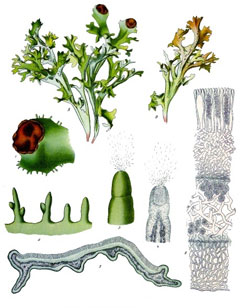
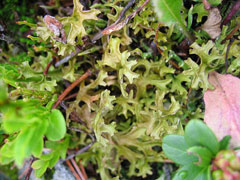
 Cetraria islandica is a LICHEN growing to 0.1 m (0ft 4in) by 0.5 m (1ft 8in) at a slow rate.
See above for USDA hardiness. It is hardy to UK zone 2.
Suitable for: light (sandy), medium (loamy) and heavy (clay) soils. Suitable pH: mildly acid, neutral and basic (mildly alkaline) soils. It can grow in semi-shade (light woodland) or no shade. It prefers moist soil.
UK Hardiness Map
US Hardiness Map
Synonyms
Plant Habitats
Woodland Garden Sunny Edge; Dappled Shade; Shady Edge;
Edible Uses
Edible Parts: Leaves
Edible Uses:
A jelly is made by boiling the whole plant. It is nutritious and medicinal[5, 55, 61]. Rather bitter, it requires leaching, which can be done by changing the cooking water once or twice during the cooking process[172]. The dried and powdered plant can be mixed with wheat and used in making bread[2, 46, 61]. It is very bitter and the process required to leach it is far too time-consuming and tedious to be countenanced[9].
References More on Edible Uses
Medicinal Uses
Plants For A Future can not take any responsibility for any adverse effects from the use of plants. Always seek advice from a professional before using a plant medicinally.
Antibiotic Antiemetic Appetizer Demulcent Disinfectant Dysentery Galactogogue Nutritive
Tonic
Iceland moss has been used since ancient times as a cough remedy and has also been used in European folk medicine as a cancer treatment[254]. In present day herbalism it is highly prized for its strongly antibiotic and demulcent actions, being used especially to soothe the mucous membranes of the chest, to counter catarrh and calm dry and paroxysmal coughs - it is particularly helpful as a treatment for elderly people[254]. Iceland moss has both a demulcent and a bitter tonic effect within the gut - a combination almost unique amongst medicinal herbs[254]. The whole plant is strongly antibiotic, antiemetic, strongly demulcent, galactogogue, nutritive and tonic[4, 7, 9, 21, 46, 61, 165, 238, 254]. It is excellent when used internally in the treatment of chronic pulmonary problems, catarrh, dysentery, chronic digestive disturbances (including irritable bowel syndrome and food poisoning) and advanced tuberculosis[4, 254]. Externally, it is used in the treatment of boils, vaginal discharges and impetigo[238]. The plant can be harvested as required throughout the year[7], preferably during dry weather, and can also be dried for later use[9]. Use with caution[21]. The German Commission E Monographs, a therapeutic guide to herbal medicine, approve Cetraria islandica for cough & bronchitis, dyspepsia, inflammation of mouth and pharynx, loss of appetite (see [302] for critics of commission E).
References More on Medicinal Uses
The Bookshop: Edible Plant Books
Our Latest books on Perennial Plants For Food Forests and Permaculture Gardens in paperback or digital formats.

Edible Tropical Plants
Food Forest Plants for Hotter Conditions: 250+ Plants For Tropical Food Forests & Permaculture Gardens.
More

Edible Temperate Plants
Plants for Your Food Forest: 500 Plants for Temperate Food Forests & Permaculture Gardens.
More

More Books
PFAF have eight books available in paperback and digital formats. Browse the shop for more information.
Shop Now
Other Uses
Disinfectant Dye
A powerful antibiotic can be obtained from the plant and this has become a fundamental ingredient in a wide range of commercially produced disinfectants[7]. A brown dye is obtained from the plant[46, 61].
Special Uses
References More on Other Uses
Cultivation details
There is no known information on the cultivation of this plant[238]. It requires clean air and is very intolerant of atmospheric pollution so cannot be grown in towns[238]. See the plants native habitat above for ideas on how it can be encouraged to grow[K]. This species is a lichen, which is actually a symbiotic association of two different species, one an algae and the other a fungus. It is very slow-growing[9]. This plant is often used in commercially produced disinfectants[7].
References Carbon Farming Information and Carbon Sequestration Information
Temperature Converter
Type a value in the Celsius field to convert the value to Fahrenheit:
Fahrenheit:
The PFAF Bookshop
Plants For A Future have a number of books available in paperback and digital form. Book titles include Edible Plants, Edible Perennials, Edible Trees,Edible Shrubs, Woodland Gardening, and Temperate Food Forest Plants. Our new book is Food Forest Plants For Hotter Conditions (Tropical and Sub-Tropical).
Shop Now
Plant Propagation
The only way of reproducing this plant is vegetatively. Almost any part of the plant can be used to produce a new plant, simply separate a portion and place it in its new home.
Other Names
If available other names are mentioned here
Native Plant Search
Search over 900 plants ideal for food forests and permaculture gardens. Filter to search native plants to your area. The plants selected are the plants in our book 'Plants For Your Food Forest: 500 Plants for Temperate Food Forests and Permaculture Gardens, as well as plants chosen for our forthcoming related books for Tropical/Hot Wet Climates and Mediterranean/Hot Dry Climates. Native Plant Search
Found In
Countries where the plant has been found are listed here if the information is available
Weed Potential
Right plant wrong place. We are currently updating this section.
Please note that a plant may be invasive in one area but may not in your area so it’s worth checking.
Conservation Status
IUCN Red List of Threatened Plants Status :

Growth: S = slow M = medium F = fast. Soil: L = light (sandy) M = medium H = heavy (clay). pH: A = acid N = neutral B = basic (alkaline). Shade: F = full shade S = semi-shade N = no shade. Moisture: D = dry M = Moist We = wet Wa = water.

Expert comment
Author
L.
Botanical References
7
Links / References
For a list of references used on this page please go here
Readers comment
| Add a comment |
|
If you have important information about this plant that may help other users please add a comment or link below. Only comments or links that are felt to be directly relevant to a plant will be included. If you think a comment/link or information contained on this page is inaccurate or misleading we would welcome your feedback at [email protected]. If you have questions about a plant please use the Forum on this website as we do not have the resources to answer questions ourselves.
* Please note: the comments by website users are not necessarily those held by PFAF and may give misleading or inaccurate information.
To leave a comment please Register or login here All comments need to be approved so will not appear immediately.
|
Subject : Cetraria islandica
|
|
|
|