 |
|
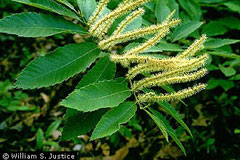
William S. Justice @ USDA-NRCS PLANTS Database |
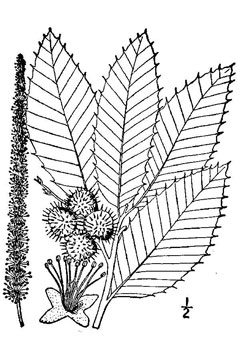 |
| USDA-NRCS PLANTS Database / Britton, N.L., and A. Brown. 1913. An illustrated flora of the northern United States, Canada and the British Possessions. Vol. 1: 616. |
Translate this page:
Summary
Physical Characteristics

 Castanea pumila is a deciduous Shrub growing to 4 m (13ft 1in) at a slow rate.
See above for USDA hardiness. It is hardy to UK zone 5 and is not frost tender. It is in flower in July, and the seeds ripen in October. The species is monoecious (individual flowers are either male or female, but both sexes can be found on the same plant) and is pollinated by Insects.
Suitable for: light (sandy), medium (loamy) and heavy (clay) soils, prefers well-drained soil and can grow in nutritionally poor soil. Suitable pH: mildly acid and neutral soils and can grow in very acid soils.
It cannot grow in the shade. It prefers dry or moist soil and can tolerate drought.
UK Hardiness Map
US Hardiness Map
Synonyms
Fagus pumila.
Plant Habitats
Woodland Garden Secondary; Sunny Edge; Dappled Shade;
Edible Uses
Edible Parts: Seed
Edible Uses:
Seed - raw or cooked[2, 61, 105]. Sweet with a nice nutty flavour[46, 82, 183], it is very acceptable raw and has a superior flavour to sweet chestnuts (C. sativa)[142, 161, K]. When baked it becomes even sweeter and develops a floury texture, it makes an excellent potato or cereal substitute[K].The seed is quite small, about 2cm thich[270], which is about half the size of C. dentata[183]. It is sold in local markets in America[82]. The seed husks only contain one (rarely two) seed[235]. The seed contains 45% starch and 2.5% protein[213].
References More on Edible Uses
Medicinal Uses
Plants For A Future can not take any responsibility for any adverse effects from the use of plants. Always seek advice from a professional before using a plant medicinally.
Antiperiodic Astringent Tonic
The leaves contain tannin and are antiperiodic, astringent and tonic[46 , 61 , 213 ]. The brittle leaves (?dried leaves) were heated and blown onto the patient to treat headaches[257 ]. An infusion of the leaves has been used as an external wash to treat fevers, chills and cold sweats[213 , 257 ].
References More on Medicinal Uses
The Bookshop: Edible Plant Books
Our Latest books on Perennial Plants For Food Forests and Permaculture Gardens in paperback or digital formats.
Edible Tropical Plants
Food Forest Plants for Hotter Conditions: 250+ Plants For Tropical Food Forests & Permaculture Gardens.
More
Edible Temperate Plants
Plants for Your Food Forest: 500 Plants for Temperate Food Forests & Permaculture Gardens.
More
More Books
PFAF have eight books available in paperback and digital formats. Browse the shop for more information.
Shop Now
Other Uses
Tannin Wood
Agroforestry Uses: The plant (particularly the cultivar 'Golden') has good potential for use in the revegetation of disturbed sites, particularly because of its wildlife value and adaptability to harsh conditions. It is likely that many planners hesitate to use it because of the threat of chestnut blight infection.[1050 ]. With its rhizomatous root system, the plant can be used in programmes to control soil erosion[317 ]. This species is an excellent soil-enriching understorey in pine forests[200 ], growing and fruiting well so long as the canopy of pines is fairly light[K ].
Other Uses: The bark, leaves, wood and seed husks all contain tannin. Wood - coarse-grained, hard, strong, light, durable, easy to split. It weighs 37lb per cubic foot. Too small for commercial use, but it is occasionally used for fence posts, fuel etc[46, 61, 227, 229].
Special Uses
Food Forest
References More on Other Uses
Cultivation details
Prefers a good well-drained slightly acid loam but succeeds in dry soils[1, 11, 200]. Once established, it is very drought tolerant[1, 11, 200]. Very tolerant of highly acid, infertile dry sands[200]. Averse to calcareous soils but succeeds on harder limestones[11, 200]. This species is an excellent soil-enriching understorey in pine forests[200], growing and fruiting well so long as the canopy of pines is fairly light. Although it is very winter-hardy, this species only really thrives in areas with hot summers[200]. The young growth in spring, even on mature plants, is frost-tender and so it is best to grow the plants in a position sheltered from the early morning sun[K]. Plants can spread widely by means of underground suckers[11]. Flowers are produced on wood of the current year's growth[229]. Plants are fairly self-sterile[200]. They hybridize freely with other members of this genus[200]. Fruits are produced in 2 - 3 years from seed[117]. One report says that plants never fruit in Britain[11], but a 2 metre tall plant at Wisley fruits most years[K]. Trees on our Cornish trial grounds produced a few female flowers when 1 metre tall and 4 years old[K]. This species is occasionally cultivated for its edible seed in N. America, there are some named varieties[183]. The plants produce seeds abundantly in the wild[183]. The sub-species C. pumila ashei. Sudw. (Zone 7) is a coastal form, found from Virginia to Texas[200]. Plants in this genus are notably resistant to honey fungus[200]. The plant is heat tolerant in zones 9 through 5. (Plant Hardiness Zones show how well plants withstand cold winter temperatures.
Plant Heat Zones show when plants would start suffering from the heat.
The Plant Heat Zone map is based on the number of "heat days" experienced in a given area where the temperature climbs to over 86 degrees F (30°C).
At this temperature, many plants begin to suffer physiological damage. Heat Zones range from 1 (no heat days) to 12 (210 or more heat days).
For example Heat Zone. 11-1 indicates that the plant is heat tolerant in zones 11 through 1.) For polyculture design as well as the above-ground architecture (form - tree, shrub etc. and size shown above) information on the habit and root pattern is also useful and given here if available. The plant growth habit is multistemmed with multiple stems from the crown [1-2]. The root pattern is flat with shallow roots forming a plate near the soil surface [1-2]. The root pattern is a heart root, dividing from the crown into several primary roots going down and out [1-2]. The root pattern is suckering with new plants from underground runners away from the plant [1-2].
References Carbon Farming Information and Carbon Sequestration Information
Temperature Converter
Type a value in the Celsius field to convert the value to Fahrenheit:
Fahrenheit:
The PFAF Bookshop
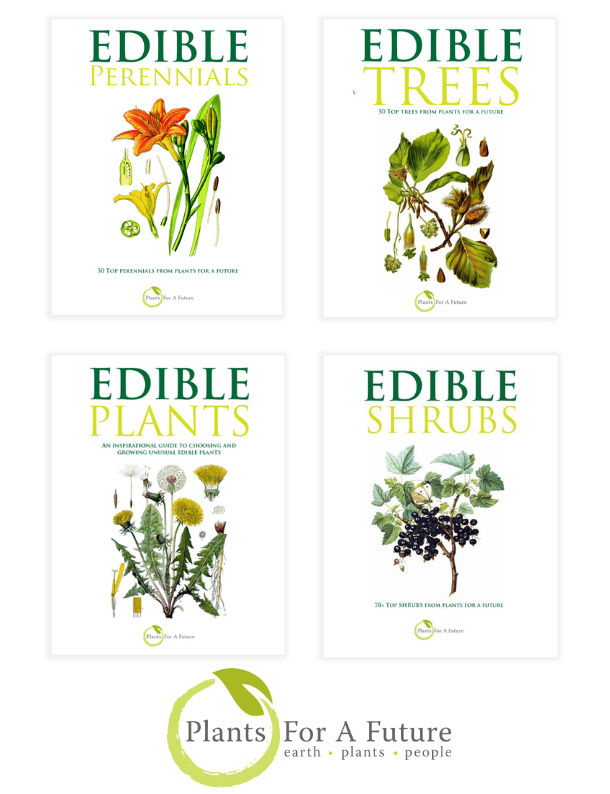
Plants For A Future have a number of books available in paperback and digital form. Book titles include Edible Plants, Edible Perennials, Edible Trees,Edible Shrubs, Woodland Gardening, and Temperate Food Forest Plants. Our new book is Food Forest Plants For Hotter Conditions (Tropical and Sub-Tropical).
Shop Now
Plant Propagation
Seed - where possible sow the seed as soon as it is ripe in a cold frame or in a seed bed outdoors[78]. The seed must be protected from mice and squirrels. The seed has a short viability and must not be allowed to become dry. It can be stored in a cool place, such as the salad compartment of a fridge, for a few months if it is kept moist, but check regularly for signs of germination. The seed should germinate in late winter or early spring. If sown in an outdoor seedbed, the plants can be left in situ for 1 - 2 years before planting them out in their permanent positions. If grown in pots, the plants can be put out into their permanent positions in the summer or autumn, making sure to give them some protection from the cold in their first winter[K]. Division of suckers in winter[200]. They can be planted straight out into their permanent positions.
Other Names
If available other names are mentioned here
Allegheny chinquapin, American chinquapin (from the Powhatan) or dwarf chestnut.
Native Plant Search
Search over 900 plants ideal for food forests and permaculture gardens. Filter to search native plants to your area. The plants selected are the plants in our book 'Plants For Your Food Forest: 500 Plants for Temperate Food Forests and Permaculture Gardens, as well as plants chosen for our forthcoming related books for Tropical/Hot Wet Climates and Mediterranean/Hot Dry Climates. Native Plant Search
Found In
Countries where the plant has been found are listed here if the information is available
Australia, North America, Ukraine, USA*. Native to the southeastern United States. The native range is from Maryland and extreme southern New Jersey and southeast Pennsylvania south to central Florida, west to eastern Texas, and north to southern Missouri and Kentucky.
Weed Potential
Right plant wrong place. We are currently updating this section.
Please note that a plant may be invasive in one area but may not in your area so it’s worth checking.
None known
Conservation Status
IUCN Red List of Threatened Plants Status : Not listed

Growth: S = slow M = medium F = fast. Soil: L = light (sandy) M = medium H = heavy (clay). pH: A = acid N = neutral B = basic (alkaline). Shade: F = full shade S = semi-shade N = no shade. Moisture: D = dry M = Moist We = wet Wa = water.

Expert comment
Author
(L.)Mill.
Botanical References
1143200
Links / References
For a list of references used on this page please go here
Readers comment
| Add a comment |
|
If you have important information about this plant that may help other users please add a comment or link below. Only comments or links that are felt to be directly relevant to a plant will be included. If you think a comment/link or information contained on this page is inaccurate or misleading we would welcome your feedback at [email protected]. If you have questions about a plant please use the Forum on this website as we do not have the resources to answer questions ourselves.
* Please note: the comments by website users are not necessarily those held by PFAF and may give misleading or inaccurate information.
To leave a comment please Register or login here All comments need to be approved so will not appear immediately.
|
Subject : Castanea pumila
|
|
|
|