 |
|
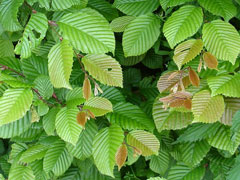
http://commons.wikimedia.org/wiki/File:Carpinus_betulus_Sturm33.jpg |
 |
| http://www.geograph.org.uk/profile/93 |
Translate this page:
Summary
Bloom Color: White.
Main Bloom Time: Early spring, Late spring, Mid spring. Form: Oval, Vase.
Physical Characteristics

 Carpinus betulus is a deciduous Tree growing to 25 m (82ft) by 20 m (65ft) at a medium rate.
See above for USDA hardiness. It is hardy to UK zone 5 and is not frost tender. It is in flower from April to May, and the seeds ripen in November. The species is monoecious (individual flowers are either male or female, but both sexes can be found on the same plant) and is pollinated by Wind.
It is noted for attracting wildlife.
Suitable for: light (sandy), medium (loamy) and heavy (clay) soils and can grow in heavy clay soil. Suitable pH: mildly acid, neutral and basic (mildly alkaline) soils and can grow in very alkaline soils.
It can grow in full shade (deep woodland) semi-shade (light woodland) or no shade. It prefers moist soil.
UK Hardiness Map
US Hardiness Map
Synonyms
Plant Habitats
Woodland Garden Canopy; not Deep Shade; Hedge;
Edible Uses
References More on Edible Uses
Medicinal Uses
Plants For A Future can not take any responsibility for any adverse effects from the use of plants. Always seek advice from a professional before using a plant medicinally.
Bach Haemostatic Ophthalmic
The leaves are haemostatic[7]. They are used in external compresses to stop bleeding and heal wounds[7]. A distilled water made from the leaves is an effective eye lotion[7]. The leaves are harvested in August and dried for later use[7]. The plant is used in Bach flower remedies - the keywords for prescribing it are 'Tiredness', 'Weariness' and 'Mental and physical exhaustion'[209].
References More on Medicinal Uses
Now available: PLANTS FOR YOUR FOOD FOREST: 500 Plants for Temperate Food Forests and Permaculture Gardens.
An important new book from PFAF. It focuses on the attributes of plants suitable for food forests, what each can contribute to a food forest ecosystem, including carbon sequestration, and the kinds of foods they yield. The book suggests that community and small-scale food forests can provide a real alternative to intensive industrialised agriculture, and help to combat the many inter-related environmental crises that threaten the very future of life on Earth.
Read More
Other Uses
Dye Fuel Hedge Hedge Wood
Plants can be grown as a medium to tall hedge, they retain their dead leaves throughout the winter if clipped at least once a year in late summer[11, 29, 186]. They should not be clipped in spring since they will bleed profusely[200]. A yellow dye is obtained from the bark[115]. Wood - heavy, close grained, hard, very tough, very durable, not very durable according to another report. Used for flooring, cogs, tools, piano mechanisms etc[1, 11, 13, 46, 115]. A good fuel[6].
Special Uses
Attracts Wildlife Espalier Hedge Hedge
References More on Other Uses
Cultivation details
Landscape Uses:Espalier, Pest tolerant, Hedge, Superior hedge, Specimen, Street tree. Thrives in any good loam, including chalk[1, 11], it does not demand much light[186]. Prefers a deep open loam[1] and does well on damp clays[186]. Succeeds in all but the most acid soils[186]. Dormant trees are very cold tolerant, the young growth is not usually damaged by late spring frosts[186]. The trees cast a deep shade[98, 186]. A very ornamental plant[1]. Trees are shallow-rooted[7]. The hornbeam has 28 species of associated insects[24]. Trees take 10 - 20 years from seed before they produce seed[98] and about 100 years to reach maturity[186]. At one time this tree was commonly pollarded or coppiced for its wood and for fuel[11, 13, 186]. Special Features:
Not North American native, Inconspicuous flowers or blooms.
References Carbon Farming Information and Carbon Sequestration Information
Temperature Converter
Type a value in the Celsius field to convert the value to Fahrenheit:
Fahrenheit:
The PFAF Bookshop
Plants For A Future have a number of books available in paperback and digital form. Book titles include Edible Plants, Edible Perennials, Edible Trees,Edible Shrubs, Woodland Gardening, and Temperate Food Forest Plants. Our new book is Food Forest Plants For Hotter Conditions (Tropical and Sub-Tropical).
Shop Now
Plant Propagation
Seed - best sown in an outdoors seedbed as soon as it is ripe[78]. Germination is usually good, though it may take 18 months[80]. If collected whilst still 'green' (after the seed is ripe but before it has dried fully on the plant) and sown immediately it should germinate in the following spring[80]. Grow the plants on for two years in the seedbed and then plant them out into their permanent positions in the winter. The average seed viability is around 65%[98]. Pre-treat stored seed with 4 weeks warm and 12 weeks cold stratification and sow in a cold frame[98]. When they are large enough to handle, prick the seedlings out into individual pots and grow them on in a cold frame until they are at least 15cm tall before planting them into their permanent positions.
Other Names
If available other names are mentioned here
Native Plant Search
Search over 900 plants ideal for food forests and permaculture gardens. Filter to search native plants to your area. The plants selected are the plants in our book 'Plants For Your Food Forest: 500 Plants for Temperate Food Forests and Permaculture Gardens, as well as plants chosen for our forthcoming related books for Tropical/Hot Wet Climates and Mediterranean/Hot Dry Climates. Native Plant Search
Found In
Countries where the plant has been found are listed here if the information is available
Weed Potential
Right plant wrong place. We are currently updating this section.
Please note that a plant may be invasive in one area but may not in your area so it’s worth checking.
Conservation Status
IUCN Red List of Threatened Plants Status :

Growth: S = slow M = medium F = fast. Soil: L = light (sandy) M = medium H = heavy (clay). pH: A = acid N = neutral B = basic (alkaline). Shade: F = full shade S = semi-shade N = no shade. Moisture: D = dry M = Moist We = wet Wa = water.

Expert comment
Author
L.
Botanical References
1117200
Links / References
For a list of references used on this page please go here
Readers comment