 |
|
http://commons.wikimedia.org/wiki/File:Canna_edulis.jpg |
 |
|
Translate this page:
Summary
Physical Characteristics

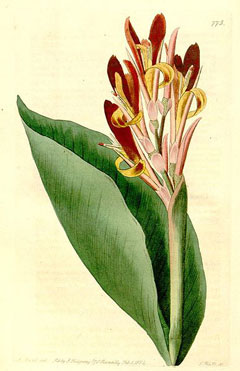
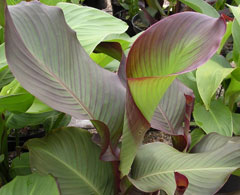
 Canna edulis is a PERENNIAL growing to 3 m (9ft) by 1 m (3ft 3in).
See above for USDA hardiness. It is hardy to UK zone 8 and is frost tender. It is in flower from August to October, and the seeds ripen in October. The species is hermaphrodite (has both male and female organs).
Suitable for: light (sandy), medium (loamy) and heavy (clay) soils and prefers well-drained soil. Suitable pH: mildly acid, neutral and basic (mildly alkaline) soils and can grow in very acid and very alkaline soils.
It cannot grow in the shade. It prefers moist soil. The plant can tolerates strong winds but not maritime exposure.
UK Hardiness Map
US Hardiness Map
Synonyms
C. achiras. C. esculenta.
Plant Habitats
Woodland Garden Sunny Edge; Cultivated Beds; South Wall. By. West Wall. By.
Edible Uses
Edible Parts: Leaves Root Seed Shoots
Edible Uses:
Root - raw or cooked[2, 22, 196]. It is the source of 'canna starch' which is used as an arrowroot[1, 46, 171, 183]. The arrowroot is obtained by rasping the root to a pulp, then washing and straining to get rid of the fibres[2]. This starch is very digestible[196]. The very young tubers can also be eaten cooked[61, 105, 142, 177], they are sweet but fibrousy[97, K]. The root can be very large, sometimes as long as a person's forearm[196]. In Peru the roots are baked for up to 12 hours by which time they become a white, translucent, fibrous and somewhat mucilaginous mass with a sweetish taste[183, 196]. The starch is in very large grains, about three times the size of potato starch grains, and can be seen with the naked eye[183, 196]. This starch is easily separated from the fibre of the root[196]. The roots contain about 25% starch[61]. The dry matter contains about 75 - 80% starch, 6 - 14% sugar, 1 - 3% protein, it is high in potassium, low in calcium and phosphorus[196]. Young shoots - cooked and eaten as a green vegetable[183, 196]. Quite nutritious, containing at least 10% protein[196]. The immature seeds are cooked in fat tortillas[183].
References More on Edible Uses
| Composition
|
| Figures in grams (g) or miligrams (mg) per 100g of food.
|
|
|
Leaves (Fresh weight)
|
|
- 0 Calories per 100g
- Water : 0%
- Protein: 10g; Fat: 0g; Carbohydrate: 0g; Fibre: 0g; Ash: 0g;
- Minerals - Calcium: 0mg; Phosphorus: 0mg; Iron: 0mg; Magnesium: 0mg; Sodium: 0mg; Potassium: 0mg; Zinc: 0mg;
- Vitamins - A: 0mg; Thiamine (B1): 0mg; Riboflavin (B2): 0mg; Niacin: 0mg; B6: 0mg; C: 0mg;
- Reference: [ ]
- Notes:
|
|
Medicinal Uses
Plants For A Future can not take any responsibility for any adverse effects from the use of plants. Always seek advice from a professional before using a plant medicinally.
None known
References More on Medicinal Uses
The Bookshop: Edible Plant Books
Our Latest books on Perennial Plants For Food Forests and Permaculture Gardens in paperback or digital formats.

Edible Tropical Plants
Food Forest Plants for Hotter Conditions: 250+ Plants For Tropical Food Forests & Permaculture Gardens.
More

Edible Temperate Plants
Plants for Your Food Forest: 500 Plants for Temperate Food Forests & Permaculture Gardens.
More

More Books
PFAF have eight books available in paperback and digital formats. Browse the shop for more information.
Shop Now
Other Uses
Fodder Mulch Size Starch
The starch from the roots is sometimes used as a laundry starch or for sizing[196]. The leaves are cut for mulch. Weed barrier. Low windbreak. Animal fodder.
Special Uses
References More on Other Uses
Cultivation details
Requires a deep rich well-drained soil in a sunny position[1, 200]. Tolerates heavy soils[196]. The plant has large leaves and dislikes windy conditions since this can tear the leaves to shreds[200]. Requires ample water in the growing season[196]. Tolerates a pH range from 4.5 to 8[196]. This species is probably hardy in the mildest areas of Britain but even then it should be given a good mulch if left in the ground overwinter[1]. The top growth tolerates light frosts and plants can be grown in areas with winter snow[196]. The tubers can be harvested in late autumn after the top growth has been killed back by frost and stored over winter. They should be kept in a frost-free place covered in moist soil or leaves[1]. According to some botanists this species is no more than a synonym for C. indica[200]. Cultivated for its edible root in the Tropics, there are some named varieties[46, 196]. The root can be harvested within 6 months from planting out, though larger yields are obtained after 8 - 10 months[196]. In the British climate this probably means 2 years growth is required for good yields[K]. Yields in the Andes range from 13 - 85 tonnes per hectare, with 22 - 50 tonnes being average[196]. Plants are rarely troubled by pests or diseases[196]. Most cultivated forms do not produce fertile seed[196]. There are also sterile triploid forms, these contain a significantly higher proportion of starch though their cropping potential is not known[196]. Slugs love the young growth in spring and can cause serious damage to plants[233].
References Carbon Farming Information and Carbon Sequestration Information
Temperature Converter
Type a value in the Celsius field to convert the value to Fahrenheit:
Fahrenheit:
The PFAF Bookshop
Plants For A Future have a number of books available in paperback and digital form. Book titles include Edible Plants, Edible Perennials, Edible Trees,Edible Shrubs, Woodland Gardening, and Temperate Food Forest Plants. Our new book is Food Forest Plants For Hotter Conditions (Tropical and Sub-Tropical).
Shop Now
Plant Propagation
Seed - pre-soak for 24 hours in warm water and sow February/March in a warm greenhouse at 20°c[1, 138]. Plant the seeds 2 - 5cm deep in individual pots[1]. Scarifying the seed can speed germination, especially if the seed has not swollen after being soaked[124, K]. The seed usually germinates in 3 - 9 weeks[138]. Grow the plants on in a greenhouse for at least their first winter. Plant them out into their permanent positions in late spring or early summer, after the last expected frosts. Division of the root clump as the plant comes into growth in the spring. Each portion must have at least one growing point. Pot up the divisions and grow them on in the greenhouse until they are well established and then plant them out in the summer. Root cuttings.
Other Names
If available other names are mentioned here
Arrowroot
Native Plant Search
Search over 900 plants ideal for food forests and permaculture gardens. Filter to search native plants to your area. The plants selected are the plants in our book 'Plants For Your Food Forest: 500 Plants for Temperate Food Forests and Permaculture Gardens, as well as plants chosen for our forthcoming related books for Tropical/Hot Wet Climates and Mediterranean/Hot Dry Climates. Native Plant Search
Found In
Countries where the plant has been found are listed here if the information is available
Weed Potential
Right plant wrong place. We are currently updating this section.
Please note that a plant may be invasive in one area but may not in your area so it’s worth checking.
Conservation Status
IUCN Red List of Threatened Plants Status :

Growth: S = slow M = medium F = fast. Soil: L = light (sandy) M = medium H = heavy (clay). pH: A = acid N = neutral B = basic (alkaline). Shade: F = full shade S = semi-shade N = no shade. Moisture: D = dry M = Moist We = wet Wa = water.

Expert comment
Author
Ker-Gawl.
Botanical References
1200
Links / References
For a list of references used on this page please go here
Readers comment