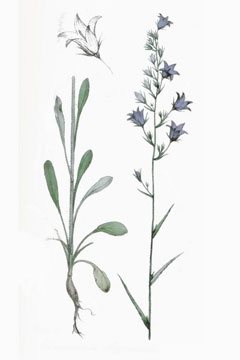
 |
|
http://commons.wikimedia.org/wiki/File:Campanula_rapunculus_L_ag1.jpg |
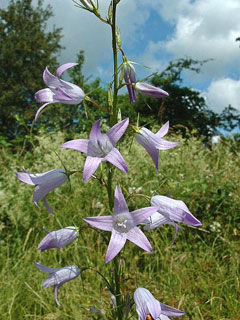 |
| http://fr.wikipedia.org/wiki/Utilisateur:Jeffdelonge |
Translate this page:
Summary
Physical Characteristics

 Campanula rapunculus is a BIENNIAL growing to 0.9 m (3ft) by 0.3 m (1ft in).
See above for USDA hardiness. It is hardy to UK zone 4. It is in flower from July to August, and the seeds ripen from August to September. The species is hermaphrodite (has both male and female organs) and is pollinated by Bees, flies, beetles, Lepidoptera (Moths & Butterflies). The plant is self-fertile.
Suitable for: light (sandy) and medium (loamy) soils and prefers well-drained soil. Suitable pH: neutral and basic (mildly alkaline) soils. It can grow in semi-shade (light woodland) or no shade. It prefers moist soil.
UK Hardiness Map
US Hardiness Map
Synonyms
Plant Habitats
Meadow; Hedgerow; Cultivated Beds;
Edible Uses
Edible Parts: Leaves Root Shoots
Edible Uses:
Root - raw or cooked[2, 5, 33, 37, 100, 183]. A very nice sweet flavour[27], reminiscent of walnuts[2]. They are best mixed with other root vegetables and used in winter salads[2, 9]. Leaves - raw or cooked as a potherb[2, 5, 9, 27, 33, 37, 100, 183]. A fairly bland flavour, with a hint of sweetness, they are quite acceptable raw in salads[K]. The leaves are rich in vitamin C, they make an acceptable winter salad[4]. Young shoots in spring can be blanched and cooked like asparagus[183].
References More on Edible Uses
Medicinal Uses
Plants For A Future can not take any responsibility for any adverse effects from the use of plants. Always seek advice from a professional before using a plant medicinally.
Vitamin C
None known
References More on Medicinal Uses
The Bookshop: Edible Plant Books
Our Latest books on Perennial Plants For Food Forests and Permaculture Gardens in paperback or digital formats.

Edible Tropical Plants
Food Forest Plants for Hotter Conditions: 250+ Plants For Tropical Food Forests & Permaculture Gardens.
More

Edible Temperate Plants
Plants for Your Food Forest: 500 Plants for Temperate Food Forests & Permaculture Gardens.
More

More Books
PFAF have eight books available in paperback and digital formats. Browse the shop for more information.
Shop Now
Other Uses
References More on Other Uses
Cultivation details
An easily cultivated plant, it prefers a moist but well-drained rich sandy loam and a neutral or alkaline soil in sun or partial shade[1, 4, 200], though it succeeds in most good soils[4]. Tolerates a pH in the range 4.8 to 7.5. Plants are hardy to at least -15°c[200]. Plants often self-sow in the garden[271]. The species in this genus do not often hybridize and so seed can generally be relied upon to come true[221]. The plants are self-fertile[221]. Rampion was formerly often cultivated for its edible root, though it has fallen into virtual disuse[4]. When grown for its edible root, the plant should not be allowed to flower[4]. Plants can be grown in a meadow[200]. Members of this genus are rarely if ever troubled by browsing deer[233].
References Carbon Farming Information and Carbon Sequestration Information
Temperature Converter
Type a value in the Celsius field to convert the value to Fahrenheit:
Fahrenheit:
The PFAF Bookshop
Plants For A Future have a number of books available in paperback and digital form. Book titles include Edible Plants, Edible Perennials, Edible Trees,Edible Shrubs, Woodland Gardening, and Temperate Food Forest Plants. Our new book is Food Forest Plants For Hotter Conditions (Tropical and Sub-Tropical).
Shop Now
Plant Propagation
Seed - surface sow May/June in situ. The seed usually germinates in 2 - 4 weeks at 18°c[138].
Other Names
If available other names are mentioned here
Native Plant Search
Search over 900 plants ideal for food forests and permaculture gardens. Filter to search native plants to your area. The plants selected are the plants in our book 'Plants For Your Food Forest: 500 Plants for Temperate Food Forests and Permaculture Gardens, as well as plants chosen for our forthcoming related books for Tropical/Hot Wet Climates and Mediterranean/Hot Dry Climates. Native Plant Search
Found In
Countries where the plant has been found are listed here if the information is available
Weed Potential
Right plant wrong place. We are currently updating this section.
Please note that a plant may be invasive in one area but may not in your area so it’s worth checking.
Conservation Status
IUCN Red List of Threatened Plants Status :

| Related Plants
|
| Latin Name | Common Name | Habit | Height | Hardiness | Growth | Soil | Shade | Moisture | Edible | Medicinal | Other |
| Adenophora denticulata | | Perennial | 0.5 |
6-9
| | LM | N | M | 2 | 0 | |
| Adenophora divaricata | | Perennial | 1.0 |
-
| | LM | N | M | 2 | 0 | |
| Adenophora lamarkii | | Perennial | 0.6 |
5-9
| | LM | N | M | 2 | 0 | |
| Adenophora latifolia | | Perennial | 0.5 |
-
| | LM | N | M | 2 | 0 | |
| Adenophora liliifolia | Ladybells, Lilyleaf | Perennial | 0.5 |
3-8
| M | LM | N | M | 2 | 0 | |
| Adenophora nikoensis | | Perennial | 0.3 |
5-9
| | LM | N | M | 2 | 0 | |
| Adenophora remotiflora | | Perennial | 1.0 |
5-9
| | LM | N | M | 2 | 1 | |
| Adenophora stricta | Sha Shen, Ladybells | Perennial | 1.0 |
7-9
| | LM | N | M | 2 | 1 | |
| Adenophora triphylla | Nan Sha Shen | Perennial | 1.0 |
6-9
| | LM | N | M | 2 | 1 | |
| Adenophora verticillata | | Perennial | 1.0 |
6-9
| | LM | SN | M | 2 | 2 | |
| Agapanthus campanulatus | | Bulb | 0.6 |
6-9
| | LM | SN | M | 0 | 1 | |
| Asyneuma pulchellum | | Perennial | 0.0 |
-
| | LMH | SN | M | 0 | 0 | 2 |
| Asyneuma salignum | | Perennial | 0.0 |
-
| | LMH | SN | M | 0 | 0 | 2 |
| Azorina vidalii | | Shrub | 0.3 |
8-11
| | LM | N | DM | 3 | 0 | 0 |
| Campanula alliariifolia | Cornish Bellflower | Perennial | 0.7 |
3-7
| M | LM | SN | M | 3 | 0 | 3 |
| Campanula carpatica | Tussock Bellflower, Carpathian Bellflower, Carpathian Harebell | Perennial | 0.3 |
3-8
| S | LM | SN | M | 3 | 0 | 2 |
| Campanula carpatica turbinata | | Perennial | 0.3 |
3-7
| | LM | N | M | 3 | 0 | 2 |
| Campanula cochleariifolia | Fairies Thimbles | Perennial | 0.2 |
5-9
| | LM | N | M | 4 | 0 | |
| Campanula edulis | | Perennial | 0.2 |
-
| | LM | SN | M | 2 | 0 | |
| Campanula fenestrellata | Adriatic Bellflower | Perennial | 0.2 |
5-9
| M | LM | SN | M | 4 | 0 | |
| Campanula garganica | Adriatic Bellflower | Perennial | 0.2 |
4-8
| | LM | N | M | 3 | 0 | |
| Campanula glomerata | Clustered Bellflower, Dane's blood, Clustered Bellflower | Perennial | 1.0 |
4-9
| M | LM | SN | M | 4 | 0 | |
| Campanula lactiflora | Milky Bellflower | Perennial | 1.0 |
4-8
| | LM | SN | M | 3 | 0 | |
| Campanula lasiocarpa | Mountain harebell | Perennial | 0.2 |
4-8
| | L | N | M | 2 | 0 | |
| Campanula latifolia | Large Campanula, Giant bellflower | Perennial | 1.5 |
3-7
| | LM | FS | DM | 3 | 1 | |
| Campanula latiloba | | Perennial | 0.9 |
3-7
| M | LM | SN | M | 3 | 0 | 3 |
| Campanula medium | Canterbury Bells, Cup and Saucer, Canterbury Bells | Biennial | 1.2 |
6-8
| M | LM | SN | M | 2 | 0 | 1 |
| Campanula parryi | Parry's Bellflower, Idaho bellflower | Perennial | 0.3 |
4-8
| F | LM | SN | M | 1 | 1 | 1 |
| Campanula persicifolia | Harebell, Peachleaf bellflower | Perennial | 1.0 |
3-7
| | LM | SN | M | 4 | 0 | |
| Campanula portenschlagiana | Adria Bellflower | Perennial | 0.3 |
3-7
| F | LM | SN | M | 3 | 0 | 3 |
|
|
Growth: S = slow M = medium F = fast. Soil: L = light (sandy) M = medium H = heavy (clay). pH: A = acid N = neutral B = basic (alkaline). Shade: F = full shade S = semi-shade N = no shade. Moisture: D = dry M = Moist We = wet Wa = water.

Expert comment
Author
L.
Botanical References
200
Links / References
For a list of references used on this page please go here
Readers comment
© 2010, Plants For A Future. Plants For A Future is a charitable company limited by guarantee, registered in England and Wales. Charity No. 1057719, Company No. 3204567.