 |
|
http://commons.wikimedia.org/wiki/User:Miya |
 |
| http://commons.wikimedia.org/wiki/User:Pepre |
Translate this page:
Summary
Physical Characteristics

 Brassica rapa is a BIENNIAL growing to 0.5 m (1ft 8in).
See above for USDA hardiness. It is hardy to UK zone 7 and is not frost tender. It is in flower from May to August, and the seeds ripen from July to September. The species is hermaphrodite (has both male and female organs) and is pollinated by Bees. The plant is self-fertile.
Suitable for: light (sandy), medium (loamy) and heavy (clay) soils and prefers well-drained soil. Suitable pH: mildly acid, neutral and basic (mildly alkaline) soils and can grow in very acid and very alkaline soils.
It can grow in semi-shade (light woodland) or no shade. It prefers moist soil.
UK Hardiness Map
US Hardiness Map
Synonyms
B. campestris rapa.
Plant Habitats
Cultivated Beds;
Edible Uses
Edible Parts: Leaves Root
Edible Uses:
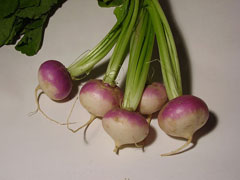
Leaves - raw or cooked[1, 5]. The cooked leaves make an acceptable vegetable, though they are coarser than the related cabbage. They are more often used as a spring greens, sowing the plants in the autumn and allowing them t overwinter. Young leaves can also be added in small quantities to salads, they have a slightly hot cabbage-like flavour and some people find them indigestible[K]. A nutritional analysis is available[218]. Root - raw or cooked[1, 5, 16, 132]. Often used as a cooked vegetable, the young roots can also be grated and eaten in salads, they have a slightly hot flavour like a mild radish. A nutritional analysis is available[218].
References More on Edible Uses
| Composition
|
| Figures in grams (g) or miligrams (mg) per 100g of food.
|
|
|
Leaves (Dry weight)
|
|
- 2300 Calories per 100g
- Water : 0%
- Protein: 30g; Fat: 4g; Carbohydrate: 54g; Fibre: 7g; Ash: 12g;
- Minerals - Calcium: 1600mg; Phosphorus: 1000mg; Iron: 17mg; Magnesium: 0mg; Sodium: 0mg; Potassium: 4500mg; Zinc: 0mg;
- Vitamins - A: 0mg; Thiamine (B1): 30mg; Riboflavin (B2): 2mg; Niacin: 8mg; B6: 0mg; C: 500mg;
- Reference: [ 218]
- Notes:
|
|
Medicinal Uses
Plants For A Future can not take any responsibility for any adverse effects from the use of plants. Always seek advice from a professional before using a plant medicinally.
Cancer Poultice
A decoction of the leaves or stems is used in the treatment of cancer[218]. The powdered seed is said to be a folk remedy for cancer[269]. The crushed ripe seeds are used as a poultice on burns[222]. Some caution should be exercised here since the seed of most brassicas is rubefacient[K]. The root when boiled with lard is used for breast tumours[269]. A salve derived from the flowers is said to help skin cancer[269].
References More on Medicinal Uses
The Bookshop: Edible Plant Books
Our Latest books on Perennial Plants For Food Forests and Permaculture Gardens in paperback or digital formats.

Edible Tropical Plants
Food Forest Plants for Hotter Conditions: 250+ Plants For Tropical Food Forests & Permaculture Gardens.
More

Edible Temperate Plants
Plants for Your Food Forest: 500 Plants for Temperate Food Forests & Permaculture Gardens.
More

More Books
PFAF have eight books available in paperback and digital formats. Browse the shop for more information.
Shop Now
Other Uses
Fodder Insecticide
Turnip root peelings contain a natural insecticide. The chopped roots can be brewed into a tea with flaked soap, this is then strained before use. It is effective against aphids, red spider mites and flies[201].
Special Uses
Dynamic accumulator
References More on Other Uses
Cultivation details
Turnip is basically a cool climate crop that is resistant to frost and mild freezes[269]. The plants are very easily grown, provided they grow quickly when young and the soil is not allowed to dry out[264]. They succeed in full sun in a well-drained fertile preferably alkaline soil[200]. Turnips grow best in deep, friable, highly fertile soil with pH 5.5 - 6.8[269]. They are said to prefer a light sandy soil, especially when grown for an early crop in the spring, and dislike a heavy soil[37, 269]. They prefer cool moist growing conditions[16]. Turnips tolerate an annual precipitation of 35 to 410cm, an annual average temperature range of 3.6 to 27.4°C and a pH in the range of 4.2 to 7.8[269]. Temperatures below 10°C cause the plants to run to seed, even if they have not yet formed an edible root[269]. The turnip is often cultivated, both in the garden and commercially, for its edible root. A fast growing plant, it can take less than ten weeks from sowing to harvesting[264]. Its short growing season makes turnips very adaptable as a catch crop[269]. There are several named varieties and by careful selection and successional sowing it is possible to harvest roots all year round. The roots are fairly cold hardy and can be left in the ground during the winter, harvesting them as required. However, they can be troubled by slugs and other creatures so it is often better to harvest them in late autumn or early winter and store them in a cool but frost-free place. This species has long been cultivated as an edible plant and a large number of forms have been developed. Botanists have divided these forms into a number of groups, and these are detailed below. Separate entries in the database have been made for each group. B. rapa. The species was actually named for the cultivated garden turnip with its edible swollen tap root. This form is dealt with on this record. B. rapa campestris. This is the wild form of the species. It does not have a swollen root and is closest to the forms grown for their oil-rich seeds. B. rapa chinensis. Pak choi has long been cultivated in the Orient for its large tender edible leaves which are mainly produced in the summer and autumn. B. rapa dichotoma. Cultivated in the Orient mainly for its oil-rich seeds. B. rapa narinosa. Chinese savoy is another Oriental form. It is grown for its edible leaves. B. rapa nipposinica. Mizuna is a fast-growing cold-hardy form with tender edible leaves that can be produced all year round. B. rapa oleifera. The stubble turnip has a swollen edible root, though it is considered too coarse for human consumption and is grown mainly for fodder and as a green manure. It is also cultivated for its oil-rich seeds. B. rapa parachinensis. False pak choi is very similar to B. rapa chinensis with tender edible leaves, though it is considerably more cold-hardy. B. rapa pekinensis. Chinese cabbages are widely grown in the Orient. The large tender leaves often form a cabbage-like head. B. rapa perviridis. Spinach mustard is grown for its edible leaves. A very cold-hardy plant, and also able to withstand summer heat, it can provide a crop all year round. B. rapa trilocularis. Indian colza is mainly grown for its oil-rich seeds. Grows well with peas but dislikes growing with hedge mustard and knotweed[18, 20]. A good bee plant[108].
References Carbon Farming Information and Carbon Sequestration Information
Temperature Converter
Type a value in the Celsius field to convert the value to Fahrenheit:
Fahrenheit:
The PFAF Bookshop
Plants For A Future have a number of books available in paperback and digital form. Book titles include Edible Plants, Edible Perennials, Edible Trees,Edible Shrubs, Woodland Gardening, and Temperate Food Forest Plants. Our new book is Food Forest Plants For Hotter Conditions (Tropical and Sub-Tropical).
Shop Now
Plant Propagation
Seed - sow in situ from early spring to late summer. The first sowing can be made under cloches in late winter and will be ready for use in early summer. The latest sowings for winter use can be made in mid to late summer.
Other Names
If available other names are mentioned here
Various widely cultivated subspecies including the turnip (a root vegetable); the mizuna, napa cabbage, bok choy, and cime di rapa (leaf vegetables); and (Brassica rapa subsp. oleifera, an oilseed which has many common names, including field mustard, bird rape, keblock, and colza).
Native Plant Search
Search over 900 plants ideal for food forests and permaculture gardens. Filter to search native plants to your area. The plants selected are the plants in our book 'Plants For Your Food Forest: 500 Plants for Temperate Food Forests and Permaculture Gardens, as well as plants chosen for our forthcoming related books for Tropical/Hot Wet Climates and Mediterranean/Hot Dry Climates. Native Plant Search
Found In
Countries where the plant has been found are listed here if the information is available
Weed Potential
Right plant wrong place. We are currently updating this section.
Please note that a plant may be invasive in one area but may not in your area so it’s worth checking.
Conservation Status
IUCN Red List of Threatened Plants Status : This taxon has not yet been assessed.

| Related Plants
|
| Latin Name | Common Name | Habit | Height | Hardiness | Growth | Soil | Shade | Moisture | Edible | Medicinal | Other |
| Alliaria petiolata | Garlic Mustard | Biennial | 1.0 |
5-8
| | LMH | FS | MWe | 3 | 2 | 1 |
| Arabidopsis thaliana | Thale Cress, Mouseear cress | Annual/Biennial | 0.5 |
0-0
| | LMH | SN | DM | 0 | 1 | 1 |
| Arabis alpina | Alpine Rock Cress, Alpine rockcress | Perennial | 0.2 |
4-8
| | LM | SN | M | 2 | 0 | |
| Arabis caucasica | Rock Cress, Wall Rockcress | Perennial | 0.2 |
4-9
| M | LMH | SN | DM | 2 | 0 | 3 |
| Arabis hirsuta | Hairy rockcress, Mountain rockcress, Creamflower rockcress | Biennial/Perennial | 0.6 |
4-8
| | LMH | SN | DM | 1 | 0 | |
| Arabis lyrata | Rock Cress, Kamchatka rockcress, Lyrate rockcress | Biennial/Perennial | 0.3 |
4-8
| | LMH | SN | DM | 1 | 0 | |
| Arabis pendula | | Biennial | 0.9 |
-
| | LMH | FSN | M | 1 | 0 | |
| Arabis sagittata | | Biennial/Perennial | 0.6 |
-
| | LMH | SN | DM | 1 | 0 | |
| Arabis serrata | | Perennial | 0.3 |
6-9
| | LMH | SN | M | 1 | 0 | |
| Armoracia rusticana | Horseradish, Red Cole | Perennial | 0.7 |
4-9
| F | LMH | SN | M | 3 | 3 | 2 |
| Aubrieta deltoidea | Aubretia, Lilacbush, False Rockcress | Perennial | 0.2 |
4-9
| M | LM | SN | DM | 0 | 0 | 3 |
| Aurinia saxatilis | Golden Alyssum, Basket of gold | Perennial | 0.3 |
4-10
| M | LMH | N | DM | 0 | 0 | 3 |
| Barbarea australis | | Biennial/Perennial | 0.5 |
-
| | LMH | SN | M | 2 | 1 | |
| Barbarea orthoceras | American Yellowrocket | Perennial | 0.5 |
0-0
| | LMH | SN | M | 2 | 0 | 0 |
| Barbarea verna | Land Cress, Early yellowrocket | Biennial | 0.3 |
5-9
| | LMH | FSN | M | 3 | 0 | |
| Barbarea vulgaris | Yellow Rocket, Garden yellowrocket | Perennial | 0.4 |
5-9
| | LMH | SN | M | 3 | 1 | 0 |
| Brassica balearica | | Perennial | 0.0 |
-
| | LMH | N | M | 1 | 0 | |
| Brassica carinata | Abyssinian Cabbage | Annual | 1.0 |
9-12
| F | LMH | SN | M | 4 | 2 | 3 |
| Brassica cretica | Mustard | Perennial | 1.0 |
0-0
| | LMH | N | M | 2 | 0 | |
| Brassica elongata | Elongated mustard | Biennial/Perennial | 0.9 |
0-0
| | LMH | SN | M | 2 | 0 | 2 |
| Brassica juncea | Brown Mustard | Annual | 0.8 |
6-9
| | LMH | SN | M | 4 | 2 | 2 |
| Brassica juncea crispifolia | Curled Mustard | Annual | 0.3 |
6-9
| F | LMH | SN | M | 4 | 2 | 2 |
| Brassica juncea foliosa | Leaf Mustard | Annual | 0.3 |
6-9
| F | LMH | SN | M | 4 | 2 | 2 |
| Brassica juncea integrifolia crispifolia | Curled Mustard | Annual | 0.3 |
6-10
| F | LMH | SN | M | 4 | 2 | 2 |
| Brassica juncea integrifolia rugosa | Head Mustard | Annual | 0.6 |
6-10
| F | LMH | SN | M | 4 | 2 | 2 |
| Brassica juncea integrifolia strumata | Large Petiole Mustard | Annual | 0.8 |
6-10
| F | LMH | SN | M | 4 | 2 | 2 |
| Brassica juncea integrifolia subintegrifolia | Leaf Mustard | Annual | 0.3 |
6-10
| F | LMH | SN | M | 4 | 2 | 2 |
| Brassica juncea multiceps | Green In The Snow | Annual | 0.4 |
6-9
| F | LMH | SN | M | 4 | 2 | 2 |
| Brassica juncea napiformis | Root Mustard | Annual | 0.8 |
6-9
| | LMH | SN | M | 4 | 2 | 2 |
| Brassica juncea rugosa | Head Mustard | Annual | 0.6 |
6-9
| | LMH | SN | M | 4 | 2 | 2 |
|
|
Growth: S = slow M = medium F = fast. Soil: L = light (sandy) M = medium H = heavy (clay). pH: A = acid N = neutral B = basic (alkaline). Shade: F = full shade S = semi-shade N = no shade. Moisture: D = dry M = Moist We = wet Wa = water.

Expert comment
Author
L.
Botanical References
200
Links / References
For a list of references used on this page please go here
Readers comment