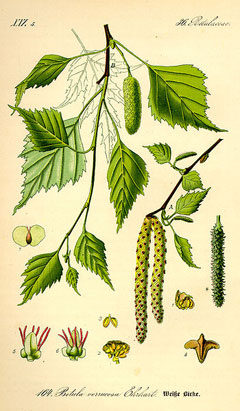
 |
|
|
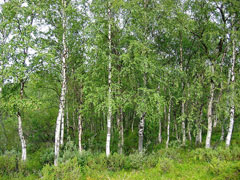 |
| http://www.flickr.com/photos/dittmars/ |
Translate this page:
Summary
Bloom Color: Brown.
Main Bloom Time: Early spring, Late spring, Mid spring.Form: Oval, Pyramidal, Weeping.
Physical Characteristics

 Betula pendula is a deciduous Tree growing to 20 m (65ft) by 10 m (32ft) at a fast rate.
See above for USDA hardiness. It is hardy to UK zone 2. It is in flower in April, and the seeds ripen from July to August. The species is monoecious (individual flowers are either male or female, but both sexes can be found on the same plant) and is pollinated by Wind.
It is noted for attracting wildlife.
Suitable for: light (sandy), medium (loamy) and heavy (clay) soils, prefers well-drained soil and can grow in heavy clay and nutritionally poor soils. Suitable pH: mildly acid, neutral and basic (mildly alkaline) soils and can grow in very acid soils.
It cannot grow in the shade. It prefers dry or moist soil. The plant can tolerates strong winds but not maritime exposure.
UK Hardiness Map
US Hardiness Map
Synonyms
Betula alba var. pendula (Roth) W.T.Aiton
Plant Habitats
Woodland Garden Canopy; Secondary; Sunny Edge;
Edible Uses
Edible Parts: Flowers Inner bark Leaves Sap
Edible Uses: Tea
Inner bark - cooked or dried and ground into a meal[2, 15, 105]. It can be added as a thickener to soups etc or can be mixed with flour for making bread, biscuits etc. Inner bark is generally only seen as a famine food, used when other forms of starch are not available or are in short supply[115, 177, K]. Sap - raw or cooked. A sweet flavour. It is harvested in early spring, before the leaves unfurl, by tapping the trunk. It makes a pleasant drink[115]. It is often concentrated into a syrup by boiling off the water[2, 9, 13, 15, 177]. Between 4 and 7 litres can be drawn off a mature tree in a day and this will not kill the tree so long as the tap hole is filled up afterwards[115]. However, prolonged or heavy tapping will kill the tree[115]. The flow is best on sunny days following a frost. The sap can be fermented into a beer. An old English recipe for the beer is as follows:- "To every Gallon of Birch-water put a quart of Honey, well stirr'd together; then boil it almost an hour with a few Cloves, and a little Limon-peel, keeping it well scumm'd. When it is sufficiently boil'd, and become cold, add to it three or four Spoonfuls of good Ale to make it work...and when the Test begins to settle, bottle it up . . . it is gentle, and very harmless in operation within the body, and exceedingly sharpens the Appetite, being drunk ante pastum."[269]. Young leaves - raw or cooked[15]. Young catkins[15]. No more details are given. A tea is made from the leaves[15, 161] and another tea is made from the essential oil in the inner bark[21].
References More on Edible Uses
Medicinal Uses
Plants For A Future can not take any responsibility for any adverse effects from the use of plants. Always seek advice from a professional before using a plant medicinally.
Anticholesterolemic Antiinflammatory Antirheumatic Antiseborrheic Antiseptic Astringent Bitter Cholagogue
Diaphoretic Diuretic Eczema Laxative Lithontripic Miscellany Skin
Urinary
Anti-inflammatory, cholagogue, diaphoretic[21, 165, 201]. The bark is diuretic and laxative[7]. An oil obtained from the inner bark is astringent and is used in the treatment of various skin afflictions, especially eczema and psoriasis[4, 238]. The bark is usually obtained from trees that have been felled for timber and can be distilled at any time of the year[238]. The inner bark is bitter and astringent, it is used in treating intermittent fevers[4]. The vernal sap is diuretic[4]. The buds are balsamic[7]. The young shoots and leaves secrete a resinous substance which has acid properties, when combined with alkalis it is a tonic laxative[4]. The leaves are anticholesterolemic and diuretic[7]. They also contain phytosides, which are effective germicides[7]. An infusion of the leaves is used in the treatment of gout, dropsy and rheumatism, and is recommended as a reliable solvent of kidney stones[4]. The young leaves and leaf buds are harvested in the spring and dried for later use[238]. A decoction of the leaves and bark is used for bathing skin eruptions[4]. Moxa is made from the yellow fungous excrescences of the wood, which sometimes swell out of the fissures[4]. The German Commission E Monographs, a therapeutic guide to herbal medicine, approve Betula species for infections of the urinary tract, kidney and bladder stones, rheumatism (see [302] for critics of commission E).
References More on Medicinal Uses
The Bookshop: Edible Plant Books
Our Latest books on Perennial Plants For Food Forests and Permaculture Gardens in paperback or digital formats.
Edible Tropical Plants
Food Forest Plants for Hotter Conditions: 250+ Plants For Tropical Food Forests & Permaculture Gardens.
More
Edible Temperate Plants
Plants for Your Food Forest: 500 Plants for Temperate Food Forests & Permaculture Gardens.
More
More Books
PFAF have eight books available in paperback and digital formats. Browse the shop for more information.
Shop Now
Other Uses
Adhesive Besom Charcoal Compost Dye Essential Fibre Fungicide Hair Miscellany Paper Pioneer Polish Repellent Tannin Thatching Waterproofing Wood
The bark is used to make drinking vessels, canoe skins, roofing tiles etc[115]. It is waterproof, durable, tough and resinous. Only the outer bark is removed, this does not kill the tree. It is most easily removed in late spring to early summer. A pioneer species, it readily invades old fields, cleared or burnt-over land and creates conditions suitable for other woodland trees to become established. Since it is relatively short-lived and intolerant of shade, it is eventually out-competed by these trees[17, 186]. A tar-oil is obtained from the white bark in spring. It has fungicidal properties and is also used as an insect repellent[4, 13, 100]. It makes a good shoe polish[61]. Another report says that an essential oil is obtained from the bark and this, called 'Russian Leather' has been used as a perfume[245]. A decoction of the inner bark is used to preserve cordage[115], it contains up to 16% tannin[178, 223]. An oil similar to Wintergreen oil (obtained from Gaultheria procumbens) is obtained from the inner bark[21, 61]. It is used medicinally and also makes a refreshing tea[21]. The resin glands (the report does not say where these glands are found) are used to make a hair lotion[226]. A brown dye is obtained from the inner bark A glue is made from the sap[2, 9, 13, 15]. Cordage can be made from the fibres of the inner bark[115]. This inner bark can also be separated into thin layers and used as a substitute for oiled paper[4]. The young branches are very flexible and are used to make whisks, besoms etc[6]. They are also used in thatching[13, 100] and to make wattles[4]. The leaves are a good addition to the compost heap, improving fermentation[14]. Wood - soft, light, durable. It is used for a wide range of purposes including furniture, tool handles, toys and carving[13, 100, 238]. A high quality charcoal is obtained from the bark. It is used by artists, painters etc[13]. The wood is also pulped and used for making paper[238].
Special Uses
Attracts Wildlife Dynamic accumulator Food Forest Scented Plants
References More on Other Uses
Cultivation details
Landscape Uses:Firewood, Specimen. A very easily grown plant, it tolerates most soils including poor ones[1, 24], sandy soils[188] and heavy clays. It prefers a well-drained loamy soil in a sunny position[11, 200]. It is occasionally found on calcareous soils in the wild but it generally prefers a pH below 6.5, doing well on acid soils[186]. Fairly wind tolerant[200] though it becomes wind shaped when exposed to strong winds[K]. The silver birch is a very ornamental tree[1] with many named varieties[11, 200]. It also has a very wide range of economic uses. It is a fast growing tree, increasing by up to 1 metre a year, but is short-lived[17, 200]. It is often one of the first trees to colonize open land and it creates a suitable environment for other woodland trees to follow[17]. These trees eventually out-compete and shade out the birch trees[17, 186]. It makes an excellent nurse tree for seedling trees, though its fine branches can cause damage to nearby trees when blown into them by the wind. Trees take about 15 years from seed to produce their own seed[98]. Although closely related, it does not usually hybridize with B. pubescens[11]. It often hybridizes with B. pubescens according to another report[186]. A superb tree for encouraging wildlife, it has 229 associated insect species[24]. A good plant to grow near the compost heap, aiding the fermentation process[14, 20]. It is also a good companion plant, its root action working to improve the soil[14]. Trees are notably susceptible to honey fungus[200]. Special Features:
Not North American native, Attractive flowers or blooms.
References Carbon Farming Information and Carbon Sequestration Information
Temperature Converter
Type a value in the Celsius field to convert the value to Fahrenheit:
Fahrenheit:
The PFAF Bookshop
Plants For A Future have a number of books available in paperback and digital form. Book titles include Edible Plants, Edible Perennials, Edible Trees,Edible Shrubs, Woodland Gardening, and Temperate Food Forest Plants. Our new book is Food Forest Plants For Hotter Conditions (Tropical and Sub-Tropical).
Shop Now
Plant Propagation
Seed - best sown as soon as it is ripe in a light position in a cold frame[78, 80, 113, 134]. Only just cover the seed and place the pot in a sunny position[78, 80, 134]. Spring sown seed should be surface sown in a sunny position in a cold frame[113, 134]. If the germination is poor, raising the temperature by covering the seed with glass can help[134]. When they are large enough to handle, prick the seedlings out into individual pots and grow them on in a cold frame for at least their first winter. Plant them out into their permanent positions in late spring or early summer, after the last expected frosts. If you have sufficient seed, it can be sown in an outdoor seedbed, either as soon as it is ripe or in the early spring - do not cover the spring sown seed. Grow the plants on in the seedbed for 2 years before planting them out into their permanent positions in the winter[78, 80, 113, 134].
Other Names
If available other names are mentioned here
Native Plant Search
Search over 900 plants ideal for food forests and permaculture gardens. Filter to search native plants to your area. The plants selected are the plants in our book 'Plants For Your Food Forest: 500 Plants for Temperate Food Forests and Permaculture Gardens, as well as plants chosen for our forthcoming related books for Tropical/Hot Wet Climates and Mediterranean/Hot Dry Climates. Native Plant Search
Found In
Countries where the plant has been found are listed here if the information is available
Weed Potential
Right plant wrong place. We are currently updating this section.
Please note that a plant may be invasive in one area but may not in your area so it’s worth checking.
Conservation Status
IUCN Red List of Threatened Plants Status :

| Related Plants
|
| Latin Name | Common Name | Habit | Height | Hardiness | Growth | Soil | Shade | Moisture | Edible | Medicinal | Other |
| Alnus acuminata | Alder | Tree | 25.0 |
10-12
| F | LMH | SN | M | 0 | 2 | 3 |
| Alnus cordata | Italian Alder | Tree | 25.0 |
5-9
| F | MH | SN | DMWe | 0 | 0 | 4 |
| Alnus glutinosa | Alder, European alder , Common Alder, Black Alder | Tree | 25.0 |
3-7
| F | MH | SN | MWe | 0 | 3 | 5 |
| Alnus hirsuta | | Tree | 18.0 |
3-7
| | MH | SN | MWe | 0 | 0 | 2 |
| Alnus incana | Grey Alder, Speckled alder, Thinleaf alder, White Alder | Tree | 18.0 |
2-6
| F | MH | SN | DMWe | 0 | 0 | 3 |
| Alnus japonica | Japanese Alder | Tree | 22.0 |
4-8
| F | MH | SN | DMWe | 0 | 1 | 2 |
| Alnus jorullensis | Mexican alder, Evergreen Alder | Tree | 25.0 |
7-12
| F | LMH | SN | MWe | 0 | 0 | 3 |
| Alnus maritima | Seaside Alder, Beach Alder | Tree | 9.0 |
3-7
| M | MH | N | MWe | 0 | 0 | 3 |
| Alnus maximowiczii | | Tree | 9.0 |
4-8
| | MH | SN | MWe | 0 | 0 | 2 |
| Alnus nepalensis | Nepalese Alder | Tree | 22.0 |
8-11
| F | MH | SN | MWe | 0 | 1 | 3 |
| Alnus nitida | West Himalayan Alder | Tree | 30.0 |
7-10
| | MH | SN | DMWe | 0 | 1 | 3 |
| Alnus rhombifolia | White Alder | Tree | 12.0 |
8-11
| F | MH | SN | MWe | 1 | 2 | 2 |
| Alnus rubra | Red Alder, Oregon Alder | Tree | 20.0 |
6-8
| F | MH | SN | MWe | 2 | 2 | 4 |
| Alnus rugosa | Speckled Alder | Tree | 22.0 |
2-6
| F | MH | SN | MWe | 0 | 2 | 3 |
| Alnus serrulata | Smooth Alder, Hazel alder | Shrub | 4.5 |
3-9
| | MH | N | MWe | 0 | 2 | 2 |
| Alnus sinuata | Sitka Alder | Shrub | 4.0 |
2-9
| F | MH | SN | MWe | 1 | 1 | 3 |
| Alnus tenuifolia | Mountain Alder, Thinleaf alder | Tree | 9.0 |
5-7
| F | MH | SN | MWe | 1 | 2 | 3 |
| Alnus viridis crispa | American Green Alder | Shrub | 3.0 |
4-8
| | MH | SN | MWe | 1 | 2 | 3 |
| Betula alleghaniensis | Yellow Birch, Swamp Birch | Tree | 12.0 |
3-7
| F | LMH | SN | M | 3 | 2 | 4 |
| Betula alnoides | | Tree | 40.0 |
7-10
| F | LMH | SN | M | 2 | 1 | 3 |
| Betula ermanii | Gold Birch | Tree | 25.0 |
3-7
| F | LMH | SN | M | 0 | 1 | 3 |
| Betula glandulosa | Scrub Birch | Shrub | 2.0 |
0-0
| | LMH | SN | M | 2 | 1 | 3 |
| Betula kenaica | Kenai Birch | Tree | 12.0 |
0-0
| F | LMH | SN | M | 3 | 1 | 3 |
| Betula lenta | Cherry Birch, Sweet birch, Black Birch, Cherry Birch | Tree | 24.0 |
3-7
| F | LMH | SN | M | 3 | 3 | 4 |
| Betula nana | Dwarf Birch | Shrub | 0.3 |
0-0
| | LMH | SN | M | 2 | 2 | 3 |
| Betula nigra | River Birch, Black Birch, Red Birch, Water Birch, River Birch | Tree | 20.0 |
3-9
| F | LMH | SN | M | 3 | 2 | 2 |
| Betula occidentalis | Water Birch | Tree | 9.0 |
0-0
| F | LMH | SN | M | 3 | 2 | 3 |
| Betula papyrifera | Paper Birch, Mountain paper birch, Kenai birch | Tree | 20.0 |
0-0
| F | LMH | N | DM | 3 | 2 | 4 |
| Betula platyphylla | White Birch, Asian white birch, | Tree | 20.0 |
3-6
| F | LMH | N | DM | 2 | 2 | 2 |
|
|
Growth: S = slow M = medium F = fast. Soil: L = light (sandy) M = medium H = heavy (clay). pH: A = acid N = neutral B = basic (alkaline). Shade: F = full shade S = semi-shade N = no shade. Moisture: D = dry M = Moist We = wet Wa = water.

Expert comment
Author
Roth.
Botanical References
1117200
Links / References
For a list of references used on this page please go here
Readers comment