 |
|
http://www.hear.org/starr/ |
 |
| http://www.hear.org/starr/ |
Translate this page:
Summary
Physical Characteristics

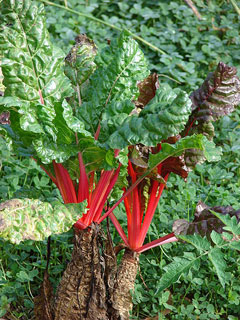
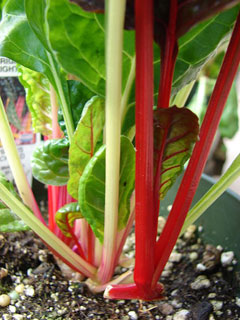
 Beta vulgaris cicla is a BIENNIAL growing to 0.9 m (3ft).
See above for USDA hardiness. It is hardy to UK zone 5 and is not frost tender. The species is hermaphrodite (has both male and female organs) and is pollinated by Wind.
Suitable for: light (sandy), medium (loamy) and heavy (clay) soils and prefers well-drained soil. Suitable pH: mildly acid, neutral and basic (mildly alkaline) soils and can grow in very alkaline and saline soils.
It cannot grow in the shade. It prefers moist soil.
UK Hardiness Map
US Hardiness Map
Synonyms
Plant Habitats
Cultivated Beds;
Edible Uses
Edible Parts: Leaves Stem
Edible Uses:
Leaves and leaf stems - raw or cooked like spinach[2, 16, 27, 33]. A very good spinach substitute, the leaves are large and easily harvested, yields are high[K]. Some people dislike the raw leaves since they can leave an unpleasant taste in the mouth[K]. Flowering stem - cooked. A broccoli substitute[K].
References More on Edible Uses
Medicinal Uses
Plants For A Future can not take any responsibility for any adverse effects from the use of plants. Always seek advice from a professional before using a plant medicinally.
Although little used in modern herbalism, beet has a long history of folk use, especially in the treatment of tumours[269]. A decoction prepared from the seed has been used as a remedy for tumours of the intestines. The seed, boiled in water, is said to cure genital tumours[269]. The juice or other parts of the plant is said to help in the treatment of tumours, leukaemia and other forms of cancer such as cancer of the breast, oesophagus, glands, head, intestines, leg, lip, lung, prostate, rectum, spleen, stomach, and uterus[269]. Some figure that betacyanin and anthocyanin are important in the exchange of substances of cancer cells; others note two main components of the amines, choline and its oxidation product betaine, whose absence produces tumours in mice[269]. The juice has been applied to ulcers[269]. A decoction is used as a purgative by those who suffer from haemorrhoids in South Africa[269]. Leaves and roots used as an emmenagogue[269]. Plant effective in the treatment of feline ascariasis[269]. In the old days, beet juice was recommended as a remedy for anaemia and yellow jaundice, and, put into the nostrils to purge the head, clear ringing ears, and alleviate toothache[269]. Beet juice in vinegar was said to rid the scalp of dandruff as scurf, and was recommended to prevent falling hair[269]. Juice of the white beet was said to clear obstructions of the liver and spleen[269]. Culpepper (1653) recommended it for treating headache and vertigo as well as all affections of the brain[269].
References More on Medicinal Uses
The Bookshop: Edible Plant Books
Our Latest books on Perennial Plants For Food Forests and Permaculture Gardens in paperback or digital formats.

Edible Tropical Plants
Food Forest Plants for Hotter Conditions: 250+ Plants For Tropical Food Forests & Permaculture Gardens.
More

Edible Temperate Plants
Plants for Your Food Forest: 500 Plants for Temperate Food Forests & Permaculture Gardens.
More

More Books
PFAF have eight books available in paperback and digital formats. Browse the shop for more information.
Shop Now
Other Uses
References More on Other Uses
Cultivation details
A very easily grown plant, it succeeds in sun or light shade in moist soils but prefers a rich well-drained light neutral to alkaline soil[33, 37]. Beets grow well in a variety of soils, growing best in a deep, friable well-drained soil abundant with organic matter, but doing poorly on clay. They prefer an open position and a light well-drained soil[52]. The optimum pH is 6.0 - 6.8, but neutral and alkaline soils are tolerated in some areas. Some salinity may be tolerated after the seedling stage. Beets are notable for their tolerance to manganese toxicity[269]. Beet is reported to tolerate an annual precipitation of 23 to 315cm, an average annual temperature range of 5.0 to 26.6°C and a pH of 4.2 to 8.2[269]. Plants are tolerant of saline soils and respond positively if salt is added to non-saline soils at a rate of about 30g per square metre[264]. Spinach beet is often cultivated by gardeners for its edible leaves[16], it does not make a very good commercial crop since the leaves quickly droop after being harvested and so do not stand the journey to market. This plant is a good hot weather substitute for spinach[183]. The leaves are available all year round from successional sowings if the winters are not too severe[K]. In severe winters it is possible to dig up some plants and move them to a protected area such as a greenhouse in order to produce fresh leaves[1]. Plants usually self-sow freely if they are well-sited and the ground is disturbed by hoeing etc[K]. A good companion for dwarf beans, onions and kohl rabi[18], though the growth of spinach beet is inhibited by runner beans, charlock and field mustard[18].
References Carbon Farming Information and Carbon Sequestration Information
Temperature Converter
Type a value in the Celsius field to convert the value to Fahrenheit:
Fahrenheit:
The PFAF Bookshop
Plants For A Future have a number of books available in paperback and digital form. Book titles include Edible Plants, Edible Perennials, Edible Trees,Edible Shrubs, Woodland Gardening, and Temperate Food Forest Plants. Our new book is Food Forest Plants For Hotter Conditions (Tropical and Sub-Tropical).
Shop Now
Plant Propagation
Seed - sow in situ in early April for the summer crop and again in early July to August for the winter and spring crop. It is also possible to obtain an earlier crop by sowing the seed in a tray in a greenhouse in March and planting out in April/May[264].
Other Names
If available other names are mentioned here
Native Plant Search
Search over 900 plants ideal for food forests and permaculture gardens. Filter to search native plants to your area. The plants selected are the plants in our book 'Plants For Your Food Forest: 500 Plants for Temperate Food Forests and Permaculture Gardens, as well as plants chosen for our forthcoming related books for Tropical/Hot Wet Climates and Mediterranean/Hot Dry Climates. Native Plant Search
Found In
Countries where the plant has been found are listed here if the information is available
Weed Potential
Right plant wrong place. We are currently updating this section.
Please note that a plant may be invasive in one area but may not in your area so it’s worth checking.
Conservation Status
IUCN Red List of Threatened Plants Status :

Growth: S = slow M = medium F = fast. Soil: L = light (sandy) M = medium H = heavy (clay). pH: A = acid N = neutral B = basic (alkaline). Shade: F = full shade S = semi-shade N = no shade. Moisture: D = dry M = Moist We = wet Wa = water.

Expert comment
Author
(L.)W.D.J.Koch.
Botanical References
200
Links / References
For a list of references used on this page please go here
Readers comment