 |
|
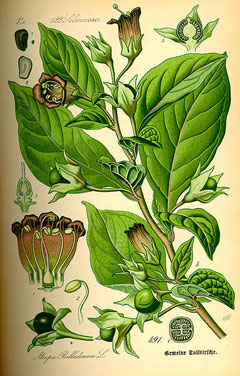
http://commons.wikimedia.org/wiki/File:Illustration_Atropa_bella-donna0.jpg |
 |
| Kurt Stueber |
Translate this page:
Summary
Physical Characteristics

 Atropa bella-donna is a PERENNIAL growing to 0.9 m (3ft) by 0.8 m (2ft 7in).
See above for USDA hardiness. It is hardy to UK zone 7. It is in flower from June to August, and the seeds ripen from August to October. The species is hermaphrodite (has both male and female organs) and is pollinated by Insects.
Suitable for: light (sandy) and medium (loamy) soils and prefers well-drained soil. Suitable pH: mildly acid, neutral and basic (mildly alkaline) soils and can grow in very alkaline soils.
It can grow in full shade (deep woodland) semi-shade (light woodland) or no shade. It prefers moist soil.
UK Hardiness Map
US Hardiness Map
Synonyms
Atropa belladonna
Plant Habitats
Woodland Garden Sunny Edge; Dappled Shade; Shady Edge; Hedgerow;
Edible Uses
References More on Edible Uses
Medicinal Uses
Plants For A Future can not take any responsibility for any adverse effects from the use of plants. Always seek advice from a professional before using a plant medicinally.
Analgesic Antidote Antispasmodic Diuretic Hallucinogenic Homeopathy Mydriatic Narcotic
Sedative Urinary
Although it is poisonous, deadly nightshade has a long history of medicinal use and has a wide range of applications, in particular it is used to dilate the pupils in eye operations, to relieve intestinal colic and to treat peptic ulcers[254]. The plant can be used to treat the symptoms of Parkinson's disease, reducing tremors and rigidity whilst improving speech and mobility[254]. It has also been used as an antidote in cases of mushroom or toadstool poisoning[7]. This is a very poisonous plant, it should be used with extreme caution and only under the supervision of a qualified practitioner[238]. See also the notes above on toxicity. All parts of the plant are analgesic, antidote, antispasmodic, diuretic, hallucinogenic, mydriatic, narcotic and sedative[4, 7, 9, 21, 46, 165, 171, 192, 240]. The root is the most active part of the plant, it is harvested in the autumn and can be 1 - 3 years old, though the older roots are very large and difficult to dig up[4, 7]. The leaves are harvested in late spring and dried for later use[7]. All parts of the plant contain tropane alkaloids[254]. The leaves contain on average 0.4% active alkaloids, whilst the root contains around 0.6%[240]. The alkaloid content also varies according to the development of the plant, being low when the plant is flowering and very high when bearing green berries[240]. These alkaloids inhibit the parasympathetic nervous system which controls involuntary body activities. This reduces saliva, gastric, intestinal and bronchial secretions, as well as the activity of the urinary tubules, bladder and intestines[254]. An extract of the plant has been used as eyedrops. It has the effect of dilating the pupils thus making it easier to perform eye operations[4, 232]. In the past women used to put the drops in their eyes in order to make them look larger and thus 'more beautiful'[4, 232]. The entire plant, harvested when coming into flower, is used to make a homeopathic remedy[232]. This is used especially in cases where there is localised and painful inflammation that radiates heat[232]. It is also used to treat sunstroke and painful menstruation[238].
References More on Medicinal Uses
The Bookshop: Edible Plant Books
Our Latest books on Perennial Plants For Food Forests and Permaculture Gardens in paperback or digital formats.

Edible Tropical Plants
Food Forest Plants for Hotter Conditions: 250+ Plants For Tropical Food Forests & Permaculture Gardens.
More

Edible Temperate Plants
Plants for Your Food Forest: 500 Plants for Temperate Food Forests & Permaculture Gardens.
More

More Books
PFAF have eight books available in paperback and digital formats. Browse the shop for more information.
Shop Now
Other Uses
Soil reclamation
This species has been found to be effective in removing PCB's from the soil and detoxifying them[248]. The plant is more effective in doing this if it is infected with the bacterial parasite Agrobacterium tumefaciens[248].
Special Uses
References More on Other Uses
Cultivation details
Succeeds in any well-drained moisture retentive soil[200] in sun or partial shade[238]. Prefers a calcareous soil[1, 4, 9, 13]. When grown as a medicinal plant, the highest levels of the medically active alkaloids are obtained from plants growing on a light, permeable chalky soil, especially when on a south-west facing slope[4]. The highest concentrations are also formed when the plant is growing in a sunny position and in hot summers[238]. The northerly limits of cultivation are about 50 - 55° north and at an altitude between 100 - 200 metres[4]. This species is widely cultivated, especially in eastern Europe, for the medically active compounds it contains. These are used in the drugs industry to produce a range of medicines[238]. Plants tend to be short-lived[200]. Slugs are very fond of this plant and have been known to completely remove the outer bark from the stems[K].
References Carbon Farming Information and Carbon Sequestration Information
Temperature Converter
Type a value in the Celsius field to convert the value to Fahrenheit:
Fahrenheit:
The PFAF Bookshop
Plants For A Future have a number of books available in paperback and digital form. Book titles include Edible Plants, Edible Perennials, Edible Trees,Edible Shrubs, Woodland Gardening, and Temperate Food Forest Plants. Our new book is Food Forest Plants For Hotter Conditions (Tropical and Sub-Tropical).
Shop Now
Plant Propagation
Seed - best sown as soon as it is ripe in a cold frame. Germination of stored seed is slow and erratic, usually taking 1 - 6 months at 10°c[134, 200]. When they are large enough to handle, prick the seedlings out into individual pots and grow them on in the greenhouse for at least their first winter. Plant them out into their permanent positions in late spring or early summer, after the last expected frosts. Cuttings of softwood terminal shoots in spring[200]. Root cuttings in winter[200].
Other Names
If available other names are mentioned here
Native Plant Search
Search over 900 plants ideal for food forests and permaculture gardens. Filter to search native plants to your area. The plants selected are the plants in our book 'Plants For Your Food Forest: 500 Plants for Temperate Food Forests and Permaculture Gardens, as well as plants chosen for our forthcoming related books for Tropical/Hot Wet Climates and Mediterranean/Hot Dry Climates. Native Plant Search
Found In
Countries where the plant has been found are listed here if the information is available
Weed Potential
Right plant wrong place. We are currently updating this section.
Please note that a plant may be invasive in one area but may not in your area so it’s worth checking.
Conservation Status
IUCN Red List of Threatened Plants Status :

Growth: S = slow M = medium F = fast. Soil: L = light (sandy) M = medium H = heavy (clay). pH: A = acid N = neutral B = basic (alkaline). Shade: F = full shade S = semi-shade N = no shade. Moisture: D = dry M = Moist We = wet Wa = water.

Expert comment
Author
L.
Botanical References
17200
Links / References
For a list of references used on this page please go here
Readers comment