 |
|
http://commons.wikimedia.org/wiki/User:Stan_Shebs |
 |
| USDA-NRCS PLANTS Database |
Translate this page:
Summary
Physical Characteristics

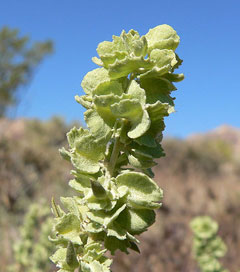
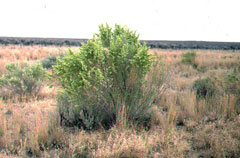
 Atriplex canescens is an evergreen Shrub growing to 1.8 m (6ft) by 1.8 m (6ft).
See above for USDA hardiness. It is hardy to UK zone 7 and is not frost tender. It is in leaf all year, in flower in July, and the seeds ripen in August. The species is dioecious (individual flowers are either male or female, but only one sex is to be found on any one plant so both male and female plants must be grown if seed is required). and is pollinated by Wind. The plant is not self-fertile.
Suitable for: light (sandy) and medium (loamy) soils, prefers well-drained soil and can grow in nutritionally poor soil. Suitable pH: mildly acid, neutral and basic (mildly alkaline) soils and can grow in very alkaline and saline soils.
It cannot grow in the shade. It prefers dry or moist soil and can tolerate drought. The plant can tolerate maritime exposure.
UK Hardiness Map
US Hardiness Map
Synonyms
Plant Habitats
Woodland Garden Sunny Edge; Hedge;
Edible Uses
Edible Parts: Leaves Seed
Edible Uses: Colouring Drink
Leaves - cooked or raw[85, 94. A very acceptable taste with a salty tang[K]. The leaves can be used at any time of the year though winter harvesting must be light because the plant is not growing much at this time of year[K]. Seed - cooked[46, 61]. Ground into a powder, mixed with cereals and used in making cakes etc or used as a piñole[94, 95, 183]. It is small and very fiddly to utilize[K]. The ground up seed can also be mixed with water and drunk as a refreshing beverage[183]. The burnt green herb yields culinary ashes high in minerals and these are used by the Hopi Indians to enhance the colour of blue corn products[183, 257]. The ashes can be used like baking soda[257].
References More on Edible Uses
Medicinal Uses
Plants For A Future can not take any responsibility for any adverse effects from the use of plants. Always seek advice from a professional before using a plant medicinally.
Skin Stings
The leaves can be made into a soapy lather and used as a wash on itches and rashes such as chickenpox[257]. A poultice of the crushed leaves can be applied to ant bites to reduce the pain and swelling[257].
References More on Medicinal Uses
The Bookshop: Edible Plant Books
Our Latest books on Perennial Plants For Food Forests and Permaculture Gardens in paperback or digital formats.

Edible Tropical Plants
Food Forest Plants for Hotter Conditions: 250+ Plants For Tropical Food Forests & Permaculture Gardens.
More

Edible Temperate Plants
Plants for Your Food Forest: 500 Plants for Temperate Food Forests & Permaculture Gardens.
More

More Books
PFAF have eight books available in paperback and digital formats. Browse the shop for more information.
Shop Now
Other Uses
Dye Fire retardant Fodder Hedge Hedge Potash
A good hedge in maritime areas, it responds well to trimming[K]. The leaves and stems were burnt by the Hopi Indians and the alkaline ash used to maintain the blue colour when cooking blue corn[216]. A yellow dye is obtained from the leaves and stems[257]. The leaves can be made into a soapy lather and used as a hair wash[257]. The plant has fire-retardant properties and can be used for barrier plantings to control bush fires[200].
Special Uses
Carbon Farming Food Forest Hedge Hedge
References More on Other Uses
Cultivation details
Fodder: Bank Management: Coppice Management: Fodder Minor Global Crop
Requires a position in full sun in any well-drained but not too fertile soil[11, 134, 200]. Tolerates saline and very alkaline soils[200]. Plants are very tolerant of maritime exposure, though they dislike wet climates[K]. Resents root disturbance when large. Succeeds in a hot dry position. A very ornamental plant[60], though it is liable to succumb to winter wet when grown on heavy or rich soils[11, 200]. This species forms hybrids with Atriplex confertifolia and A. gardneri[270]. Dioecious. Male and female plants must be grown if seed is required. Occasional monoecious plants are found[274]. Individual plants can change sex. The change is more generally from female to male and is apparently associated with stress such as cold or drought. It would appear that the change confers a survival advantage on the plant[274].
Carbon Farming
-
Fodder: Bank
Fodder banks are plantings of high-quality fodder species. Their goal is to maintain healthy productive animals. They can be utilized all year, but are designed to bridge the forage scarcity of annual dry seasons. Fodder bank plants are usually trees or shrubs, and often legumes. The relatively deep roots of these woody perennials allow them to reach soil nutrients and moisture not available to grasses and herbaceous plants.
-
Management: Coppice
Cut to the ground repeatedly - resprouting vigorously. Non-destructive management systems maintaining the soil organic carbon.
-
Management: Fodder
Non-destructive management systems maintaining the soil organic carbon.
-
Minor Global Crop
These crops are already grown or traded around the world, but on a smaller scale than the global perennial staple and industrial crops, The annual value of a minor global crop is under $1 billion US. Examples include shea, carob, Brazil nuts and fibers such as ramie and sisal.
References Carbon Farming Information and Carbon Sequestration Information
Temperature Converter
Type a value in the Celsius field to convert the value to Fahrenheit:
Fahrenheit:
The PFAF Bookshop
Plants For A Future have a number of books available in paperback and digital form. Book titles include Edible Plants, Edible Perennials, Edible Trees,Edible Shrubs, Woodland Gardening, and Temperate Food Forest Plants. Our new book is Food Forest Plants For Hotter Conditions (Tropical and Sub-Tropical).
Shop Now
Plant Propagation
Seed - sow April/May in a cold frame in a compost of peat and sand. Germination usually takes place within 1 - 3 weeks at 13°c[134]. Pot up the seedlings when still small into individual pots, grow on in a greenhouse for the first winter and plant out in late spring or early summer after the last expected frosts. Cuttings of half-ripe wood, July/August in a very sandy compost in a frame. Very easy. Pot up as soon as they start to root (about 3 weeks) and plant out in their permanent positions late in the following spring[K]. Cuttings of mature wood of the current season's growth, November/December in a frame. Very easy. Pot up in early spring and plant out in their permanent position in early summer[K].
Other Names
If available other names are mentioned here
Chamisa, Chamizo, Grey sage brush,
Native Plant Search
Search over 900 plants ideal for food forests and permaculture gardens. Filter to search native plants to your area. The plants selected are the plants in our book 'Plants For Your Food Forest: 500 Plants for Temperate Food Forests and Permaculture Gardens, as well as plants chosen for our forthcoming related books for Tropical/Hot Wet Climates and Mediterranean/Hot Dry Climates. Native Plant Search
Found In
Countries where the plant has been found are listed here if the information is available
Africa, Asia, Australia, Canada, Central America, China, Egypt, Hawaii, Iran, Israel, Libya, Mexico*, North Africa, North America, Pacific, Pakistan, Saudi Arabia, USA,
Weed Potential
Right plant wrong place. We are currently updating this section.
Please note that a plant may be invasive in one area but may not in your area so it’s worth checking.
Conservation Status
IUCN Red List of Threatened Plants Status :

| Related Plants
|
| Latin Name | Common Name | Habit | Height | Hardiness | Growth | Soil | Shade | Moisture | Edible | Medicinal | Other |
| Atriplex argentea | Silvery Orach, Silverscale saltbush, Stalked saltbush | Annual | 0.5 |
0-0
| | LM | N | M | 2 | 2 | 2 |
| Atriplex argentea expansa | Silverscale Saltbush | Annual | 0.6 |
-
| | LM | N | M | 2 | 0 | |
| Atriplex californica | California Orach, California saltbush | Perennial | 0.1 |
7-10
| | LM | N | DM | 3 | 0 | |
| Atriplex carnosa | Thickleaf Orach | Annual | 0.9 |
-
| | LM | N | DM | 2 | 0 | |
| Atriplex confertifolia | Shadscale, Shadscale saltbush | Shrub | 1.8 |
6-9
| | LM | N | DM | 4 | 1 | 0 |
| Atriplex coronata | Crownscale | Annual | 0.4 |
-
| | LM | N | DM | 2 | 0 | |
| Atriplex dimorphostegia | | Annual | 0.2 |
-
| | LM | N | DM | 2 | 0 | |
| Atriplex elegans | Wheelscale Saltbush | Annual | 0.2 |
0-0
| | LM | N | DM | 2 | 0 | 0 |
| Atriplex glabriuscula | Scotland orache, Maritime saltbush, Frankton's saltbush, Northeastern saltbush | Annual | 0.3 |
0-0
| | LM | N | DM | 2 | 0 | |
| Atriplex gmelinii | Gmelin's saltbush | Annual | 0.5 |
0-0
| | LM | N | DM | 2 | 0 | |
| Atriplex halimus | Sea Orach, Saltbush | Shrub | 2.0 |
7-10
| M | LM | N | DM | 5 | 1 | 3 |
| Atriplex hastata | Hastate Orach | Annual | 0.8 |
0-0
| | LM | N | DM | 3 | 0 | 2 |
| Atriplex hortensis | Orach, Garden orache | Annual | 1.8 |
5-9
| F | LM | N | M | 4 | 2 | 3 |
| Atriplex lapathifolia | | Annual | 0.9 |
-
| | LM | N | DM | 3 | 0 | |
| Atriplex lentiformis | Quail Bush, Big saltbush, Quailbush, | Shrub | 3.0 |
7-10
| | LM | N | DM | 3 | 1 | 2 |
| Atriplex maximowicziana | Maximowicz's saltbush | Perennial | 0.8 |
0-0
| | LM | N | DM | 2 | 0 | |
| Atriplex mucronata | | Annual | 0.4 |
-
| | LMH | N | DM | 2 | 0 | |
| Atriplex nummularia | Giant Saltbush, Bluegreen saltbush | Shrub | 3.5 |
7-10
| | LM | N | DM | 3 | 2 | 3 |
| Atriplex nuttallii | Nuttall's Saltbush | Shrub | 0.9 |
5-9
| | LM | N | DM | 4 | 0 | 0 |
| Atriplex patula | Spreading Orach, Spear saltbush | Annual | 0.8 |
0-0
| | LM | N | M | 3 | 1 | |
| Atriplex powellii | Powell's Saltweed | Annual | 1.5 |
-
| | LM | N | DM | 2 | 0 | |
| Atriplex saccaria | Sack Saltbush | Annual | 0.3 |
-
| | LM | N | DM | 2 | 0 | |
| Atriplex semibaccata | Australian Saltbush. Australian saltbush, Creeping saltbush | Shrub | 0.5 |
9-11
| F | LMH | N | DM | 2 | 0 | 3 |
| Atriplex serenana | Bractscale, Davidson's bractscale | Annual | 3.0 |
7-10
| | LM | N | DM | 2 | 0 | |
| Atriplex subcordata | | Annual | 0.5 |
-
| | LM | N | DM | 2 | 0 | |
| Atriplex tatarica | Tatarian orache | Annual | 1.5 |
0-0
| | LM | N | DM | 2 | 0 | |
| Atriplex truncata | Wedgescale Saltbush | Annual | 0.9 |
7-10
| | LM | N | DM | 2 | 0 | 4 |
|
Growth: S = slow M = medium F = fast. Soil: L = light (sandy) M = medium H = heavy (clay). pH: A = acid N = neutral B = basic (alkaline). Shade: F = full shade S = semi-shade N = no shade. Moisture: D = dry M = Moist We = wet Wa = water.

Expert comment
Author
(Pursh.)Nutt.
Botanical References
1160200
Links / References
For a list of references used on this page please go here
Readers comment