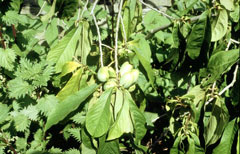
 |
|
http://commons.wikimedia.org/wiki/User:Clarknova |
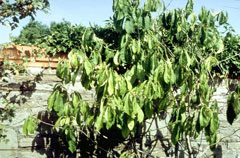 |
| http://commons.wikimedia.org/wiki/User:Clarknova |
Translate this page:
Summary
Bloom Color: Purple.
Main Bloom Time: Early spring, Late spring, Mid spring.
Physical Characteristics

 Asimina triloba is a deciduous Shrub growing to 4.5 m (14ft) by 4 m (13ft) at a slow rate.
See above for USDA hardiness. It is hardy to UK zone 5. It is in flower from May to June, and the seeds ripen in October. The species is hermaphrodite (has both male and female organs). The plant is not self-fertile.
It is noted for attracting wildlife.
Suitable for: medium (loamy) soils and prefers well-drained soil. Suitable pH: mildly acid, neutral and basic (mildly alkaline) soils. It can grow in semi-shade (light woodland) or no shade. It prefers moist soil.
UK Hardiness Map
US Hardiness Map
Synonyms
Annona triloba.
Plant Habitats
Woodland Garden Sunny Edge; South Wall. By. West Wall. By.
Edible Uses
Edible Parts: Fruit
Edible Uses:
Edible fruit - raw or cooked[2, 3, 11, 46, 62, 99]. A very good size, it can be up to 16cm long and 4cm wide[82, 200]. Of variable quality, some forms (with orange skins) are exquisite with the flavour of banana custard whilst others (with yellow, white or dark brown skins) can be unpleasant[57, 85, 183]. Another report says that the white fruits are mildly flavoured and later ripening than the orange fruits[227]. The fruit can also be used for making preserves, pies, ice cream and other sweet desserts[183]. The fruit falls from the tree in autumn and is then stored until fully ripe[227]. The fruit can cause gastro-intestinal upsets for some people[274].
References More on Edible Uses
Medicinal Uses
Plants For A Future can not take any responsibility for any adverse effects from the use of plants. Always seek advice from a professional before using a plant medicinally.
Antiemetic Diuretic Emetic Laxative Narcotic Parasiticide
The fruit is used as a laxative[222]. The leaves are diuretic[222]. They are applied externally to boils, ulcers and abscesses[4, 222]. The seed contains the alkaline asiminine, which is emetic and narcotic[222, 227]. They have been powdered and applied to hair to kill lice[222]. The bark is a bitter tonic[4]. It contains the alkaline analobine, which is used medicinally[227].
References More on Medicinal Uses
The Bookshop: Edible Plant Books
Our Latest books on Perennial Plants For Food Forests and Permaculture Gardens in paperback or digital formats.
Edible Tropical Plants
Food Forest Plants for Hotter Conditions: 250+ Plants For Tropical Food Forests & Permaculture Gardens.
More
Edible Temperate Plants
Plants for Your Food Forest: 500 Plants for Temperate Food Forests & Permaculture Gardens.
More
More Books
PFAF have eight books available in paperback and digital formats. Browse the shop for more information.
Shop Now
Other Uses
Dye Fibre Insecticide Parasiticide Wood
A fibre from the inner bark is used for making strong rope and string[61, 82, 227, 257]. The seed has insecticidal properties[222]. A yellow dye is made from the ripe flesh of the fruit[229]. Wood - light, soft, weak, spongy, coarse grained[82]. It weighs 24lb per cubic foot[227]. It is not used commercially[229]. Landscape Uses: Border, Pest tolerant, Specimen, Woodland Forest garden - a good understory tree. Shelter for wildlife [1-2].
Special Uses
Food Forest
References More on Other Uses
Cultivation details
Pawpaw is a forest understory tree. Prefers a rich loamy soil with plenty of moisture and a sunny position[1, 134, 160]. Full sun to part shade. Pawpaw is shade tolerant and would prefer some afternoon shade from other trees or perhaps the shade of a building. Spreads by root suckers to form colonies, so give it room to spread (nfs.unl.edu). Plants are hardy to about -20°c according to one report[184], whilst another says that they are hardy to -35°c when fully dormant[160]. The papaw produces a delicious edible fruit which is a potentially commercial crop[61]. The wild-collected fruit is often sold in local markets in America[82]. The tree commences bearing in 4 - 6 years from seed and yields up to 30 kilos per tree[160]. There are some named varieties[183]. The mature fruit is rarely seen in Britain[182], only ripening after a long hot summer[200]. A small tree growing against a south-facing wall at Bristol Botanical Gardens had a small crop of immature fruit in early September 1996 (following the hot summer of 1995) - this was the first time it had been seen to bear fruit[K]. Flowers are formed in the leaf axils of wood produced the previous summer[82, 229]. Established plants resent root disturbance, the best plants are obtained by planting them out into their permanent positions as young as possible though young plants should be given some protection for their first year or two[200]. The leaves emit a heavy unpleasant odour when crushed[82, 229]. Plants are untroubled by pests or diseases[160]. Special Features:North American native, Attracts butterflies, Inconspicuous flowers or blooms. The plant is heat tolerant in zones 8 through 6. (Plant Hardiness Zones show how well plants withstand cold winter temperatures.
Plant Heat Zones show when plants would start suffering from the heat.
The Plant Heat Zone map is based on the number of "heat days" experienced in a given area where the temperature climbs to over 86 degrees F (30°C).
At this temperature, many plants begin to suffer physiological damage. Heat Zones range from 1 (no heat days) to 12 (210 or more heat days).
For example Heat Zone. 11-1 indicates that the plant is heat tolerant in zones 11 through 1). For polyculture design as well as the above-ground architecture (form - tree, shrub etc. and size shown above) information on the habit and root pattern is also useful and given here if available. The plant growth habit is suckering with suckers sent up away from the trunk from rhizomes, roots, or stolons [1-2]. For polyculture design as well as the above-ground architecture (form - tree, shrub etc. and size shown above) information on the habit and root pattern is also useful and given here if available. The root pattern is a heart root, dividing from the crown into several primary roots going down and out [1-2]. The root pattern is a tap root similar to a carrot going directly down [1-2]. The root pattern is suckering with new plants from underground runners away from the plant [1-2]. Form: Rounded, Upright or erect. Flowers are strongly protogynous, self-incompatible and require cross-pollination. However, some trees may be self-compatible; it is an excellent idea to plant two or more trees for cross-pollination.
References Carbon Farming Information and Carbon Sequestration Information
Temperature Converter
Type a value in the Celsius field to convert the value to Fahrenheit:
Fahrenheit:
The PFAF Bookshop
Plants For A Future have a number of books available in paperback and digital form. Book titles include Edible Plants, Edible Perennials, Edible Trees,Edible Shrubs, Woodland Gardening, and Temperate Food Forest Plants. Our new book is Food Forest Plants For Hotter Conditions (Tropical and Sub-Tropical).
Shop Now
Plant Propagation
Seed - best sown as soon as it is ripe in a cold frame[200]. The seed usually germinates in 1 - 3 months at 15°c[134]. Stored seed requires stratification, it has embryo dormancy and an impermeable seedcoat and can take up to 18 months to germinate[113, 134]. Dried seed quickly loses its viability. As soon as the seedlings are large enough to handle, prick them out into individual pots and grow them on in the greenhouse for t least their first winter. If trying them outdoors, plant them into their permanent positions in early summer once the plants are more than 15cm tall. Consider giving them some protection from winter cold for their first winter outdoors. Layering.
Other Names
If available other names are mentioned here
Also known as: Annona triloba, Asimina, Asiminier, Asiminier Trilobé, Asiminier de Virginie, Banane du Pauvre Homme, Custard Apple, Dog-Banana, Papaye Américaine, Papaye American, Papaye Nordique, Pawpaw, Paw Paw.
Native Plant Search
Search over 900 plants ideal for food forests and permaculture gardens. Filter to search native plants to your area. The plants selected are the plants in our book 'Plants For Your Food Forest: 500 Plants for Temperate Food Forests and Permaculture Gardens, as well as plants chosen for our forthcoming related books for Tropical/Hot Wet Climates and Mediterranean/Hot Dry Climates. Native Plant Search
Found In
Countries where the plant has been found are listed here if the information is available
Afghanistan, Australia, Britain, Canada, Europe, North America (native), Tasmania, USA [1-4]. A Missouri native small understory tree [2-2]. The USDA database lists Asimina triloba (pawpaw ) as native to some of the L48 (Lower 48 States), and Canada.
Weed Potential
Right plant wrong place. We are currently updating this section.
Please note that a plant may be invasive in one area but may not in your area so it’s worth checking.
Conservation Status
IUCN Red List of Threatened Plants Status :

Growth: S = slow M = medium F = fast. Soil: L = light (sandy) M = medium H = heavy (clay). pH: A = acid N = neutral B = basic (alkaline). Shade: F = full shade S = semi-shade N = no shade. Moisture: D = dry M = Moist We = wet Wa = water.

Expert comment
Author
(L.)Dunal.
Botanical References
1143200
Links / References
For a list of references used on this page please go here
Readers comment