 |
|
http://zsoldosmarton.freeblog.hu/archives/2007/08/ |
 |
| http://commons.wikimedia.org/wiki/User:Karelj |
Translate this page:
Summary
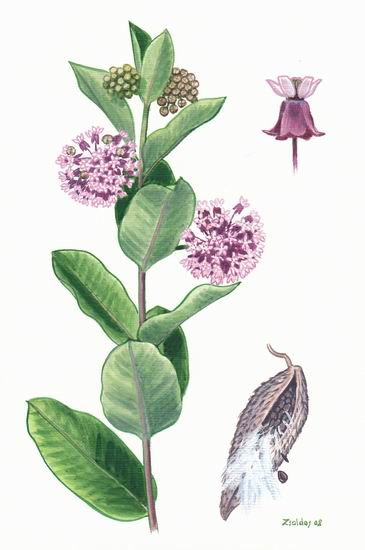
A perennial herb with long-spreading rhizomes. Flowers sweet-smelling, pink to white. Edible Parts include the flowers, leaves; oil, seed, and seedpod. It has some good medicinal and other uses. Common Names: broadleaf milkweed; butterfly flower; cotton weed; silkweed; silky milkweed; silky swallow-wort; Virginia silkweed milkweed; wild cotton. Spanish: asclepia; vencetosigo comun. French: asclepiade; asclepiade de Syrie; cotonnier; petit-cochon. Germany: Gehoernte Seidenpflanze. Netherlands: zijdeplant. Bloom Color: Pink.
Main Bloom Time: Early summer, Late summer, Mid summer. Form: Upright or erect.
Physical Characteristics

 Asclepias syriaca is a PERENNIAL growing to 1 m (3ft 3in) by 1 m (3ft 3in) at a medium rate.
See above for USDA hardiness. It is hardy to UK zone 3. It is in flower from July to August, and the seeds ripen from August to October. The species is hermaphrodite (has both male and female organs) and is pollinated by Bees, insects, Lepidoptera (Moths & Butterflies).
It is noted for attracting wildlife.
Suitable for: light (sandy) and medium (loamy) soils and prefers well-drained soil. Suitable pH: mildly acid, neutral and basic (mildly alkaline) soils. It can grow in semi-shade (light woodland) or no shade. It prefers dry or moist soil.
UK Hardiness Map
US Hardiness Map
Synonyms
A. cornuttii.
Plant Habitats
Cultivated Beds;
Edible Uses
Edible Parts: Flowers Leaves Oil Oil Seed Seedpod Shoots
Edible Uses: Gum Oil Oil Sweetener
Unopened flower buds - cooked. They taste somewhat like peas. They are used like broccoli[183]. Flowers and young flower buds - cooked. They have a mucilaginous texture and a pleasant flavour, they can be used as a flavouring and a thickener in soups etc[55, 102, 257]. The flower clusters can be boiled down to make a sugary syrup[2, 85]. The flowers are harvested in the early morning with the dew still on them[95]. When boiled up they make a brown sugar[95]. Young shoots - cooked. An asparagus substitute[2, 4, 43, 55, 62, 95, 183]. They should be used when less than 20cm tall[159]. A slightly bitter taste[159]. Tips of older shoots are cooked like spinach[85, 183]. Young seed pods, 3 - 4 cm long, cooked[2, 43, 55, 85]. They are very appetizing. Best used when about 2 - 4cm long and before the seed floss forms, on older pods remove any seed floss before cooking them[85, 159]. If picked at the right time, the pods resemble okra[183]. The sprouted seeds can be eaten[183]. An edible oil is obtained from the seed[55, 171]. The latex in the stems is a suitable replacement for chicle and can be made into a chewing gum[46, 61, 269]. It is not really suitable for use in tyres[269]. The latex is found mainly in the leaves and is destroyed by frost[112]. Yields are higher on dry soils[112].
References More on Edible Uses
Medicinal Uses
Plants For A Future can not take any responsibility for any adverse effects from the use of plants. Always seek advice from a professional before using a plant medicinally.
Anodyne Contraceptive Diaphoretic Diuretic Emetic Expectorant Homeopathy Purgative
Warts
The root is anodyne, diaphoretic, diuretic, emetic, expectorant and purgative[4, 21, 222]. It has been used in the treatment of asthma, kidney stones, venereal disease etc[254, 257]. Caution is advised, see the notes above on toxicity. An infusion of the pounded roots has been used by the women of some native North American Indian tribes to promote temporary sterility[213, 257]. The leaves and/or the latex are used in folk remedies for treating cancer and tumours[269]. The milky latex from the stems and leaves is used in the treatment of warts[4, 159, 222, 257]. The latex needs to be applied at least daily over a period of up to a few weeks to be effective. The stems can be cooked and applied as a poultice on rheumatic joints[257]. One reported Mohawk antifertility concoction contained milkweed and jack-in-the-pulpit, both considered contraceptive. Dried and pulverized, a fistful of milkweed and three Arisaema rhizomes were infused in a pint of water for 20 minutes. The infusion was drunk, a cupful an hour, to induce temporary sterility[269]. The rhizome is used in homeopathy as an antioedemic and emmenagogue in the treatment of dropsy and dysmenorrhoea[269].
References More on Medicinal Uses
The Bookshop: Edible Plant Books
Our Latest books on Perennial Plants For Food Forests and Permaculture Gardens in paperback or digital formats.
Edible Tropical Plants
Food Forest Plants for Hotter Conditions: 250+ Plants For Tropical Food Forests & Permaculture Gardens.
More
Edible Temperate Plants
Plants for Your Food Forest: 500 Plants for Temperate Food Forests & Permaculture Gardens.
More
More Books
PFAF have eight books available in paperback and digital formats. Browse the shop for more information.
Shop Now
Other Uses
Adhesive Fibre Gum Latex Oil Oil Pollution Stuffing Wick
A good quality fibre is obtained from the inner bark of the stems. It is long and quite strong, but brittle[269]. It can be used in making twine, cloth, paper etc[95, 112, 169]. The fibre is of poor quality in wet seasons[112]. It is easily harvested in late autumn after the plant has died down by simply pulling the fibres off the dried stems[169]. It is estimated that yields of 1,356 kilos per hectare could be obtained from wild plants[269]. The seed floss is used to stuff pillows etc or is mixed with other fibres to make cloth[112, 159, 169, 171]. It is a Kapok substitute, used in Life Jackets or as a stuffing material[112]. Very water repellent, it can yield up to 550 kilos per hectare[112]. The floss absorbs oil whilst repelling water and so has also been used to mop up oil spills at sea. Candlewicks can be made from the seed floss[112, 207]. In cultivation, only 1 - 3% of the flowers produce mature pods[269]. It is estimated that yields of 1,368 kilos per hectare could be obtained from wild plants[269]. Rubber can be made from latex contained in the leaves and the stems[46, 57, 102, 159]. It is found mainly in the leaves and is destroyed by frost[112]. Yields of 197 kilos per hectare can be expected from wild plants, it is estimated that by selection these yields could be increased to 897 kilos[269]. Yields are higher on dry soils[112]. The latex can also be used as a glue for fixing precious stones into necklaces, earrings etc[257]. The latex contains 0.1 - 1.5% caoutchouc, 16 - 17% dry matter, and 1.23% ash. It also contains the digitalis-like mixture of a- and b-asclepiadin, the antitumor b-sitosterol, and a- and b-amyrin and its acetate, dextrose and wax[269]. Pods contain an oil and a wax which are of potential importance. The seed contains up to 20% of an edible semi-drying oil[74, 112]. It is also used in making liquid soap[74]. The dogbane-milkweed family Asclepias, Apocynum, Calotropis, and Trachomitum spp) has been used for fiber industrial crops for millennia with a number in cultivation as regional crops. All of these crops are dual-purpose fibres, offering bast fibres from the stem and seed finer or ‘floss’ in the fruit pods. Many have also been identified as potential hydrocarbon crops due to high latex content. Could be integrated into various agroforestry systems rather than as monocultures [1-1].
Special Uses
Attracts Wildlife Carbon Farming Food Forest Scented Plants
References More on Other Uses
Cultivation details
Experimental Crop Industrial Crop: Fiber Industrial Crop: Hydrocarbon Management: Hay
Succeeds in any good soil[187]. Prefers a well-drained light rich or peaty soil[1, 200]. Requires a moist peaty soil and a sunny position[111, 134]. Plants are hardy to about -25°c[187]. A very ornamental plant[1], though it can be invasive by means of its spreading root system[200]. The flowers diffuse a delicious scent into the garden. This scent attracts bees, who obtain copious supplies of nectar from the plants[50, 74, K], though unfortunately the plants do not always flower in Britain[K]. The flower of many members of this genus can trap insects between its anther cells, the struggles of the insect in escaping ensure the pollination of the plant[207]. This plant has a very wide range of uses and merits attention as a food, fibre and rubber crop[K]. It was possibly cultivated at one time by the North American Indians for its many uses[159]. It is considered by some to be the greatest underachiever among plants. Its potential appears great, yet until now it has never been continuously processed for commercial purposes[269]. Many members of this genus seem to be particularly prone to damage by slugs. The young growth in spring is especially vulnerable, but older growth is also attacked and even well-established plants have been destroyed in wet years[K]. Plants resent root disturbance and are best planted into their final positions whilst small[134]. Special Features:North American native, Invasive, Naturalizing, Attracts butterflies, Fragrant flowers. The plant is heat tolerant in zones 9 through 2. (Plant Hardiness Zones show how well plants withstand cold winter temperatures.
Plant Heat Zones show when plants would start suffering from the heat.
The Plant Heat Zone map is based on the number of "heat days" experienced in a given area where the temperature climbs to over 86 degrees F (30°C).
At this temperature, many plants begin to suffer physiological damage. Heat Zones range from 1 (no heat days) to 12 (210 or more heat days).
For example Heat Zone. 11-1 indicates that the plant is heat tolerant in zones 11 through 1.) For polyculture design as well as the above-ground architecture (form - tree, shrub etc. and size shown above) information on the habit and root pattern is also useful and given here if available. The plant growth habit is a runner spreading indefinitely by rhizomes or stolons [1-2]. The root pattern is rhizomatous with underground stems sending roots and shoots along their length [1-2].
Carbon Farming
-
Experimental Crop
Plant breeders are testing these plants to see if they could be domesticated for cultivation, but they are still in an experimental phase. Examples include milkweed and leafy spurge.
-
Industrial Crop: Fiber
Clothing, rugs, sheets, blankets etc. Currently, almost none of our fiber are produced from perennial crops but could be!
-
Industrial Crop: Hydrocarbon
Materials, chemicals and energy include bioplastics, rubber, biomass products gasoline, jet fuel, diesel, butane, propane, biogas. Plants are usually resprouting plants and saps.
-
Management: Hay
Cut to the ground and harvested annually. Non-destructive management systems maintaining the soil organic carbon.
References Carbon Farming Information and Carbon Sequestration Information
Temperature Converter
Type a value in the Celsius field to convert the value to Fahrenheit:
Fahrenheit:
The PFAF Bookshop
Plants For A Future have a number of books available in paperback and digital form. Book titles include Edible Plants, Edible Perennials, Edible Trees,Edible Shrubs, Woodland Gardening, and Temperate Food Forest Plants. Our new book is Food Forest Plants For Hotter Conditions (Tropical and Sub-Tropical).
Shop Now
Plant Propagation
Seed - best sown in a greenhouse as soon as it is ripe in the autumn or in late winter[134, 169]. We have also had good results from sowing the seed in the greenhouse in early spring[K], though stored seed might need 2 - 3 weeks cold stratification[134]. Germination usually takes place in 1 - 3 months at 18°c[134]. As soon as the seedlings are large enough to handle, prick them out into individual pots and grow them on in the greenhouse for their first winter. Plant out when they are in active growth in late spring or early summer and give them some protection from slugs until they are growing away strongly. Division in spring. With great care since the plant resents root disturbance. Pot the divisions up and place them in a lightly shaded position in the greenhouse until they are growing away strongly, then plant them out in the summer, giving them some protection from slugs until they are established.. Basal cuttings in late spring. Use shoots about 10cm long with as much of their white underground stem as possible. Pot them up individually and place them in a lightly shaded position in a greenhouse until they are rooting and growing actively. If the plants grow sufficiently, they can be put into their permanent positions in the summer, otherwise keep them in the greenhouse until the following spring and when they are in active growth plant them out into their permanent positions. Give them some protection from slugs until they are established.
Other Names
If available other names are mentioned here
Native Plant Search
Search over 900 plants ideal for food forests and permaculture gardens. Filter to search native plants to your area. The plants selected are the plants in our book 'Plants For Your Food Forest: 500 Plants for Temperate Food Forests and Permaculture Gardens, as well as plants chosen for our forthcoming related books for Tropical/Hot Wet Climates and Mediterranean/Hot Dry Climates. Native Plant Search
Found In
Countries where the plant has been found are listed here if the information is available
Weed Potential
Right plant wrong place. We are currently updating this section.
Please note that a plant may be invasive in one area but may not in your area so it’s worth checking.
Can be an aggressive and persistent weed and contains several poisonous glucosidic substances (cardenolides) known to be poisonous to sheep, cattle, and occasionally horses. A. syriaca has been found to be the most abundant invasive species in open sand grasslands.
Conservation Status
IUCN Red List of Threatened Plants Status : This taxon has not yet been assessed.

| Related Plants
|
| Latin Name | Common Name | Habit | Height | Hardiness | Growth | Soil | Shade | Moisture | Edible | Medicinal | Other |
| Asclepias asperula | Antelope Horns, Spider milkweed, Trailing Milkweed | Perennial | 1.0 |
7-9
| M | LM | SN | DM | 2 | 1 | 3 |
| Asclepias brachystephana | Bract milkweed | Perennial | 0.3 |
0-0
| | L | SN | DM | 0 | 0 | 2 |
| Asclepias californica | California Milkweed, Greene's milkweed | Perennial | 0.5 |
0-0
| | L | SN | DM | 2 | 1 | 2 |
| Asclepias currasavica | Blood Flower | Perennial | 2.0 |
10-12
| F | LMH | N | M | 0 | 1 | 2 |
| Asclepias decumbens | | Perennial | 0.9 |
-
| | L | SN | DM | 2 | 0 | 2 |
| Asclepias eriocarpa | Woollypod Milkweed | Perennial | 0.9 |
7-10
| | L | SN | DM | 2 | 2 | 3 |
| Asclepias erosa | Desert Milkweed | Perennial | 0.8 |
0-0
| | L | N | DM | 2 | 0 | 3 |
| Asclepias galioides | Bedstraw Milkweed | Perennial | 0.4 |
-
| | L | SN | DM | 2 | 1 | 2 |
| Asclepias hallii | Purple Silkweed, Hall's milkweed | Perennial | 1.0 |
3-7
| | LM | SN | DM | 3 | 1 | 3 |
| Asclepias incarnata | Swamp Milkweed, Swamp Butterfly Weed, Marsh Milkweed | Perennial | 1.2 |
3-8
| M | LM | SN | DMWe | 3 | 2 | 3 |
| Asclepias involucrata | Dwarf Milkweed | Perennial | 0.0 |
-
| | L | SN | DM | 2 | 1 | 2 |
| Asclepias lanceolata | Purple Silkweed, Fewflower milkweed | Perennial | 1.2 |
4-8
| | LM | SN | DM | 2 | 1 | 3 |
| Asclepias latifolia | Broadleaf Milkweed | Perennial | 0.8 |
-
| | L | SN | DM | 0 | 1 | 2 |
| Asclepias mexicana | | Perennial | 0.8 |
5-9
| | L | SN | DM | 1 | 0 | 2 |
| Asclepias ovalifolia | Oval-leaf milkweed | Perennial | 0.6 |
5-9
| | LM | SN | DM | 2 | 0 | 3 |
| Asclepias pumila | Low Milkweed, Plains milkweed | Perennial | 0.4 |
5-9
| | LM | SN | DM | 2 | 1 | 3 |
| Asclepias purpurascens | Purple Milkweed | Perennial | 0.8 |
-
| | LM | SN | DM | 2 | 1 | 3 |
| Asclepias quadrifolia | Fourleaf Milkweed | Perennial | 0.5 |
4-8
| | LM | SN | DM | 2 | 2 | 3 |
| Asclepias rubra | Red Silkweed | Perennial | 1.2 |
4-8
| | LM | SN | DM | 3 | 1 | 3 |
| Asclepias speciosa | Showy Milkweed | Perennial | 0.8 |
3-9
| | LM | SN | DM | 3 | 2 | 3 |
| Asclepias subulata | Rush Milkweed | Perennial | 2.0 |
5-9
| | L | SN | DM | 0 | 1 | 3 |
| Asclepias sullivantii | Prairie milkweed | Perennial | 1.2 |
0-0
| | L | SN | DM | 0 | 0 | 3 |
| Asclepias tuberosa | Pleurisy Root, Butterfly milkweed, Rolfs' milkweed, Indian Paintbrush | Perennial | 0.8 |
3-9
| M | LM | SN | DM | 3 | 3 | 4 |
| Asclepias viridiflora | Green Milkweed, Green comet milkweed | Perennial | 1.0 |
0-0
| | LM | SN | DM | 3 | 2 | 3 |
|
Growth: S = slow M = medium F = fast. Soil: L = light (sandy) M = medium H = heavy (clay). pH: A = acid N = neutral B = basic (alkaline). Shade: F = full shade S = semi-shade N = no shade. Moisture: D = dry M = Moist We = wet Wa = water.

Expert comment
Author
L.
Botanical References
43200
Links / References
For a list of references used on this page please go here
Readers comment
© 2010, Plants For A Future. Plants For A Future is a charitable company limited by guarantee, registered in England and Wales. Charity No. 1057719, Company No. 3204567.