 |
|
http://www.hear.org/starr/ |
 |
| http://commons.wikimedia.org/wiki/File:Illustration_Arundo_donax0.jpg |
Translate this page:
Summary
Arundo donax is a tall, perennial grass species with edible, medicinal and other uses. It is one of the most promising crops for energy production in the Mediterranean climate of Europe and Africa. Bloom Color: Green, Purple.
Main Bloom Time: Early fall, Late fall, Mid fall. Form: Upright or erect. Common Names: bamboo reed; giant cane; spanish reed; wild cane. Spanish: caña común; caña de Castilla; carizo; carrizo. French: canne de Provence; grand roseau. Arabic: ghab; qalam. Chinese: lu zhu. Portuguese: cana palustre; canno de reino. Australia: bamboo; Danubian reed; e-grass; elephant grass; giant Danube grass; oboe reed. Brazil: cana do brejo; cana do reino; cana-brava; canno do reino; capim plumoso; taquara-do-reino. Chile: cañamo. Colombia: caña brava. Costa Rica: caña hueca. Cuba: caña de Castilla; caña de río; caña hueca; cañita de la india. Dominican Republic: cañita. Fiji: ngasau ni vavalangi. Germany: Pfahlrohr. Haiti: herbe roseau; roseau. India: nal. Italy: canna commune; canna comune; canna di Provenza. Netherlands: Pijlriet. Puerto Rico: caña gigante; guajana. Samoa: fiso palagi. South Africa: Spaanse-riet. Spain: falso bamboo; gallipato alcublano; junco gigante. Tonga: kaho; kaho folalahi. Uruguay: caña musical.
Physical Characteristics

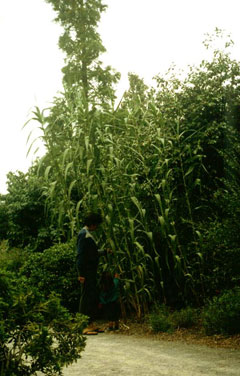
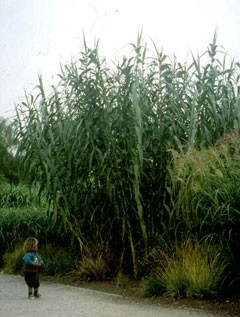
 Arundo donax is a PERENNIAL growing to 6 m (19ft) by 4 m (13ft) at a fast rate.
See above for USDA hardiness. It is hardy to UK zone 6. It is in flower in September, and the seeds ripen in October. The species is hermaphrodite (has both male and female organs) and is pollinated by Wind.
Suitable for: light (sandy), medium (loamy) and heavy (clay) soils and prefers well-drained soil. Suitable pH: mildly acid, neutral and basic (mildly alkaline) soils and can grow in very alkaline soils.
It cannot grow in the shade. It prefers moist or wet soil. The plant can tolerates strong winds but not maritime exposure.
UK Hardiness Map
US Hardiness Map
Synonyms
A. maxima.
Plant Habitats
Woodland Garden Sunny Edge; Hedge; Bog Garden;
Edible Uses
Edible Parts: Leaves Root
Edible Uses:
Rhizome - raw or cooked[84]. The rhizome can be dried and ground into a powder to make bread, usually in conjunction with cereal flours[7, K]. It can also be roasted or boiled[84]. Leaves - cooked as a potherb[84]. They are very bitter[177]. The young shoots are used[177].
References More on Edible Uses
Medicinal Uses
Plants For A Future can not take any responsibility for any adverse effects from the use of plants. Always seek advice from a professional before using a plant medicinally.
Diaphoretic Diuretic Emollient Galactofuge Hypotensive
The root is diaphoretic, diuretic, emollient and galactofuge[7]. An infusion is said to stimulate menstrual discharge and diminish milk flow[240, 272]. A paste of the root is applied to the forehead to treat headaches[272]. Isolated alkaloids have been experimentally shown to raise the blood pressure and contract the intestine and uterus[240]. The rhizome or rootstock is used in the treatment of dropsy. Boiled in wine with honey, the root or rhizome has been used for treating cancer[269]. The plant contains the alkaloid gramine. This is said to be a vasopressor, raising the blood pressure in dogs after small doses, causing a fall in larger doses[269]. The stems have been used as splints for broken limbs[257].
References More on Medicinal Uses
The Bookshop: Edible Plant Books
Our Latest books on Perennial Plants For Food Forests and Permaculture Gardens in paperback or digital formats.

Edible Tropical Plants
Food Forest Plants for Hotter Conditions: 250+ Plants For Tropical Food Forests & Permaculture Gardens.
More

Edible Temperate Plants
Plants for Your Food Forest: 500 Plants for Temperate Food Forests & Permaculture Gardens.
More

More Books
PFAF have eight books available in paperback and digital formats. Browse the shop for more information.
Shop Now
Other Uses
Basketry Biomass Broom Dye Fodder Hedge Hedge Musical Paper Pipes Plant support Shelterbelt Soil stabilization Thatching Weaving
Brooms are made from the terminal panicles[7]. Plants are grown alongside irrigation canals to check soil erosion[169]. The plant can be grown as a windbreak screen[1, 169]. If cut down, the culms branch and in this form the plants can be used as a hedge[236]. The leaves can be woven into mats etc, whilst the split and flattened stems are used to make screens, walls of houses etc[46, 50, 61, 84]. A yellow dye is obtained from the pollen[257]. The stems of the plant have a multitude of applications. They are used as plant supports for vines and other climbing plants[7, 169, 269] and to make clarinets, bag-pipes etc[46, 61, 103]. They are also used as pipe stems[84], for roofing[46], to make screens, walking sticks and in basketry[100, 195]. They are used to make the reeds of clarinets and organ pipes[236]. The stems can be harvested as desired at any time of the year[269]. The fibre from the stems can be used to make a good quality paper[269]. This plant is currently (1995) under investigation at Rosewarne in Cornwall as a potential commercial paper crop for small-scale industries in SW. England[K]. Because of rather high yields from natural stands, the plant has been suggested as a source of biomass for energy production[7, 269]. Dry cane yields of ca 10, 15, and 20 tonnes per hectare were reported respectively from infertile, partly fertile and fertile soils[269]. According to the phytomass files annual productivity ranges from 10 to 59 tonnes per hectare, the latter figure from Westlake's (1963) estimate of 57 - 59 tonnes[269]. In addendum, Westlake cites evidence that Arundo donax can produce 40–75 MT/ha/yr. in warm temperate and tropical regions. Early vegetative growth has ME (metabolizable energy) of 2.22 megacalories/kg DM, while hay has an ME of only 1.37 (Gohl, 1981). Such annual productivity, if sustainable, makes this a notable energy candidate, especially when one considers the energy as a by-product, with leaf protein and potential pharmaceutical as primary products[269]. A particular type of cellulose is obtained from the plant[7]. In Italy, the plant is used in the manufacture of rayon[269]. Bio-fuel crop.
Special Uses
Carbon Farming Hedge Hedge
References More on Other Uses
Cultivation details
Fodder: Bank Industrial Crop: Biomass Management: Hay Minor Global Crop
Landscape Uses:Container, Screen, Specimen, Winter interest. Prefers a moist fertile soil in a sunny sheltered position, preferably by water[1, 134, 200]. Tolerates a pH in the range 5.5 to 8.3. Plants can be grown as a specimen in lawns etc, succeeding in quite coarse grass[233]. Plants are succeeding in a site that is very exposed to maritime winds at Rosewarne in Cornwall[K]. Adapted to tropical, subtropical and warm temperate climates of the World, Giant reed is often found on sand dunes near seashores. It tolerates some salt. It grows best along river banks and in other wet places, and is best developed in poor sandy soil and in sunny situations. Said to tolerate all types of soils, from heavy clays to loose sands and gravelly soils. Ranging from Cool Temperate Wet through Tropical Dry to Wet Forest Life Zones, giant reed is reported to tolerate annual precipitation of 30 to 400cm, an average annual temperature range of 9 to 28.5°C and a pH in the range of 5.0 to 8.7[269]. One report says that this plant is only hardy in the milder areas of Britain[1] whilst another report says that it is hardy to between -5 and -10°c[200]. This contradicts with the hardiness zone rating of 6 which would make the plant hardy in most areas of Britain[200]. Plants thrive outdoors at Oxford Botanical Gardens[233] as well as at Hilliers Arboretum in Hampshire and the RHS Gardens in Surrey[K]. Extensively cultivated in S. Europe for basket making etc[50]. Plants rarely if ever flower in British gardens233]. Members of this genus are rarely if ever troubled by browsing deer[233]. Special Features:
Attracts birds, Attractive foliage, Not North American native, Naturalizing, Wetlands plant, Suitable for cut flowers, Suitable for dried flowers, Attractive flowers or blooms.
Carbon Farming
-
Fodder: Bank
Fodder banks are plantings of high-quality fodder species. Their goal is to maintain healthy productive animals. They can be utilized all year, but are designed to bridge the forage scarcity of annual dry seasons. Fodder bank plants are usually trees or shrubs, and often legumes. The relatively deep roots of these woody perennials allow them to reach soil nutrients and moisture not available to grasses and herbaceous plants.
-
Industrial Crop: Biomass
Three broad categories: bamboos, resprouting woody plants, and giant grasses. uses include: protein, materials (paper, building materials, fibers, biochar etc.), chemicals (biobased chemicals), energy - biofuels
-
Management: Hay
Cut to the ground and harvested annually. Non-destructive management systems maintaining the soil organic carbon.
-
Minor Global Crop
These crops are already grown or traded around the world, but on a smaller scale than the global perennial staple and industrial crops, The annual value of a minor global crop is under $1 billion US. Examples include shea, carob, Brazil nuts and fibers such as ramie and sisal.
References Carbon Farming Information and Carbon Sequestration Information
Temperature Converter
Type a value in the Celsius field to convert the value to Fahrenheit:
Fahrenheit:
The PFAF Bookshop
Plants For A Future have a number of books available in paperback and digital form. Book titles include Edible Plants, Edible Perennials, Edible Trees,Edible Shrubs, Woodland Gardening, and Temperate Food Forest Plants. Our new book is Food Forest Plants For Hotter Conditions (Tropical and Sub-Tropical).
Shop Now
Plant Propagation
Seed - surface sow in a greenhouse in February to April. Stand the pots in about 3cm of water to keep the soil moist until the seed germinates. It usually germinates in 1 - 3 months at 15°c[134]. When large enough to handle, prick the seedlings out into individual pots and grow them on in the greenhouse for at least their first winter. Once they are 20cm or more tall, plant them out into their permanent positions in late spring or early summer. Division in spring[1]. Whilst large divisions can be planted out direct into their permanent positions, we have found that it is best to pot the divisions up and keep them in light shade in a greenhouse until they are rooting away well. Stem cuttings, placed in water, root easily[1].
Other Names
If available other names are mentioned here
Native Plant Search
Search over 900 plants ideal for food forests and permaculture gardens. Filter to search native plants to your area. The plants selected are the plants in our book 'Plants For Your Food Forest: 500 Plants for Temperate Food Forests and Permaculture Gardens, as well as plants chosen for our forthcoming related books for Tropical/Hot Wet Climates and Mediterranean/Hot Dry Climates. Native Plant Search
Found In
Countries where the plant has been found are listed here if the information is available
Weed Potential
Right plant wrong place. We are currently updating this section.
Please note that a plant may be invasive in one area but may not in your area so it’s worth checking.
This plant can be weedy or invasive. Listed as one of the 100 world’s worst invasive alien species. Primary threats to native riparian habitats. Highly invasive plant in southwestern North American rivers. In New Zealand it is listed under the National Pest Plant Accord as an unwanted organism.
Conservation Status
IUCN Red List of Threatened Plants Status : Arundo donax (Giant Reed)
Status: Least Concern.

Growth: S = slow M = medium F = fast. Soil: L = light (sandy) M = medium H = heavy (clay). pH: A = acid N = neutral B = basic (alkaline). Shade: F = full shade S = semi-shade N = no shade. Moisture: D = dry M = Moist We = wet Wa = water.

Expert comment
Author
L.
Botanical References
50200
Links / References
For a list of references used on this page please go here
Readers comment