 |
|
(c) 2010 Ken Fern & Plants For A Future |
 |
| (c) 2010 Ken Fern & Plants For A Future |
Translate this page:
Summary
Physical Characteristics

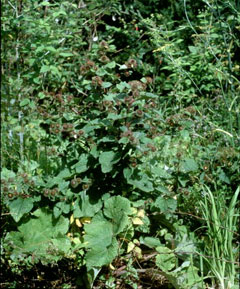
 Arctium lappa is a BIENNIAL growing to 2 m (6ft) by 1 m (3ft 3in).
See above for USDA hardiness. It is hardy to UK zone 3 and is not frost tender. It is in flower from July to September, and the seeds ripen from September to October. The species is hermaphrodite (has both male and female organs) and is pollinated by Bees, Lepidoptera (Moths & Butterflies). The plant is self-fertile.
It is noted for attracting wildlife.
Suitable for: light (sandy), medium (loamy) and heavy (clay) soils and prefers well-drained soil. Suitable pH: mildly acid, neutral and basic (mildly alkaline) soils. It can grow in semi-shade (light woodland) or no shade. It prefers moist soil.
UK Hardiness Map
US Hardiness Map
Synonyms
Arctium majus. Arcion majus. Arcion tomentosum. Lappa glabra.
Plant Habitats
Woodland Garden Sunny Edge; Meadow; Cultivated Beds;
Edible Uses
Edible Parts: Leaves Root Seed Stem
Edible Uses:
Root - raw or cooked[2, 7, 9, 14, 179]. Very young roots can be eaten raw, but older roots are normally cooked[206]. They can be up to 120cm long and 2.5cm wide at the top, but are best harvested when no more than 60cm long[206]. Old and very long roots are apt to become woody at the core[206]. Although it does not have much flavour the root can absorb other flavours[116]. Young roots have a mild flavour, but this becomes stronger as the root gets older[206]. The root is white but discolours rapidly when exposed to the air[206]. Roots can be dried for later use[213]. They contain about 2.5% protein, 0.14% fat, 14.5% carbohydrate, 1.17% ash[179]. The root contains about 45% inulin[240]. Inulin is a starch that cannot be digested by the human body, and thus passes straight through the digestive system. In some people this starch will cause fermentation in the gut, resulting in wind[K]. Inulin can be converted into a sweetener that is suitable for diabetics to eat[K]. Young leaves - raw or cooked[9, 12, 14, 62]. A mucilaginous texture[179]. The leaves contain about 3.5% protein, 1.8% fat, 19.4% carbohydrate, 8.8% ash[179]. Young stalks and branches - raw or cooked[2, 9, 52, 55, 62]. Used like asparagus or spinach[12, 183]. They taste best if the rind is removed[85, 117]. The leaf stalks can be parboiled and used as a substitute for cardoons[183]. The pith of the flowering stem can be eaten raw in salads, boiled or made into confections[4, 183]. A delicate vegetable, somewhat like asparagus in flavour[4]. The seeds can be sprouted and used like bean-sprouts[12, 52, 183].
References More on Edible Uses
| Composition
|
| Figures in grams (g) or miligrams (mg) per 100g of food.
|
|
|
Leaves (Fresh weight)
|
|
- 0 Calories per 100g
- Water : 0%
- Protein: 3.5g; Fat: 1.8g; Carbohydrate: 19.4g; Fibre: 0g; Ash: 8.8g;
- Minerals - Calcium: 0mg; Phosphorus: 0mg; Iron: 0mg; Magnesium: 0mg; Sodium: 0mg; Potassium: 0mg; Zinc: 0mg;
- Vitamins - A: 0mg; Thiamine (B1): 0mg; Riboflavin (B2): 0mg; Niacin: 0mg; B6: 0mg; C: 0mg;
- Reference: [ ]
- Notes:
|
|
Medicinal Uses
Plants For A Future can not take any responsibility for any adverse effects from the use of plants. Always seek advice from a professional before using a plant medicinally.
Alterative Antibacterial Antifungal Antiphlogistic Antipsoriatic Aperient Blood purifier Carminative
Cholagogue Depurative Diaphoretic Diuretic Eczema Hypoglycaemic Stomachic
Burdock is one of the foremost detoxifying herbs in both Chinese and Western herbal medicine[254]. The dried root of one year old plants is the official herb, but the leaves and fruits can also be used[4]. It is used to treat conditions caused by an 'overload' of toxins, such as throat and other infections, boils, rashes and other skin problems[254]. The root is thought to be particularly good at helping to eliminate heavy metals from the body[254]. The plant is also part of a North American formula called essiac which is a popular treatment for cancer. Its effectiveness has never been reliably proven or disproven since controlled studies have not been carried out. The other herbs included in the formula are Rumex acetosella, Ulmus rubra and Rheum palmatum[254]. The plant is antibacterial, antifungal, carminative[9, 21, 147, 165, 176]. It has soothing, mucilaginous properties and is said to be one of the most certain cures for many types of skin diseases, burns, bruises etc[4, 244]. It is used in the treatment of herpes, eczema, acne, impetigo, ringworm, boils, bites etc[244]. The plant can be taken internally as an infusion, or used externally as a wash[244]. Use with caution[165]. The roots of one-year old plants are harvested in mid-summer and dried. They are alterative, aperient, blood purifier, cholagogue, depurative, diaphoretic, diuretic and stomachic[218, 222]. The seed is alterative, antiphlogistic, depurative, diaphoretic and diuretic[218]. Recent research has shown that seed extracts lower blood sugar levels[238]. The seed is harvested in the summer and dried for later use[254]. The crushed seed is poulticed onto bruises[222]. The leaves are poulticed onto burns, ulcers and sores[222].
References More on Medicinal Uses
The Bookshop: Edible Plant Books
Our Latest books on Perennial Plants For Food Forests and Permaculture Gardens in paperback or digital formats.

Edible Tropical Plants
Food Forest Plants for Hotter Conditions: 250+ Plants For Tropical Food Forests & Permaculture Gardens.
More

Edible Temperate Plants
Plants for Your Food Forest: 500 Plants for Temperate Food Forests & Permaculture Gardens.
More

More Books
PFAF have eight books available in paperback and digital formats. Browse the shop for more information.
Shop Now
Other Uses
References More on Other Uses
Cultivation details
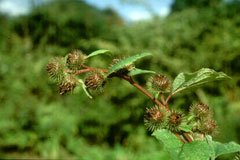
Succeeds in most soils when grown in partial shade[200]. Prefers a moist neutral to alkaline soil[238] and a sunny position in a heavy soil[22]. Plants are best grown in a light well-drained soil if the roots are required for culinary use[200, 206]. Tolerates a pH in the range 4.6 to 7.8. The top growth dies back at temperatures a little above freezing, but the roots tolerate much lower temperatures[206] and can be left in the ground all winter to be harvested as required. Burdock is cultivated for its edible root in Japan, there are some named varieties[183]. Spring-sown seed produces edible roots in late summer and autumn, whilst autumn sown crops mature in the following spring or early summer[206]. Although the plants are quite large, it is best to grow them fairly close together (about 15cm apart, or in rows 30cm apart with the plants 5 - 8cm apart in the rows) since this encourages the development of long straight roots[206]. The seed head has little hooked prickles and these attach themselves to the hairs or clothing of passing creatures and can thus be carried for some considerable distance from the parent plant[4]. The plants usually self-sow freely[238]. The flowers are very attractive to bees and butterflies[206]. In garden design, as well as the above-ground architecture of a plant, root structure considerations help in choosing plants that work together for their optimal soil requirements including nutrients and water. The root pattern is fleshy. Thick or swollen - fibrous or tap root [2-1].
References Carbon Farming Information and Carbon Sequestration Information
Temperature Converter
Type a value in the Celsius field to convert the value to Fahrenheit:
Fahrenheit:
The PFAF Bookshop
Plants For A Future have a number of books available in paperback and digital form. Book titles include Edible Plants, Edible Perennials, Edible Trees,Edible Shrubs, Woodland Gardening, and Temperate Food Forest Plants. Our new book is Food Forest Plants For Hotter Conditions (Tropical and Sub-Tropical).
Shop Now
Plant Propagation
Seed - best sown in situ in the autumn[200]. The seed can also be sown in spring[206]. Germination can be erratic, it is best to sow the seed in trays and plant out the young plants before the tap-root develops[206]. Seed requires a minimum temperature of 10°c, but a temperature of 20 - 25°c is optimum[206]. Germination rates can be improved by pre-soaking the seed for 12 hours or by scarification[206]. They germinate best in the light[206]. The autumn sowing should be made as late as possible because any plants with roots more than 3mm in diameter in the spring will quickly run to seed if cold temperatures are followed by daylengths longer than 12½ hours[206].
Other Names
If available other names are mentioned here
Native Plant Search
Search over 900 plants ideal for food forests and permaculture gardens. Filter to search native plants to your area. The plants selected are the plants in our book 'Plants For Your Food Forest: 500 Plants for Temperate Food Forests and Permaculture Gardens, as well as plants chosen for our forthcoming related books for Tropical/Hot Wet Climates and Mediterranean/Hot Dry Climates. Native Plant Search
Found In
Countries where the plant has been found are listed here if the information is available
Weed Potential
Right plant wrong place. We are currently updating this section.
Please note that a plant may be invasive in one area but may not in your area so it’s worth checking.
Conservation Status
IUCN Red List of Threatened Plants Status :

Growth: S = slow M = medium F = fast. Soil: L = light (sandy) M = medium H = heavy (clay). pH: A = acid N = neutral B = basic (alkaline). Shade: F = full shade S = semi-shade N = no shade. Moisture: D = dry M = Moist We = wet Wa = water.

Expert comment
Author
L.
Botanical References
17200
Links / References
For a list of references used on this page please go here
Readers comment