Woodland, scrub and rocky hillsides, often on limestone and sandstone[17, 45].
Edibility Rating
4 (1-5)
Medicinal Rating
2 (1-5)
Physical Characteristics
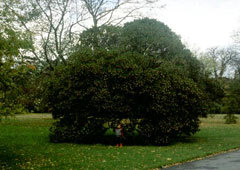
An evergreen Tree growing to 9m by 8m at a medium rate.
It is hardy to zone 7 and is not frost tender. It is in leaf all year, in flower from October to December, and the seeds ripen from October to December. The flowers are hermaphrodite (have both male and female organs) and are pollinated by Bees.
The plant is self-fertile.
The plant prefers light (sandy) and medium (loamy) soils, requires well-drained soil and can grow in heavy clay soil.
The plant prefers acid, neutral and basic (alkaline) soils.
It can grow in semi-shade (light woodland) or no shade.
It requires dry or moist soil.
The plant can tolerate maritime exposure.
It can tolerate atmospheric pollution.
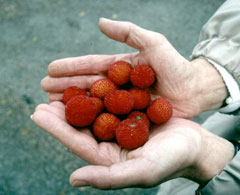
Fruit - raw or cooked. Sweet but insipid[2, 3, 5]. The Latin name 'unedo' means 'I eat one (only)' and suggests that the fruit is not very palatable[K], though another report says that the fruit is so delicious that a person only needs to eat one[245]. It does have a somewhat gritty skin, but the fruit itself has the texture of a lush tropical fruit and has a delicate pleasant flavour. For those people with sensitive taste buds, this is a fruit that can be enjoyed when eaten in moderate quantities[K]. The fruit contains about 20% sugars and can be used to make delicious and nourishing jams and preserves[7]. It is ripe in November/December and is about 15mm in diameter. When fully ripe it falls from the tree and so it is advisable to grow the plant in short grass in order to cushion the fall of the fruit[K].
Medicinal Uses
Plants For A Future can not take any responsibility for any adverse effects from the use of plants.
Always seek advice from a professional before using a plant medicinally.
The strawberry tree is little used in herbalism, though it does deserve modern investigation[268]. All parts of the plant contain ethyl gallate, a substance that possesses strong antibiotic activity against the Mycobacterium bacteria[268].
The leaves, bark and root are astringent and diuretic[7, 46, 268]. They are also a renal antiseptic[7] and so are of use in the treatment of affections of the urinary system such as cystitis and urethritis[254]. Their astringent action makes them of use in the treatment of diarrhoea and dysentery and, like many other astringent plants, a gargle can be made for treating sore and irritated throats[254]. The leaves are gathered in the summer and dried for later use[7].
The flowers are weakly diaphoretic[268].
Tannin is obtained from the leaves, bark and fruit[46, 61]. The bark contains 45% tannin[46].
Wood - used for turning, Greek flutes etc[89, 148]. It makes a good charcoal[4, 89, 148].
Scented Plants
Flowers: Fresh
The flowers have a soft honey scent.
Cultivation details
Requires a nutrient-rich well-drained moisture-retentive soil in sun or semi-shade and shelter from cold drying winds, especially when young[11, 200]. Grows well in heavy clay soils and in dry soils. Most species in this genus require a lime-free soil but this species is fairly lime tolerant[11, 200]. Succeeds in fairly exposed maritime positions[166, 200]. A tree in a very exposed position at Rosewarne in N. Cornwall was looking rather tattered in April 1987 but it was 4.5 metres tall and carrying a very good crop of immature fruit[K]. Tolerates industrial pollution[200].
Plants have withstood temperatures down to -16°c without injury at Kew[11]. They grow very well in S.W. England, fruiting well in Cornwall[49, 59].
Plants resent root disturbance and are best placed in their final positions whilst young[11, 134]. Give them some protection in their first winter.
The strawberry tree flowers in November and December, the fruit takes 12 months to ripen and so the tree carries both mature fruit and flowers at the same time and is incredibly beautiful at this time[K]. The flowers have a soft honey scent[245].
There are a number of named varieties[183] developed for their ornamental value. 'Elfin King', 'Croomei' and 'Rubra' are all small forms that fruit well when small[182]. The variety 'Rubra' was 1.2 metres tall at Kew in late 1990 and was laden down with fruits and flowers[K]. 'Elfin King' only reaches a height of 1 metre, comes into bearing when young and fruits well[183]. It is ideal for container culture[183]. 'Croomei' is said to be a more reliable fruiting form[49].
Propagation
Seed - best surface sown in a cold frame as soon as it is ripe. Stored seed should be soaked for 5 - 6 days in warm water and then surface sown in a shady position in a greenhouse[78]. Do not allow the compost to become dry. 6 weeks cold stratification helps[134]. The seed usually germinates well in 2 - 3 months at 20°c[134]. Seedlings are prone to damp off[184], they are best transplanted to individual pots as soon as they are large enough to handle and should be kept well ventilated. Grow them on in a greenhouse for their first winter and then plant out in late spring after the last expected frosts[K].
Basal cuttings in late winter[200].
Cuttings of mature wood of the current season's growth, November/December in a frame. Poor percentage[78].
Layering of young wood - can take 2 years[1, 200].
Cultivars
'Compacta'
A dwarf cultivar, it is said not to flower very freely[11].
'Croomei'
A dwarf-growing cultivar, it is said to be a reliable fruiting form[49].
'Elfin King'
The fruits are up to 25mm in diameter and have a sweet flavour[183, K].
A slow-growing compact plant, often no more than 1 metre tall[183]. It comes into bearing early, sets fruit freely and is ideal for container growing[183].
'Rubra'
Smaller than the species type, this form grows to about 2 - 3 metres in height, fruiting abundantly even when only 60cm tall[K].
[K] Ken Fern Notes from observations, tasting etc at Plants For A Future and on field trips.
[1] F. Chittendon.RHS Dictionary of Plants plus Supplement. 1956 Oxford University Press 1951 Comprehensive listing of species and how to grow them. Somewhat outdated, it has been replaces in 1992 by a new dictionary (see [200]).
[2] Hedrick. U. P.Sturtevant's Edible Plants of the World. Dover Publications 1972 ISBN 0-486-20459-6 Lots of entries, quite a lot of information in most entries and references.
[3] Simmons. A. E.Growing Unusual Fruit. David and Charles 1972 ISBN 0-7153-5531-7 A very readable book with information on about 100 species that can be grown in Britain (some in greenhouses) and details on how to grow and use them.
[4] Grieve.A Modern Herbal. Penguin 1984 ISBN 0-14-046-440-9 Not so modern (1930's?) but lots of information, mainly temperate plants.
[5] Mabey. R.Food for Free. Collins 1974 ISBN 0-00-219060-5 Edible wild plants found in Britain. Fairly comprehensive, very few pictures and rather optimistic on the desirability of some of the plants.
[7] Chiej. R.Encyclopaedia of Medicinal Plants. MacDonald 1984 ISBN 0-356-10541-5 Covers plants growing in Europe. Also gives other interesting information on the plants. Good photographs.
[11] Bean. W.Trees and Shrubs Hardy in Great Britain. Vol 1 - 4 and Supplement. Murray 1981 A classic with a wealth of information on the plants, but poor on pictures.
[17] Clapham, Tootin and Warburg.Flora of the British Isles. Cambridge University Press 1962 A very comprehensive flora, the standard reference book but it has no pictures.
[45] Polunin. O.Flowers of Greece and the Balkans. Oxford University Press 1980 ISBN 0-19-217626-9 A good pocket flora, it also lists quite a few plant uses.
[46] Uphof. J. C. Th.Dictionary of Economic Plants. Weinheim 1959 An excellent and very comprehensive guide but it only gives very short descriptions of the uses without any details of how to utilize the plants. Not for the casual reader.
[49] Arnold-Forster.Shrubs for the Milder Counties. 0 Trees and shrubs that grow well in Cornwall and other mild areas of Britain. Fairly good, a standard reference book.
[59] Thurston.Trees and Shrubs in Cornwall. 0 Trees and shrubs that succeed in Cornwall based on the authors own observations. Good but rather dated.
[61] Usher. G.A Dictionary of Plants Used by Man. Constable 1974 ISBN 0094579202 Forget the sexist title, this is one of the best books on the subject. Lists a very extensive range of useful plants from around the world with very brief details of the uses. Not for the casual reader.
[78] Sheat. W. G.Propagation of Trees, Shrubs and Conifers. MacMillan and Co 1948 A bit dated but a good book on propagation techniques with specific details for a wide range of plants.
[89] Polunin. O. and Huxley. A.Flowers of the Mediterranean. Hogarth Press 1987 ISBN 0-7012-0784-1 A very readable pocket flora that is well illustrated. Gives some information on plant uses.
[134] Rice. G. (Editor)Growing from Seed. Volume 2. Thompson and Morgan. 1988 Very readable magazine with lots of information on propagation. An interesting article on Ensete ventricosum.
[148] Niebuhr. A. D.Herbs of Greece. Herb Society of America. 1970 A pleasant little book about Greek herbs.
[166] Taylor. J.The Milder Garden. Dent 1990 A good book on plants that you didn't know could be grown outdoors in Britain.
[182] Thomas. G. S.Ornamental Shrubs, Climbers and Bamboos. Murray 1992 ISBN 0-7195-5043-2 Contains a wide range of plants with a brief description, mainly of their ornamental value but also usually of cultivation details and varieties.
[183] Facciola. S.Cornucopia - A Source Book of Edible Plants. Kampong Publications 1990 ISBN 0-9628087-0-9 Excellent. Contains a very wide range of conventional and unconventional food plants (including tropical) and where they can be obtained (mainly N. American nurseries but also research institutes and a lot of other nurseries from around the world.
[184] Phillips. R. & Rix. M.Shrubs. Pan Books 1989 ISBN 0-330-30258-2 Excellent photographs and a terse description of 1900 species and cultivars.
[200] Huxley. A.The New RHS Dictionary of Gardening. 1992. MacMillan Press 1992 ISBN 0-333-47494-5 Excellent and very comprehensive, though it contains a number of silly mistakes. Readable yet also very detailed.
[245] Genders. R.Scented Flora of the World. Robert Hale. London. 1994 ISBN 0-7090-5440-8 An excellent, comprehensive book on scented plants giving a few other plant uses and brief cultivation details. There are no illustrations.
[254] Chevallier. A.The Encyclopedia of Medicinal Plants Dorling Kindersley. London 1996 ISBN 9-780751-303148 An excellent guide to over 500 of the more well known medicinal herbs from around the world.
[268] Stuart. M. (Editor)The Encyclopedia of Herbs and Herbalism Orbis Publishing. London. 1979 ISBN 0-85613-067-2 Excellent herbal with good concise information on over 400 herbs.
Readers Comments
Plants for a Future does not verify the accuracy of reader comments,
use at your own risk. In particular
Plants For A Future can not take any responsibility for any adverse effects from the use of plants.
You should always consult a professional before using plants medicinally.
Arbutus unedo, The Strawberry Tree
mark
Thu Apr 12 19:46:40 2001
Where is the largest known specimin growing in the U.K. if so where and how big
Many thanks Mark .
Arbutus unedo, The Strawberry Tree
Ian Bruce
Tue May 28 21:33:40 2002
Does this plant have any invasive species characteristics for growing in the Northwest??
Arbutus unedo, The Strawberry Tree
Shari
Mon Jun 3 22:31:35 2002
Hi. :) I wanted to comment on something in the essay at the top of this page. It mentions that the strawberry tree's fruit is edible and although usually bland, some people like to eat it, and it also makes good perserves and jams. Yes, the fruit IS edible. In fact, I've tried the fruits myself, and I've found that some trees/bushes seem to have more flavourful fruit than others. However, I have read on several websites related to plants and trees that this fruit should NOT be eaten in large or even medium quantities, because it can cause stomach/intestinal upset, vomiting and even seizures in some people. I don't know how often this is the case, but it doesn't exactly sound like something I'd want to spread on my bread! :( Anyone else have further information about whether the fruits are indeed mildly toxic?
Arbutus unedo, The Strawberry Tree
Keith Juden
Wed Sep 11 11:55:41 2002
Known in Spain as "modroño". The emblem of Madrid is this tree, with a bear stretching to eat the fruit, so it's at least edible by some species!
Arbutus unedo, The Strawberry Tree
Sat Oct 5 04:20:06 2002
Thanks for the post. My golden retriever ate a bunch of the fruit and leaves and vomited a couple of times and is feeling quite poorly now. I thik she will be ok. I was a bit concerned for a while.
Arbutus unedo, The Strawberry Tree
Sean
Mon Oct 7 16:03:20 2002
I've just returned from Corsica where I have eaten some extremely nice Arbous jam made from this plant and also bought a bottle of Arbous liqueur which was one of the nicest I have ever tasted.
Arbutus unedo, The Strawberry Tree
Ana Margarida Martins
Tue Dec 10 16:46:54 2002
Hello!!!
About the toxicity of this fruit: in Portugal we do make jam and liqueur
(aguardente de Medronho) with it.
I have personally eaten many of these fruits and I can tell you they're
very sweet and tasty.
But in Portugal the cultural say about Arbous is that you shouldn't eat
too many, or you risk beeing drunk. That's probably because the fruit
ripens very quickly and ferments.
That's why you feel sick and dizzy... because you're slightly drunk...
But nothing serious...
Enjoy the fruits everybody!!!
Arbutus unedo
John McMillan
Thu Jan 2 17:22:15 2003
On a recent trip to Paris, I found this fruit served stewed (or canned?)
as a sweet in a chinese restaurant. They were fine. Also about 20mm
across, whereas the only tree I've seen here in the north of england produced
fruit more like 8mm across. Could be a different cultivar or more likely
the different climate. And that's bound to affect the palatability of the
fruit too.
Arbutus unedo, The Strawberry Tree
Clem Snide
Tue Feb 11 10:16:38 2003
I can't understand the frequent references in books to the
unpalatibility of this fruit. One reference said it was inedible in
Ireland. You never see it mentoned in books on edible fruit.
I find it quite delicious, with a tropical flavour,
like a cross between guava and nectarine. Mind you, I usually eat it
from the inside out, purely in order to avoid any dirt on the outside.
The only problem with the skin is its mealy texture rather than
its taste, though this isn't really unpleasant anyway. I can only think
that in cold climates it doesn't get enough sun to make good fruit (I
am in Australia), or perhaps it's the soil. Or maybe some people pick it
when unripe. Given its hardiness, it could be that people don't treat
it as carefully as it deserves. According to Frances Bodkin, it is
narcotic in large quantities, but I have had no problems eating a few
at a time.
Arbutus unedo
Dr. Shannon
Thu Mar 13 07:11:04 2003
Does anyone know of using this plant for arthritis or rheumatism?
Arbutus unedo, The Strawberry Tree
Ilene Holmes
Fri Jun 13 13:05:58 2003
I need to know how it turned out for the dog that ate some of the fruit and leaves and got sick. I am planning to put in 2 arbutus unedo and i have an AKC champion dog. He sometimes collects sticks and fruits to chew on. I would not want to plant the tree if it is going to make my dog sick.
Can anybody tell me about toxicity of the plant for animals and children?
imholmes@mindspring.com
Ilene Holmes
Arbutus unedo, The Strawberry Tree
Jane Doe
Fri Jun 13 22:41:57 2003
I live in the hills of Berkeley, CA. I have been told not to eat the
fruit of this very beautiful large and loaded with fruit Strawberry tree
in the back yard also because it was believed to be poisonous. I saw a bird carry a fruit to a roof
top the other day and eat it so I decided to do some research. I ate one
today and have to agree that it tastes like a a guava and nectarine.
I found it tasty and plan to eat more. I would love to get the recipe
for jam & maybe even the liquer.
Arbutus unedo
Pedro Moreira
Mon Jun 30 13:48:37 2003
I don't believe the fruits are toxic...
Here in Portugal it grows in many places, and the fruit is quite edible, though usually is used to make "Aguardente de Medronho" (a type of firewater, very strong and aromatic) and also jams.
What happens is that the fruits begin to decay and ferment, and the sugar in the fruit is turned into alcohol.... you can actually get quite drunk from eating the fruits, especially if you eat the ones that have already fallen....
I don't have any recipes, though... the firewater is probably distilled from ripened fruits (or actually over-ripe fruits)... and you could probably make a nice liquer by putting the pulp of some fruits in a bottle of "normal" firewater and leave them there for some months.... That is a common way to make liquers in Portugal, at least, since normal firewater (from wine grapes) is commonly available.
And the jam, I supose would follow common recipes for jam's... like cooking the pulp with sugar (and maybe adding some lemon as an anti-oxidant, or something....)
I'll try to look into that....
BTW: Portuguese common name: "Medronheiro", the fruit is called "Medronho" (sounds like spanish Medroño)
Arbutus unedo
K. GOKSU
Tue Sep 23 08:51:11 2003
I live in Turkey and we have some strawberry trees in our garden,
but we don't know any jam recipe about the fruit of this tree.
I appreciate if anybody can send me interesting jam recipes or web sites
include these recipes.
PC: If the jam is delicious, I promise to send a jar of jam to owner of the recipe.
Arbutus unedo, The Strawberry Tree
John Sampson
Tue Oct 14 21:30:24 2003
We have grown an Arbutus Unedo in Cornwall. It is in a small garden and
is now over 20 feet high and with a splendid canopy of leaves. But it is too large
too large for the small garden. Could any one advise how and when we
should prune it?
Arbutus unedo
Norm Nelson
Fri Oct 22 22:03:52 2004
I live in Sunnyvale,CA USA and have a neighbors tree overhanging my fence. I like to explain to my friends that the Strawberry Tree fruit has the sweetness of kiwi fruit and the consistancey of Sycamore seeds.
As for sampling color alone in not a goood indicator of how sweet the fruit will be. I have tasted some that were fully red and tasted bland and others not fully red that were "out of this world". Likewise I've tasted not fully red thar are not ripe and fully red that are woth picking through a hundred just to get that one.
You must be able to separate texture from taste to enjoy this fruit. Some fruits contain fiber. This one contains gravel.
Arbutus unedo
Boris
Tue Feb 1 17:26:50 2005
Hi to all! omg omg... What a mess we got around here...
This fruit is know as "Medronho" in Portuguese.
Its a tipicall fruit of the south of Portugal.
Everybody got Stomach problems, beacause when its ok for eating it's very sweet, juicy and produces itself Alchool as a process of maturation.
So if you eat too much you will got DRUNK!
That's why people(animals) gets dizzy and with stomachal problems.
Avoid eating it like normal fruit and specially avoid children eat it.
Hope you understood all the message.
In chinese restaurant you have eaten Lichyas, a fruit typical chinese that isn't nothing to the normal and usual Strawberry tree fruit.
Any doubt about it, say!
P.s.- Usuall to do liqueur in Portugal with the fruits, but not for newbies, since it's easy to get about 80% Alchool in home maid liqueur!
Can you please tell me where in Ireland this plant can be found? Carol
Arbutus unedo
Patricia
Fri Oct 27 2006
Hi
What about getting the seeds?
I had contact with many of them in Continental Portugal, but now I'm looking to get a good amount of seeds to grow it in Azores Islands in a botanical centre.
Can we get a way to have a trading seeds system here?
Thanks so much for this and all the info in the website.
By the way: came around looking for info on Tagetes minuta, that seems interesting as a natural herb and fungicide.
See you soon
Arbutus unedo
bash
Fri Nov 3 2006
This plant is mentioned in CS Forester's novel about the Peninsular Campaign during the Napoleonic Wars as growing in ravines and valleys in the hills along the river Tagus near Lisbon.
Arbutus unedo
BEV SPOONER
Mon Dec 18 2006
HI I HAD A VERY NICE ARBUTUS UNEDO AT MY LAST HOUSE IN BENFEET IN ESSEX
THE SOIL WAS CLAY AND SOUTH FACEING IT WAS ABOUT 15 FEET WIDE AND
15 FEET HIGH THE HOUSE WAS BUILT IN THE 1930S BY THE SIZE OF THE TRUNK
IT LOOKED VERY OLD. AND WAS STUNNING IN FLOWER AND FRUIT.
BUT I NEVER TRIED TO EAT THEM. BUT THE BIRDS LOVE THEM.
I WOULD TELL ANY ONE TO PLANT THIS TREE IT IS LOVELY .
S
Arbutus unedo
Fri Feb 9 2007
Fruit is just fine to eat; in response to the poster from the northwest, inquiring about it's invasive potential, no worries: not invasive at all, and being closely related to the madrone (arbutus menszii), has a local botanical precedent.
Arbutus unedo
karen
Fri Mar 9 2007
would a tree climbing snake be harmed by the arbutus tree?
its a beautiful tree and would compliament a terrarium. Used as a climbing log.
There are certain types of trees that are considered poisionus and not recomended.
what of the arbutus tree?
Arbutus unedo
Ogedengbe Oluwatobi Stephen
Thu Jul 5 2007
Need to get more information on jam processing,preservation,deterioration,utilization.
Arbutus unedo
Mary
Tue Oct 9 2007
Do you know what the mature caliper of the tree could be expected to be?
Arbutus unedo
Jeannette
Mon Oct 22 2007
Does anyone know of the suitability of planting Arbutus unedo in the northeastern United States, USDA planting zone 6b? I live outside Philadelphia, PA, saw this tree in Portland, Oregon, and fell in love! We have clay soil, slightly acid, and an average minimum winter temperature of 0ºF to -10ºF.
Arbutus unedo
Kaylene Keck
Fri Nov 2 2007
Arbutus unedo Does anyone have a recipe for the jam or preserves?
Arbutus unedo
Rebecca Waterhouse
Tue Dec 4 2007
I am going to college in California, and we have these bushes all over our
campus. I always enjoyed their lovely red and yellow fruit. When I read
that they were edible, I started eating them, and found them to be pretty
good. They are seedy, but not bad. I, too, have had no luck in finding a
recipe for their use, so I made one up. I used the general guidelines for
making jam: cook fruit, mash, add sugar, cook some more, done. I ended up
with a jam that was seedy, but very good. I'm not sure the fruits have
quite enough pectin in them naturally to jell, but what I got has a thick
jam-like consistency, with a beautiful orangey-red color. It would be very
good over ice cream. Here's the
recipe:
4 cups ripe strawberry tree fruit
Juice of one lemon
1 cup sugar
Cook the fruit down with the lemon juice first, and mash it to an even
consistency. Then add the sugar, cook about 5-10 minutes longer, and
remove from heat. I would recommend straining it if possible, to get rid
of some of the seeds, but being a poor college student I don't have a
strainer.
I hope this helps! Try it, and let me know what you think.
Arbutus unedo
Judy Hill
Wed Jun 25 2008
I recently bought an Arbutus unedo and have it in a pot, against a wall, but not in the sun. The inner leaves have started to go yellow and drop off. HELP!
Arbutus unedo
david n
Thu Sep 25 2008
When I had an Arbutus unnedo I found some of what looked like ripe red friut were quite tasty while some were bland and dryish, gritty. The tastly ones had an additional orange color/"glow" in the skin, the bland ones didn't, I think they were past full ripeness, dried up.
Perhaps this explains the very mixed reputation regarding flavor.
Add a comment/link:
Discussion Monitor
To have posts to this page mailed to you enter your email address here:
(Your email address will not appear on the webpage or be passed on to third parties).
All the information contained in these pages is Copyright
(C) Plants For A Future, 1996-2008.
Plants For A Future is a charitable company limited by guarantee, registered in England and Wales.
Charity No. 1057719, Company No. 3204567,
This work is licensed under a
Creative Commons License. You
can copy, distribute, display this works and to make derivative works but: Attribution is required, and it's Share Alike (GNUish/copyleft)
i.e. has an identical license. We also ask that you let us know (webmaster@pfaf.org) if
you link to, redistribute, make a derived work or do anything groovy with this information.