Mountain slopes in deep sandy soils in coniferous woodland, usually with Nothofagus spp[139].
Edibility Rating
5 (1-5)
Medicinal Rating
1 (1-5)
Physical Characteristics
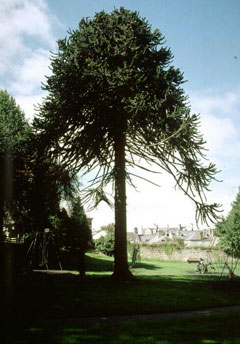
An evergreen Tree growing to 30m by 15m at a slow rate.
It is hardy to zone 8 and is not frost tender. It is in leaf all year, in flower from June to July, and the seeds ripen from September to October. The flowers are dioecious (individual flowers are either male or female, but only one sex is to be found on any one plant so both male and female plants must be grown if seed is required) and are pollinated by Wind.
The plant is not self-fertile.
The plant prefers light (sandy), medium (loamy) and heavy (clay) soils and requires well-drained soil.
The plant prefers acid, neutral and basic (alkaline) soils.
It can grow in semi-shade (light woodland) or no shade.
It requires moist soil.
The plant can tolerate maritime exposure.
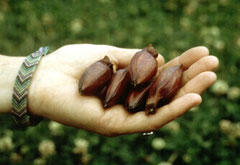
Seed - raw or cooked. Rich in starch[183]. The seed is soft like a cashew nut and has a slight flavour of pine nuts. This is a delicious seed and it makes very pleasant eating. It is a food that can easily be eaten in quantity and can be used as a staple food in the diet[K]. Fairly large, the seeds are about the size of an almond and can be 3cm long x 1cm wide. They are harvested in the autumn and, when kept in cool, dry conditions will store for at least 9 months[K].
Medicinal Uses
Plants For A Future can not take any responsibility for any adverse effects from the use of plants.
Always seek advice from a professional before using a plant medicinally.
Very tolerant of maritime exposure, trees can be grown as part of a shelterbelt, though they are very slow growing and have an open canopy and so do not give a lot of shelter[75, 81].
A resin is obtained from incisions in the trunk. This is used mainly for medicinal purposes[46, 61, 139].
Wood - pale yellowish, good quality, takes a beautiful polish. Used for joinery and carpentry[1, 46, 61, 139].
Cultivation details
Prefers a deep well-drained soil[11, 200]. Dislikes hot dry soils[1]. Dislikes atmospheric pollution[166]. Very tolerant of maritime exposure and salt laden winds[75, 81].
The monkey puzzle is a very slow growing tree that can take 5 - 10 years before it even gets above grass height and then grows around 35cm a year[185]. New growth takes place from late June to September[185].
The seed forms a staple food for the native Indians in regions where it grows in Chile, it is also sold in local markets there[46, 139].
This tree has an excellent potential to become a commercial crop in the western parts of Britain, it is high yielding, has large tasty seeds and is easily harvested. Its main disadvantages are its slow rate of growth and the time it takes before the first crop is produced - this can be up to 40 years from seed though we have often seen plants less than 20 years old produce cones[K]. The plant is dioecious so at least one male plant needs to be grown for every 5 - 6 females - unfortunately there is no way of telling the sex of the tree until it flowers. There are means of vegetative reproduction and it might be possible to produce clones of known sex in the future - these will probably come into bearing at an earlier age. If you have the space to plant at least 5 trees, and the foresight, this is a tree that will be a very valuable food crop in the future[K]. It is said that 18 good-sized trees can provide enough for an adult's sustenance all year round[2].
Plants grow best in S.W. England and along the west coast of Britain where they produce seed regularly and abundantly[11, 80]. Female cones take 2 - 3 years to mature and break up at the end of the year[185]. They contain up to 200 large seeds. Plants self-sow in Cornwall[80].
We have records of trees regularly producing good crops of seeds in various sites in Cornwall, Devon and the west coast of Scotland. We also have one report of an excellent crop in 1997 from trees at Alvaston Castle near Derby and of a tree in Bedfordshire producing a heavy crop[K].
Trees are notably susceptible to honey fungus[81, 200].
Unlike most conifers, this tree can be coppiced[81].
Propagation
Seed - best sown as soon as it is ripe in a cold frame[134] or it can be stored cool and moist then sown February in a greenhouse[78, 80]. Although the plants are quite cold-tolerant, the root systems of seedling plants can be damaged in spells of very cold weather so give some extra protection at this time if necessary. The seed usually germinates in 1 - 2 months at 15°c[134]. As soon as they are large enough to handle, prick the seedlings out into individual pots. The plants have a rather sparse root system and are best placed in their final positions as soon as possible. Give them some protection for their first winter[K].
Cuttings of half-ripe wood, May to July in a cold frame. Only epicormic side-shoots should be used, normal side-shoots do not develop properly[81]. An epicormic shoot is one that develops from a dormant bud on the main trunk of the tree[K].
[K] Ken Fern Notes from observations, tasting etc at Plants For A Future and on field trips.
[1] F. Chittendon.RHS Dictionary of Plants plus Supplement. 1956 Oxford University Press 1951 Comprehensive listing of species and how to grow them. Somewhat outdated, it has been replaces in 1992 by a new dictionary (see [200]).
[2] Hedrick. U. P.Sturtevant's Edible Plants of the World. Dover Publications 1972 ISBN 0-486-20459-6 Lots of entries, quite a lot of information in most entries and references.
[11] Bean. W.Trees and Shrubs Hardy in Great Britain. Vol 1 - 4 and Supplement. Murray 1981 A classic with a wealth of information on the plants, but poor on pictures.
[46] Uphof. J. C. Th.Dictionary of Economic Plants. Weinheim 1959 An excellent and very comprehensive guide but it only gives very short descriptions of the uses without any details of how to utilize the plants. Not for the casual reader.
[61] Usher. G.A Dictionary of Plants Used by Man. Constable 1974 ISBN 0094579202 Forget the sexist title, this is one of the best books on the subject. Lists a very extensive range of useful plants from around the world with very brief details of the uses. Not for the casual reader.
[75] Rosewarne experimental horticultural station.Shelter Trees and Hedges. Ministry of Agriculture, Fisheries and Food 1984 A small booklet packed with information on trees and shrubs for hedging and shelterbelts in exposed maritime areas.
[78] Sheat. W. G.Propagation of Trees, Shrubs and Conifers. MacMillan and Co 1948 A bit dated but a good book on propagation techniques with specific details for a wide range of plants.
[80] McMillan-Browse. P.Hardy Woody Plants from Seed. Grower Books 1985 ISBN 0-901361-21-6 Does not deal with many species but it is very comprehensive on those that it does cover. Not for casual reading.
[81] Rushforth. K.Conifers. Christopher Helm 1987 ISBN 0-7470-2801-X Deals with conifers that can be grown outdoors in Britain. Good notes on cultivation and a few bits about plant uses.
[134] Rice. G. (Editor)Growing from Seed. Volume 2. Thompson and Morgan. 1988 Very readable magazine with lots of information on propagation. An interesting article on Ensete ventricosum.
[139] ?Flora of Chile. (in Spanish) 0 Some information about the useful plants of Chile.
[166] Taylor. J.The Milder Garden. Dent 1990 A good book on plants that you didn't know could be grown outdoors in Britain.
[183] Facciola. S.Cornucopia - A Source Book of Edible Plants. Kampong Publications 1990 ISBN 0-9628087-0-9 Excellent. Contains a very wide range of conventional and unconventional food plants (including tropical) and where they can be obtained (mainly N. American nurseries but also research institutes and a lot of other nurseries from around the world.
[185] Mitchell. A. F.Conifers in the British Isles. HMSO 1975 ISBN 0-11-710012-9 A bit out of date (first published in 1972), but an excellent guide to how well the various species of conifers grow in Britain giving locations of trees.
[200] Huxley. A.The New RHS Dictionary of Gardening. 1992. MacMillan Press 1992 ISBN 0-333-47494-5 Excellent and very comprehensive, though it contains a number of silly mistakes. Readable yet also very detailed.
Readers Comments
Plants for a Future does not verify the accuracy of reader comments,
use at your own risk. In particular
Plants For A Future can not take any responsibility for any adverse effects from the use of plants.
You should always consult a professional before using plants medicinally.
Araucaria araucana
Wed Jan 4 2006
My monkey puzzle has fruited for the first time this year. I guess this means it is female! However, I do not know of another monkey puzzle tree in the vicinity of my house so I am intrigued about how the flowers got pollinated! Presumably the pollen can travel long distances on the wind? lynn Martin lyn44martin@aol.com
Araucaria araucana
Ron Meadows
Tue Jul 4 2006
I live an the North Yorshire about a half mile from the sea. My monkey puzzle tree is about 35 years old and two years age developed two cones and this year they are starting to turn brown
Two more cones have started to grow this year (2006).The point I would like to make is if the can grow and fruit here they will so anywere!!
Araucaria araucana
barry wardle
Fri Jul 21 2006
I live in Teeside and our monkey tree is obout fifteen years old and stands about17 feet tall. Last year two balls appeared and have now grown to about therr inches in diameter and are turning brown, there are now an additional 9 balls starting to grow, can any one give me some info about the addition to the tree, and if they will flower, or do they fall off and the seeds scatter, to grow again into new trees.
any info would be most welcome.
Araucaria araucana
sue robinson
Sun Aug 13 2006
i bought a monkey puzzle tree last year it, its approx 1.5feet high but it is turning brown - is it dying? what should i do?
its still in the original pot
Araucaria araucana
Willie Lang
Wed Sep 27 2006
Believe it or not I have a twenty-five year old tree in my yard I planted as a seedling brought back from Chili, here in North Florida. The tree is a male and I hope to add some females in the coming
Araucaria araucana
Mon Dec 4 2006
i have a monkey puzzle tree that is 99 years old and this year it has compleltely turned brown. it is dead or dying and is there a chance that it will continue to grow. What could have possibly caused it to die as there has been nothing done to it or any changes made to it in any way.
Many thanks
Julia
Araucaria araucana
Ken Fern, Plants for a Future.
Tue Dec 5 2006
Julie, I am afraid that it sounds as though your tree is already dead.
I am not sure where you are located, but one of the most common causes of death in old trees is environmental stress - particularly drought and excessive heat.
Certainly, if you were somewhere like southeast England, where the weather in 2006 was very hot and dry, then this would probably be the cause of death.
There are many Monkey Puzzle trees in Britain more than 100 years old and still healthy, but they do tend to die by the time they are around 130 years of age.
Araucaria araucana
Debbie Tapley
Sun Jan 7 2007
Hello I am the owner of a 3 year old monkey puzzle tree which is still in a pot on the patio and I have recently aquired a 7ft tall monkey puzzle tree - can anyone advise me on how to dig up the 7ft one from another garden to replant in my garden ie how deep do I dig and where do I locate it? Many thanks debbie.tapley@googlemail.com
Araucaria araucana
Dani Nofal
Sun Jan 28 2007
The weather were this trees grow is farly cold and humid winters and autumms, mild springs, also humid, and dry and farly warm summers.
If you water them excesively during the summer they will die. They are used to some drought during the summer. They cannot handle a lot of competition in the ground either, they commonly grow as pure woods down here.
Hope it helps
Araucaria araucana
Carla VanDeBeek
Thu Feb 1 2007
Are there any key difference's between the A auraucana (monkey puzzle) and the A bidwillii (bunya nut). So far the only aspect I have come up with is the seeds. Monkey Puzzle has longer slimmer seeds compared to the bunya's fatter seeds. Is this true.
Araucaria araucana
Dave Whyman
Sun Feb 4 2007
I have inherited two monkey puzzle trees in my garden at my new house
they are about 2-3 feet high but are only about a foot apart.
Is it possible to move these apart and if so when is the best time of year to do this?
Any advice would be appreciated.
Dave
Araucaria araucana
Ken Fern, Plants for a Future
Mon Mar 5 2007
In response to Carla's question.
Whilst the two species are fairly closely related, there are a number of key differences, some botanical and some environmental. I am not a botanist, but from the gardener's viewpoint these are some of the differences:-
A. bidwillii is a much larger tree when fully grown - to 45 metres compared with the 30 metres of A. araucana.
The seed cone of A. bidwillii is pineapple-like, up to 30cm long by 23cm wide. A. araucana is globose, 10 - 18cm long.
The branchlets of A. bidwillii are pendant, whilst those of A. araucana curve upwards when young.
A. araucana is a considerably hardier tree, tolerating a reasonable amount of frost and growing successfully in many areas of mainland Britain, whereas A. bidwillii cannot be grown successfully on the mainland and, even in the milder Isles of Scilly is likely to be killed in a cold winter.
These are by no means the only differences, but are enough to show that these are two distinct species.
Araucaria araucana
Brian Nolan
Mon Apr 16 2007
My dad bought an old estate...and there are 2 beautiful trees in an old orchard in the west of Ireland...they are easily 20 metres tall, and healthy...however...I dont know if they are male of female...nor if they are fertile...how can I go about getting them to propogate...?
Brian, Galway
Araucaria araucana
peter Sneddon
Sun Apr 22 2007
I ws driving from Ballarat to Newstead in Victoria Australia yesterday with a friend and spotted a Monkey puzzle tree in the grounds of an old house. probably quite old at least 2-3 mtr in girth and looked to be in good condition despite the drought that we have here in Vioctoria at present
Will Send a picture next time I am in the area
Araucaria araucana
Kerry
Wed May 9 2007
I have a monkey puzzle which is atleast 80 years old. Unfortunately the previous occupants have laid tarmac around the base of the tree and I fear it is not getting enough moisture now. The very top of the tree is green with new growth, the rest is brown, however on the brown branches there are little shoots of green. I have been told by a tree surgeon to expect alot of the lower branches to die naturally. Is this true? Or is the tree dying? We live on the edge of Ashdown forest, surrounded by all types of firs and they all seem fine. Whats the verdict?
Araucaria araucana
Nigel Spinks
Mon Jun 4 2007
Hi we have just moved a monkey puzzle tree from one garden to another
any tips please on how to look after it.We live in suffolk many thanks.
Araucaria araucana
Nicky
Sat Jun 9 2007
I am a monkey puzzle enthusiast and draw and make prints of trees local to me, particularly in the south east. One owner said that there is a Monkey Puzzle Society. Is there?
Araucaria araucana
Barry Andrews
Thu Jul 5 2007
We live in Matlock Bath in Derbyshire and have 2 Monkey Puzzle trees in the front garden. They were planted when the house was built in 1848 and are now about 30m tall. This year I looked out as I thought there was a fire and realized that it was the cones. Whenever the wind blew or a bird landed on a branch, they exploded with what I presume was pollen. It spewed out in a great cloud. They are greatly admired by visitors to the village.
Araucaria araucana
Ian Mulley
Wed Aug 8 2007
We have a monkey puzzle which is around 150 years old. We live in Burnley in North West England and we have looked after it for the last twenty years. Unfortunately it has lost most of its branches and has only a topnot left. The house was built in 1862 and the tree was here before then according to local history, as part of the local church's ornamental garden. It is also weeping sap from the base and looks like it is on its last legs. I fear it will have to go before it falls. Big shame.
Araucaria araucana
Tony Johnson
Mon Oct 1 2007
Monkey puzzle trees lose their lower branches and are left with a top knot naturally. Please see the link - it's just reaching maturity!
I have seen a number of grown up MP Trees in Couthorn near Barnsley(S. Yorshire) England. The soil is heavy clay developed on weathered coal measures. The winter temperatures can go down to as low as -20 C on ocasions.
Araucaria araucana
jason lewis
Sat Nov 17 2007
can anyone help i have only had the tree since september and re potted itwhich i
was told to do by thegarden centre ,but now someof the leaves are brown a few were already brown but not all of the leaves only parts othem .please help jason in eastleigh ,hampshire
Araucaria araucana
Simon
Tue Dec 4 2007
In response to the message posted by Barry Wardle in July of last year, sounds like your monkey puzzle is very precocious. Have you got any seeds from it yet?
Araucaria araucana
nicky browne
Mon Jan 21 2008
jason...your monkeypuzzle needs shade and slightly moist conditions while it grows and becomes established. they are such lovely trees cheers nicky
Araucaria araucana
Billy Fowles
Fri Jan 25 2008
Billy Fowles
Just bought a MP about 6 inches tall. I live in a flat in Penzance, Cornwall at the moment but hope to move into a house with a garden in Falmouth in the next 6 months or so.Any advise with regards replanting?
Araucaria araucana
Jesus
Wed Feb 13 2008
I would like to know if A. araucana will take heat/drought. I live in New Mexico, and temperatures can reach 37 to 38C in summer and -17 C in winter. I've a couple of firs, spruces, gigant sequoia, etc. Should I try it
Thanks
Araucaria araucana
P Darvill
Sat Feb 23 2008
I have a tiny Monkey Puzzle tree in the garden of my new house I doubt i will live to see it grow huge as I am in my late 50's. I have noticed that MP trees seem to come in different shapes, are there different types or can they be pruned. Some have a full wide spread whilst others are shaped more like cartoon Christmas tree, and some have a round top and bare trunk.
Araucaria araucana
Bogichevich Nebojsa
Wed May 21 2008
I've got 2 MP trees few days ago.Since I am living in Aticca (Greece) what are the chances of surviveing
for these trees?I was warned that they don't do well in hot climate that we have.Trees are potted and about 1 meter hgh.
Araucaria araucana
Ian Hamilton
Tue Jun 10 2008
Our monkey puzzle is sick, we are sure of this and it worries us that it might come down in astorm
and cause serious problems. It is surrounded by block paving which we have decided to take up from around the
base for better watering purposes. Can anyone come up with a GOOD fed for the tree once the ground around it
has been better exposed. It sheds brances and leaves at quite a rate. Really don`t wont to lose it.
Araucaria araucana
Darrell Willis
Sat Jun 21 2008
We have a 10 year old monkey puzzle in our front garden and would like
to move it approximately 1 metre away from a palm tree because they have
grown very close to each other. Is this possible? What would be the
procedure?
Many thanks in anticipation.
Araucaria araucana
kally
Wed Jun 25 2008
we have a monkey puzzle tree and the bottom half of it has turned brown,it is approximately 50 years old. what coud be causing it, and is ther any cure for it?
Araucaria araucana
gurugamage
Fri Jul 11 2008
I do have many seeds but i do not know hove to plant them in a bed of revers sand please give instructions how to plant them -guru
Araucaria araucana
Bernard James
Sat Aug 30 2008
Can anyone tell me if a Monkey Puzzle will survive on the Gold Coast (Queensland Australia)? I only know of mature specimens as far north as Sydney.
Cheers
Bernard
Araucaria araucana
david n
Fri Sep 5 2008
Re: A.araucana in New Mexico. This plant is unlikely do survive in New Mexico, it needs moist coolish environments by most accounts.
Araucaria araucana
Alison R
Sat Sep 13 2008
Could anybody tell me how big the root systems are on this tree.I have an elderly neighbour who has one in her garden which has been there for at least 35 years an she is worried that the roots could be doing damage to her property.
Araucaria araucana
david n
Sat Sep 13 2008
RE: root system doing damage?
The root system of a tree is basically as large as the part of the tree that is above ground. I've seen the roots of a similar plant Araucaria heteraphylla break through concrete, but only near the base. I suspect most of the roots go deep to anchor this huge tree. I'm afraid I cant say for sure if it would threaten a house, it's certainly possible.
Araucaria araucana
jennifur haig
Wed Sep 17 2008
Araucaria araucana
Isabelle
Sun Nov 2 2008
We have only had our 8 foot high monkey puzzle for one year. It has has small white balls in higher branches that we thought may be due to an insect? More worryingly the lower branches are turning brown and we have a fungus growing around the trunk. we feared honey fungus but the landscaper & nursery say it is unlikely. Does anyone know of a site with pictures so we can try our own diagnosis? Does anyone have any treatment ideas? Thanks for any advice. Isabelle
Araucaria araucana
Jack Russell
Mon Nov 3 2008
Jack 3rd Nov. 2008
My female tree has produced numerous seed balls but they have not been
pollinated therefore the seeds are empty when they fall
There are other trees in the district but a bit away from mine.
It is possible to manually pollinate this tree?
Araucaria araucana
Eunice
Sun Nov 9 2008
Our monkey puzzle tree is approx 30ft tall and we don't want it to grow any taller. Any advice on pruning at the top, if feasible, would be appreciated.
Araucaria araucana
Jack Russell
Tue Nov 11 2008
As stated on Nov. 3rd, my female tree has numerous seed balls. At first I thought that they were all empty, now I have found a few that have been pollinated. Any reason why only a few pollinate? Has anyone got an answer?
Araucaria araucana
Steve Newton
Sun Nov 30 2008
I'm think of buying a small (2.5ft) monkey puzzle tree for my garden. But I only have room for say a 5ft diameter space. I understand that they grow very slowly but how many years will it be before it gets to this size?
I would then have to replant it or give it away. The local garden centre says I could plant it in a container to limit it's growth. does any one know if this will work?
Location: Nottingham, England
Araucaria araucana
Linda
Tue Apr 14 2009
I live at about 7500 feet in New Mexico, where we have juniper, ponderosa, pinon trees and other conifers on our property and would like to start a Monkey Puzzle tree from seed. I have obtained about 16 seeds and need information on where and how to plant them. Any information would be appreciated.
Araucaria araucana
david n
Tue Apr 14 2009
did you see the notes under propagation above on this page (Araucaria araucana)? covers seed a bit, that's all we have
Araucaria araucana
Dilnawaz Ahmed
Tue Apr 21 2009
I am looking for seeds to grow Araucaria can somebody advise
i will be most greatfull Thank you
Araucaria araucana
Frank and Jeannette Ayton
Wed Apr 22 2009
We have a large monkey puzzle tree the trunk of which is some 45 cm in diameter.
It must be at least 30 years old. We are planning to have a conservatory built but we are told
by our builder's rep that the tree could be too close to the proposed foundations.
Just how much farther than the span of the branches do the roots of this tree spread?
Help - the tree will come before any building but it would be nice to have both!
Araucaria araucana
david
Thu Apr 30 2009
The roots of a mature tree can definately go well beyond the outermost branches, I don't know anything specific about this plant except that it it could be awakwardly large in a normal suburban garden to say the least.
Araucaria araucana
Diane Morton
Sat May 30 2009
We have an 18 year old monkey puzzle tree that was planted in the wrong spot
and is now pressing up against a hedge which doesn't look very nice but can't be
good for it either. We would like to relocate it but were warned that it could
die during the process? Has anyone had success moving them and got any
tips? Alternatively, does anyone know if having its branches restricted
will affect it?
Araucaria araucana
marta
Sun Jun 7 2009
How old must be a MP tree to bear cones? In which year of life Araucaria Araucana will have it's first cones? Does anyone know?
Araucaria araucana
david
Sun Jun 7 2009
It can be from around twenty years to forty years from seed, they are slow(see above under "cultivation details" note also that separate male and female trees are needed for nuts.
Araucaria araucana
Chuck Sachs
Thu Jul 16 2009
HI, I think my Monkey Puzzle tree might be dying. We had too much rain in June and the area where our tree is got flooded. The bottom branches are now brown, with just the very tips green. Is there anything I can do? Will the whole tree die? Please help. Thanks.
Araucaria araucana
KATE GORDON
Fri Aug 14 2009
CAN YOU TELL ME THE BEST WAY TO REMOVE A HEDGE THAT HAS BEEN IN MY GARDEN FOR ABOUT 20 YEARS
I HAVE CUT IT BACK BUT I AM FINDING IT HARD TO REMOVE THE ROOTS
I WOULD REALLY APPRECIATE IF SOMEONE COULD TELL ME THE BEST WAY TO GET RID OF THEM
KATE
Araucaria araucana
Helen
Sat Sep 12 2009
I have a monkey puzzle tree in a house I have just moved to, it is about 2 storeys tall but is really close to the house about 15ft. It is very unusual as it has both male and female parts on the same plant. We really need to remove it to keep the house safe does anyone have any suggestions as to how to move it and if anyone would want it.
Araucaria araucana
Peter Eaton (South Normanton)
Sat Jan 16 2010
hi.
I purchased a puzzle tree from a garden centre.
About a foot high at the time.
left it in its pot.
Seemed to completely die, then growth as to 4 new shoots starting from the top.
Left on at the moment all the old dead side branches.
What happed here ??? Shall I keep it.
Very little growth in the last 3 years we have had it.
now planted out in the garden but unlike why I purchased an unusual & nice tree now an ugly mess I am sorry to say.
Lucky we have on the estate a fine example of the tree probably 20 foot high to look at.
Araucaria araucana
Sat Jan 23 2010
We have two Monkey Puzzle trees - both about 150 feet tall - not sure how old but the house was built in 1840's. So I guess these would have been planted well over 100 years ago. This year one of them has dropped a number of huge balls which I guess are the things which contain the nuts. Have no idea what to do with them. Incidentally, there are a number of smaller (very young) trees growing in the garden.
Araucaria araucana
Jean Mulholland
Fri Feb 5 2010
FRIDAY 5 FEBRUARY 2010
WE LIVE IN SOUTH AFRICA (GAUTENG AREA) AND WE HAVE HAD A MONKEY PUZZLE TREE IN OUR GARDEN FOR OVER 40 YEARS. ABOUT 5-6 YEARS AGO EACH DECEMBER ONE OR TWO CONES WOULD DROP FROM THE TREE. THIS YEAR, PRESUMABLY AS A RESULT OF THE EXTENSIVE RAIN WE HAVE BEEN EXPERIENCING, ABOUT 20 OF THESE CONES HAVE FALLEN IN VARIOUS STAGES OF DEVELOPMENT. SOFT ONES BEAKING UP ON IMPACT WITH THE GROUND. FIND THEM FASCINATING. DON'T KNOW IF MALE OR FEMALE BUT THERE ARE SEENDS IN THE LITTLE SEGMENTS THAT BREAK AWAY. GLAD TO FIND YOUR SITE - HAVE BEEN BATTLING TO FIND INFO ON THIS CURIOUS TREE. WOULD LIKE TO FIND PICTURES. JEAN
Add a comment/link:
Discussion Monitor
To have posts to this page mailed to you enter your email address here:
(Your email address will not appear on the webpage or be passed on to third parties).
All the information contained in these pages is Copyright
(C) Plants For A Future, 1996-2008.
Plants For A Future is a charitable company limited by guarantee, registered in England and Wales.
Charity No. 1057719, Company No. 3204567,
This work is licensed under a
Creative Commons License. You
can copy, distribute, display this works and to make derivative works but: Attribution is required, and it's Share Alike (GNUish/copyleft)
i.e. has an identical license. We also ask that you let us know (webmaster@pfaf.org) if
you link to, redistribute, make a derived work or do anything groovy with this information.