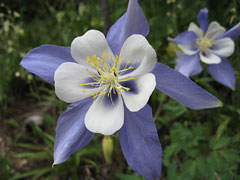
 |
|
http://commons.wikimedia.org/wiki/File:Aquilegia_caerulea.jpg |
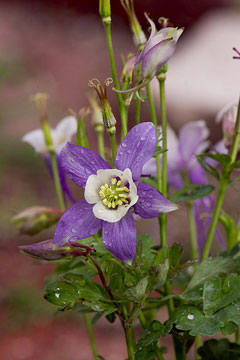 |
| ttp://en.wikipedia.org/wiki/User:Jsegraves99 |
Translate this page:
Summary
Physical Characteristics

 Aquilegia coerulea is a PERENNIAL growing to 0.6 m (2ft).
See above for USDA hardiness. It is hardy to UK zone 3. It is in flower from April to July. The species is hermaphrodite (has both male and female organs) and is pollinated by Bees.
Suitable for: light (sandy) and medium (loamy) soils and prefers well-drained soil. Suitable pH: mildly acid, neutral and basic (mildly alkaline) soils. It can grow in semi-shade (light woodland) or no shade. It prefers moist soil.
UK Hardiness Map
US Hardiness Map
Synonyms
Plant Habitats
Woodland Garden Dappled Shade; Shady Edge;
Edible Uses
Edible Parts: Flowers
Edible Uses:
Flowers - raw. Rich in nectar, they have a sweet taste[172], they make a very attractive addition to mixed salads and can also be used as a thirst-quenching munch in the garden[K].
References More on Edible Uses
Medicinal Uses
Plants For A Future can not take any responsibility for any adverse effects from the use of plants. Always seek advice from a professional before using a plant medicinally.
Antispasmodic Diaphoretic Parasiticide Parasiticide Resolvent Salve
Antispasmodic, diaphoretic, parasiticide, resolvent, salve[172]. The seed was chewed, or an infusion of the root was used, to treat abdominal pains and general sickness[257].
References More on Medicinal Uses
The Bookshop: Edible Plant Books
Our Latest books on Perennial Plants For Food Forests and Permaculture Gardens in paperback or digital formats.

Edible Tropical Plants
Food Forest Plants for Hotter Conditions: 250+ Plants For Tropical Food Forests & Permaculture Gardens.
More

Edible Temperate Plants
Plants for Your Food Forest: 500 Plants for Temperate Food Forests & Permaculture Gardens.
More

More Books
PFAF have eight books available in paperback and digital formats. Browse the shop for more information.
Shop Now
Other Uses
References More on Other Uses
Cultivation details
Succeeds in ordinary garden soil, preferring a moist but not wet soil and a sheltered sunny position[1]. It also succeeds in partial shade[187]. Intolerant of heavy clay soils[200]. A very ornamental plant, it is the state flower of Colorado[187, 270]. Most species are short-lived, dying out after 2 - 3 years, though they usually produce seed prolifically[200]. However, they are very apt to hybridize with other members of the genus and so it becomes difficult to keep a species true to type if more than one is grown in the garden[200]. Plants seem to be immune to the predations of rabbits[233]. A greedy plant, inhibiting the growth of nearby plants, especially legumes[54].
References Carbon Farming Information and Carbon Sequestration Information
Temperature Converter
Type a value in the Celsius field to convert the value to Fahrenheit:
Fahrenheit:
The PFAF Bookshop
Plants For A Future have a number of books available in paperback and digital form. Book titles include Edible Plants, Edible Perennials, Edible Trees,Edible Shrubs, Woodland Gardening, and Temperate Food Forest Plants. Our new book is Food Forest Plants For Hotter Conditions (Tropical and Sub-Tropical).
Shop Now
Plant Propagation
Seed - best sown as soon as it is ripe in a cold frame. The seed can be slow to germinate[200]. Stored seed can be sown in late winter in a cold frame. When large enough to handle, prick the seedlings out into individual pots and grow them on in a cold frame for their first winter. Plant out in late spring or early summer. Division in spring[200].
Other Names
If available other names are mentioned here
Native Plant Search
Search over 900 plants ideal for food forests and permaculture gardens. Filter to search native plants to your area. The plants selected are the plants in our book 'Plants For Your Food Forest: 500 Plants for Temperate Food Forests and Permaculture Gardens, as well as plants chosen for our forthcoming related books for Tropical/Hot Wet Climates and Mediterranean/Hot Dry Climates. Native Plant Search
Found In
Countries where the plant has been found are listed here if the information is available
Weed Potential
Right plant wrong place. We are currently updating this section.
Please note that a plant may be invasive in one area but may not in your area so it’s worth checking.
Conservation Status
IUCN Red List of Threatened Plants Status :

| Related Plants
|
| Latin Name | Common Name | Habit | Height | Hardiness | Growth | Soil | Shade | Moisture | Edible | Medicinal | Other |
| Aquilegia brevistyla | Smallflower columbine | Perennial | 0.9 |
0-0
| | LM | SN | M | 2 | 1 | 1 |
| Aquilegia buergeriana | | Perennial | 0.6 |
6-9
| | LMH | SN | M | 2 | 0 | 1 |
| Aquilegia canadensis | Wild Columbine, Red columbine, Meeting Houses, Common Columbine | Perennial | 0.6 |
4-10
| M | LM | SN | M | 2 | 2 | 2 |
| Aquilegia flabellata | Fan Columbine, Dwarf Columbine | Perennial | 0.3 |
3-9
| S | LM | SN | M | 2 | 0 | 1 |
| Aquilegia flavescens | Columbine, Yellow columbine | Perennial | 0.8 |
4-8
| | LM | SN | M | 2 | 1 | 1 |
| Aquilegia formosa | Western Columbine | Perennial | 0.8 |
3-7
| | LM | SN | M | 2 | 2 | 1 |
| Aquilegia formosa truncata | Columbine | Perennial | 0.9 |
3-7
| | LM | SN | M | 2 | 2 | 1 |
| Aquilegia jonesii | Columbine, Jones' columbine, Blue limestone columbine | Perennial | 0.1 |
3-7
| | LM | SN | M | 2 | 1 | 1 |
| Aquilegia karelinii | | Perennial | 0.8 |
-
| | LM | SN | M | 2 | 0 | 1 |
| Aquilegia pubescens | Columbine, Sierra columbine | Perennial | 0.5 |
4-8
| | LM | SN | M | 2 | 1 | 1 |
| Aquilegia shockleyi | | Perennial | 0.8 |
6-9
| | LM | SN | M | 2 | 1 | 1 |
| Aquilegia vulgaris | Columbine, European columbine, Granny's Bonnet, European Crowfoot | Perennial | 1.0 |
3-9
| M | LM | SN | M | 2 | 1 | 1 |
| Semiaquilegia adoxoides | Tian Kui | Perennial | 0.3 |
5-9
| | LMH | SN | M | 0 | 2 | |
|
Growth: S = slow M = medium F = fast. Soil: L = light (sandy) M = medium H = heavy (clay). pH: A = acid N = neutral B = basic (alkaline). Shade: F = full shade S = semi-shade N = no shade. Moisture: D = dry M = Moist We = wet Wa = water.

Expert comment
Author
E.James.
Botanical References
60200270
Links / References
For a list of references used on this page please go here
Readers comment
| Add a comment |
|
If you have important information about this plant that may help other users please add a comment or link below. Only comments or links that are felt to be directly relevant to a plant will be included. If you think a comment/link or information contained on this page is inaccurate or misleading we would welcome your feedback at [email protected]. If you have questions about a plant please use the Forum on this website as we do not have the resources to answer questions ourselves.
* Please note: the comments by website users are not necessarily those held by PFAF and may give misleading or inaccurate information.
To leave a comment please Register or login here All comments need to be approved so will not appear immediately.
|
Subject : Aquilegia coerulea
|
|
|
|