 |
|
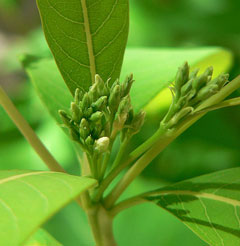
USDA-NRCS PLANTS Database / USDA NRCS. Wetland flora: Field office illustrated guide to plant species. USDA Natural Resources Conservation Service. |
 |
| http://commons.wikimedia.org/wiki/User:Stan_Shebs |
Translate this page:
Summary
A perennial herbaceous plant with some edible, medicinal and other uses. A very good quality fibre obtained from the bark is used for making clothes, twine, bags, linen, and paper. Indian hemp is an unpleasantly bitter stimulant irritant herb that acts on the heart, respiratory and urinary systems, and also on the uterus. It has been used as a Antirheumatic; Cardiotonic; Diaphoretic; Diuretic; Emetic; Expectorant; Tonic; VD;
Vermifuge; and for Warts. Similar to Cannabis (Cannabis sativa) as a fiber plant (see Hemp) but not as a source of a psychoactive drug. Common names include: Dogbane, Amy Root, Hemp Dogbane, Prairie Dogbane, Indian Hemp, Rheumatism Root, or Wild Cotton. Can be misspelt as Apocynum cannibinum
Physical Characteristics

 Apocynum cannabinum is a PERENNIAL growing to 0.6 m (2ft) by 1 m (3ft 3in).
See above for USDA hardiness. It is hardy to UK zone 4. It is in flower from July to August. The species is hermaphrodite (has both male and female organs) and is pollinated by Lepidoptera (Moths & Butterflies).
Suitable for: light (sandy), medium (loamy) and heavy (clay) soils and prefers well-drained soil. Suitable pH: mildly acid, neutral and basic (mildly alkaline) soils. It can grow in full shade (deep woodland) semi-shade (light woodland) or no shade. It prefers moist soil.
UK Hardiness Map
US Hardiness Map
Synonyms
Apocynum cannibinum (misspelt)
Plant Habitats
Woodland Garden Sunny Edge; Dappled Shade; Shady Edge; Meadow;
Edible Uses
Edible Parts: Seed
Edible Uses: Gum
Seed - raw or cooked[257]. It can be ground into a powder and used as a meal[94]. A latex obtained from the plant is used as a chewing gum[61, 94, 177]. After the latex has been squeezed from the plant it s allowed to stand overnight to harden into a white gum[257]. The latex was sometimes mixed with clean clay[257].
References More on Edible Uses
Medicinal Uses
Plants For A Future can not take any responsibility for any adverse effects from the use of plants. Always seek advice from a professional before using a plant medicinally.
Antirheumatic Cardiotonic Diaphoretic Diuretic Emetic Expectorant Tonic Urinary
VD Vermifuge Warts
Indian hemp is an unpleasantly bitter stimulant irritant herb that acts on the heart, respiratory and urinary systems, and also on the uterus[238]. It was much employed by various native North American Indian tribes who used it to treat a wide variety of complaints including rheumatism, coughs, pox, whooping cough, asthma, internal parasites, diarrhoea and also to increase milk flow in lactating mothers[257]. The plant is still used in modern herbalism, but it should be used with great caution, and only under the supervision of a qualified practitioner if taken internally[[4, 222, 238]. See the notes above on toxicity[4, 222]. The root is cardiotonic, diaphoretic, diuretic, emetic and expectorant[4, 46, 61, 94, 238]. It is harvested in the autumn and dried for later use[238]. The fresh root is the most active part medicinally. It has been used in the treatment of syphilis and as a tonic[207]. A weak tea made from the dried root has been used for cardiac diseases[207, 222]. A tea made from the root has been used as a vermifuge[213]. The milky sap is a folk remedy for venereal warts[222].
References More on Medicinal Uses
The Bookshop: Edible Plant Books
Our Latest books on Perennial Plants For Food Forests and Permaculture Gardens in paperback or digital formats.

Edible Tropical Plants
Food Forest Plants for Hotter Conditions: 250+ Plants For Tropical Food Forests & Permaculture Gardens.
More

Edible Temperate Plants
Plants for Your Food Forest: 500 Plants for Temperate Food Forests & Permaculture Gardens.
More

More Books
PFAF have eight books available in paperback and digital formats. Browse the shop for more information.
Shop Now
Other Uses
Fibre Gum Latex
The flowers are attractive to bees[418
]. Other Uses: A very good quality fibre obtained from the bark is used for making clothes, twine, bags, linen, paper etc[1, 46, 61, 92, 94, 95, 189, 257]. It is about 12 - 18mm long[189]. Very strong[99], it is used as a flax substitute[57], it does not shrink and it retains its strength in water[99]. The fibre is produced late in the season[85], it can be harvested after the leaves fall in autumn but are probably at its best as the seed pods are forming[169]. When making paper, the stems can be retted by leaving them in the ground until they are dry in the winter or they can be harvested in late summer, the leaves removed and the stems steamed to remove the fibre[189]. The stems are then cooked for two hours with lye and pounded with mallets[189]. The plant yields a latex which is a possible source of rubber[46, 61, 177]. The latex is also used as chewing gum. Carbon Farming - Industrial Crop: hydrocarbon, fibre. The dogbane-milkweed family Asclepias, Apocynum, Calotropis, and Trachomitum spp) has been used for fiber industrial crops for millennia with a number in cultivation as regional crops. All of these crops are dual-purpose fibres, offering bast fibres from the stem and seed fibre or ‘floss’ in the fruit pods. Many have also been identified as potential hydrocarbon crops due to high latex content. Could be integrated into various agroforestry systems rather than as monocultures [1-1].
Special Uses
Carbon Farming
References More on Other Uses
Cultivation details
Industrial Crop: Fiber Industrial Crop: Hydrocarbon Management: Hay Minor Global Crop
Succeeds in sun or shade in most well-drained moist soils[169, 238]. Plants can be invasive[200]. The young shoots of this plant are extremely attractive to slugs[K]. Carbon Farming - Cultivation: minor global crop. Management: hay.
Carbon Farming
-
Industrial Crop: Fiber
Clothing, rugs, sheets, blankets etc. Currently, almost none of our fiber are produced from perennial crops but could be!
-
Industrial Crop: Hydrocarbon
Materials, chemicals and energy include bioplastics, rubber, biomass products gasoline, jet fuel, diesel, butane, propane, biogas. Plants are usually resprouting plants and saps.
-
Management: Hay
Cut to the ground and harvested annually. Non-destructive management systems maintaining the soil organic carbon.
-
Minor Global Crop
These crops are already grown or traded around the world, but on a smaller scale than the global perennial staple and industrial crops, The annual value of a minor global crop is under $1 billion US. Examples include shea, carob, Brazil nuts and fibers such as ramie and sisal.
References Carbon Farming Information and Carbon Sequestration Information
Temperature Converter
Type a value in the Celsius field to convert the value to Fahrenheit:
Fahrenheit:
The PFAF Bookshop
Plants For A Future have a number of books available in paperback and digital form. Book titles include Edible Plants, Edible Perennials, Edible Trees,Edible Shrubs, Woodland Gardening, and Temperate Food Forest Plants. Our new book is Food Forest Plants For Hotter Conditions (Tropical and Sub-Tropical).
Shop Now
Plant Propagation
Seed - best sown as soon as it is ripe in late summer and overwintered outdoors. The seed requires a period of cold stratification if it is to germinate well[238]. Prick out the seedlings when large enough to handle and grow them on in a cold frame for their first winter, planting out in late spring of the following year[K]. Division in spring just before active growth begins[200]. Plants can also be divided in the autumn[238].
Other Names
If available other names are mentioned here
Native Plant Search
Search over 900 plants ideal for food forests and permaculture gardens. Filter to search native plants to your area. The plants selected are the plants in our book 'Plants For Your Food Forest: 500 Plants for Temperate Food Forests and Permaculture Gardens, as well as plants chosen for our forthcoming related books for Tropical/Hot Wet Climates and Mediterranean/Hot Dry Climates. Native Plant Search
Found In
Countries where the plant has been found are listed here if the information is available
Weed Potential
Right plant wrong place. We are currently updating this section.
Please note that a plant may be invasive in one area but may not in your area so it’s worth checking.
This plant can be weedy or invasive growing from spreading roots.
Conservation Status
IUCN Red List of Threatened Plants Status : This taxon has not yet been assessed.

Growth: S = slow M = medium F = fast. Soil: L = light (sandy) M = medium H = heavy (clay). pH: A = acid N = neutral B = basic (alkaline). Shade: F = full shade S = semi-shade N = no shade. Moisture: D = dry M = Moist We = wet Wa = water.

Expert comment
Author
L.
Botanical References
43200
Links / References
For a list of references used on this page please go here
Readers comment
© 2010, Plants For A Future. Plants For A Future is a charitable company limited by guarantee, registered in England and Wales. Charity No. 1057719, Company No. 3204567.