 |
|
http://commons.wikimedia.org/wiki/User:Stan_Shebs |
 |
| http://commons.wikimedia.org/wiki/User:Stan_Shebs |
Translate this page:
Summary
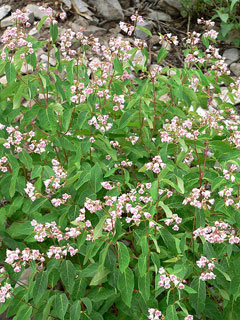
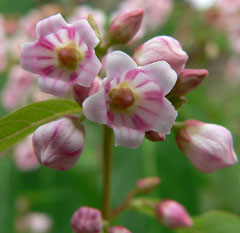
A perennial flowering plant from North America with some useful medicinal and other uses. Common names include bitterroot, flytrap dogbane and spreading dogbane.
Physical Characteristics

 Apocynum androsaemifolium is a PERENNIAL growing to 0.6 m (2ft) by 1 m (3ft 3in).
See above for USDA hardiness. It is hardy to UK zone 4. It is in flower in July. The species is hermaphrodite (has both male and female organs).
Suitable for: light (sandy), medium (loamy) and heavy (clay) soils and prefers well-drained soil. Suitable pH: mildly acid, neutral and basic (mildly alkaline) soils and can grow in very acid soils.
It can grow in full shade (deep woodland) semi-shade (light woodland) or no shade. It prefers dry or moist soil.
UK Hardiness Map
US Hardiness Map
Synonyms
Plant Habitats
Woodland Garden Sunny Edge; Dappled Shade; Shady Edge; not Deep Shade;
Edible Uses
References More on Edible Uses
Medicinal Uses
Plants For A Future can not take any responsibility for any adverse effects from the use of plants. Always seek advice from a professional before using a plant medicinally.
Cardiotonic Cathartic Contraceptive Diaphoretic Diuretic Emetic Expectorant Urinary
VD
Spreading dogbane is an unpleasantly bitter stimulant irritant herb that acts on the heart, respiratory and urinary systems, and also on the uterus[238]. It was widely employed by the native North American Indians who used it to treat a wide variety of complaints including headaches, convulsions, earache, heart palpitations, colds, insanity and dizziness[257]. It should be used with great caution, and only under the supervision of a qualified practitioner if taking this plant internally[21, 238]. The root contains cymarin, a cardioactive glycoside that is toxic to ruminants[222]. The root is cardiotonic, cathartic, diaphoretic, diuretic, emetic and expectorant[1, 4, 21, 61, 222]. It has a powerful action in slowing the pulse and also has a very strong action on the vaso-motor system, it is rather an irritant to the mucous membranes though, so some people cannot tolerate it[4]. The juice of the fresh root has been used in the treatment of syphilis[207]. The sap of the plant has been applied externally to get rid of warts[257]. The roots were boiled in water and the water drunk once a week in order to prevent conception[213]. The green fruits were boiled and the decoction used in the treatment of heart and kidney problems and for the treatment of dropsy[213]. This preparation can irritate the intestines and cause unpleasant side-effects[213].
References More on Medicinal Uses
The Bookshop: Edible Plant Books
Our Latest books on Perennial Plants For Food Forests and Permaculture Gardens in paperback or digital formats.

Edible Tropical Plants
Food Forest Plants for Hotter Conditions: 250+ Plants For Tropical Food Forests & Permaculture Gardens.
More

Edible Temperate Plants
Plants for Your Food Forest: 500 Plants for Temperate Food Forests & Permaculture Gardens.
More

More Books
PFAF have eight books available in paperback and digital formats. Browse the shop for more information.
Shop Now
Other Uses
Fibre Latex
The bark yields a good quality fibre that is used for making twine, bags, linen etc[4, 99, 155, 257]. It is inferior to A. cannabinum[99]. The fibre is finer and stronger than cotton[207]. It can be harvested after the leaves fall in the autumn but is probably at its best as the seed pods are forming[169]. The plant yields a latex, which is a possible source of rubber[46, 61]. It is obtained by making incisions on the stem and resembles indiarubber when dry[4].
Special Uses
References More on Other Uses
Cultivation details
Prefers an acid peaty soil[1] but it succeeds in sun or shade in most well-drained soils and climates[169, 200]. A very ornamental plant[1], but it can be invasive[200]. The flowers the flowers secrete a sweet liquid that is very attractive to flies[4]. The flies are then imprisoned by their proboscis which becomes trapped between the short filaments of the stamens[207].
References Carbon Farming Information and Carbon Sequestration Information
Temperature Converter
Type a value in the Celsius field to convert the value to Fahrenheit:
Fahrenheit:
The PFAF Bookshop
Plants For A Future have a number of books available in paperback and digital form. Book titles include Edible Plants, Edible Perennials, Edible Trees,Edible Shrubs, Woodland Gardening, and Temperate Food Forest Plants. Our new book is Food Forest Plants For Hotter Conditions (Tropical and Sub-Tropical).
Shop Now
Plant Propagation
Seed - best sown as soon as it is ripe in late summer and overwintered outdoors. The seed requires a period of cold stratification if it is to germinate well[238]. Prick out the seedlings when large enough to handle and grow them on in a cold frame for their first winter, planting out in late spring of the following year[K]. Division in spring just before active growth begins[200]. Plants can also be divided in the autumn[238].
Other Names
If available other names are mentioned here
Native Plant Search
Search over 900 plants ideal for food forests and permaculture gardens. Filter to search native plants to your area. The plants selected are the plants in our book 'Plants For Your Food Forest: 500 Plants for Temperate Food Forests and Permaculture Gardens, as well as plants chosen for our forthcoming related books for Tropical/Hot Wet Climates and Mediterranean/Hot Dry Climates. Native Plant Search
Found In
Countries where the plant has been found are listed here if the information is available
Weed Potential
Right plant wrong place. We are currently updating this section.
Please note that a plant may be invasive in one area but may not in your area so it’s worth checking.
This plant can be weedy or invasive. Some reports in Western USA.
Conservation Status
IUCN Red List of Threatened Plants Status : This taxon has not yet been assessed.

Growth: S = slow M = medium F = fast. Soil: L = light (sandy) M = medium H = heavy (clay). pH: A = acid N = neutral B = basic (alkaline). Shade: F = full shade S = semi-shade N = no shade. Moisture: D = dry M = Moist We = wet Wa = water.

Expert comment
Author
L.
Botanical References
43200
Links / References
For a list of references used on this page please go here
Readers comment
| Add a comment |
|
If you have important information about this plant that may help other users please add a comment or link below. Only comments or links that are felt to be directly relevant to a plant will be included. If you think a comment/link or information contained on this page is inaccurate or misleading we would welcome your feedback at [email protected]. If you have questions about a plant please use the Forum on this website as we do not have the resources to answer questions ourselves.
* Please note: the comments by website users are not necessarily those held by PFAF and may give misleading or inaccurate information.
To leave a comment please Register or login here All comments need to be approved so will not appear immediately.
|
Subject : Apocynum androsaemifolium
|
|
|
|