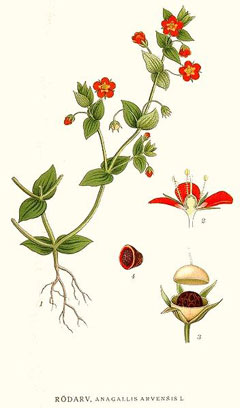
 |
|
http://commons.wikimedia.org/wiki/File:Illustration_Anagallis_caerulea0.jpg |
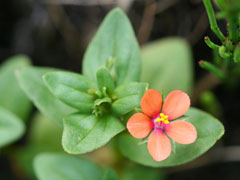 |
| http://commons.wikimedia.org/wiki/User:Fabelfroh |
Translate this page:
Summary
A low-growing annual plant. Once highly regarded as a medicinal herb but now questioned due to it's toxicity. The whole herb is antitussive, cholagogue, diaphoretic, diuretic, expectorant, nervine, purgative, stimulant and vulnerary.
Physical Characteristics

 Anagallis arvensis is a ANNUAL growing to 0.1 m (0ft 4in) by 0.4 m (1ft 4in).
See above for USDA hardiness. It is hardy to UK zone 7 and is not frost tender. It is in flower from June to August, and the seeds ripen from July to September. The species is hermaphrodite (has both male and female organs) and is pollinated by Insects. The plant is self-fertile.
Suitable for: light (sandy), medium (loamy) and heavy (clay) soils. Suitable pH: mildly acid, neutral and basic (mildly alkaline) soils. It cannot grow in the shade. It prefers dry or moist soil.
UK Hardiness Map
US Hardiness Map
Synonyms
Plant Habitats
Cultivated Beds;
Edible Uses
Edible Parts: Leaves Shoots
Edible Uses:
Leaves - raw or cooked[2, 105, 115]. Used in salads[4] and as a spinach[2]. The tender shoots are cooked as a vegetable[272]. It is best not to eat these leaves[55, 238], see the notes above on toxicity.
References More on Edible Uses
Medicinal Uses
Plants For A Future can not take any responsibility for any adverse effects from the use of plants. Always seek advice from a professional before using a plant medicinally.
Antidepressant Antipruritic Antitussive Antiviral Cholagogue Diaphoretic Diuretic Epilepsy
Expectorant Homeopathy Nervine Purgative Stimulant Vulnerary
The scarlet pimpernel was at one time highly regarded as a medicinal herb, especially in the treatment of epilepsy and mental problems[254], but there is little evidence to support its efficacy and it is no longer recommended for internal use because it contains toxic saponins and cytotoxic cucurbitacins[238, 254]. The whole herb is antitussive, cholagogue, diaphoretic, diuretic, expectorant, nervine, purgative, stimulant and vulnerary[4, 7, 9, 21, 46]. It can be taken internally or applied externally as a poultice[7]. An infusion is used in the treatment of dropsy, skin infections and disorders of the liver and gall bladder[9, 272]. The plant is best harvested in June and can be dried for later use[4]. Use with caution[21], large doses can cause polyuria and tremor[7]. A homeopathic remedy is made from the plant[9]. It is used internally to treat itchy skins and externally to remove warts[9].
References More on Medicinal Uses
The Bookshop: Edible Plant Books
Our Latest books on Perennial Plants For Food Forests and Permaculture Gardens in paperback or digital formats.
Edible Tropical Plants
Food Forest Plants for Hotter Conditions: 250+ Plants For Tropical Food Forests & Permaculture Gardens.
More
Edible Temperate Plants
Plants for Your Food Forest: 500 Plants for Temperate Food Forests & Permaculture Gardens.
More
More Books
PFAF have eight books available in paperback and digital formats. Browse the shop for more information.
Shop Now
Other Uses
Soap
The squeezed plant is used in Nepal for washing and bathing[272]. Anagallis arvensis is insecticidal or at least is repellent to some insects. Dynamic accumulator.
Special Uses
Dynamic accumulator
References More on Other Uses
Cultivation details
Prefers a sunny position and a good soil[1]. Succeeds in dry or sandy soils[238]. The flowers open at about 8 am and close at 3pm each day, though they close earlier if it rains. The flowers are also said to foretell wet weather if they close early[207].
References Carbon Farming Information and Carbon Sequestration Information
Temperature Converter
Type a value in the Celsius field to convert the value to Fahrenheit:
Fahrenheit:
The PFAF Bookshop
Plants For A Future have a number of books available in paperback and digital form. Book titles include Edible Plants, Edible Perennials, Edible Trees,Edible Shrubs, Woodland Gardening, and Temperate Food Forest Plants. Our new book is Food Forest Plants For Hotter Conditions (Tropical and Sub-Tropical).
Shop Now
Plant Propagation
Seed - sow spring in situ.
Other Names
If available other names are mentioned here
Common Names include: blue pimpernel; care-all; common pimpernel; poor man's weatherglass; red chickweed. Spanish: coralillo; jaboncillo; murrajes; pilpis; pimpinela escarlata. French: morgeline; morgeline d'ete; mouron des champs; mouron rouge. Arabic: 'ayen el jamel. Portuguese: escarlate; morriao vermelho; murriao. Algeria: lizireg; meridjana. Brazil: escalarte.
Chile: pimpinela azul.
Croatia: krika poljska.
Czechoslovakia (former): drchnicka roini.
Denmark: rod arve.
Egypt: 'ain el-gamal; omm lebben; qonfooda; saboon gheit.
Finland: puna alpi.
Germany: Acker Gauchheil; Feld Gauchheil; Roter Gauchheil.
Hawaii: poisonous pimpernel.
Hungary: mezel tikszem.
India: biliputi (Punjabi); krishnaneel.
Iran: bazrak vahshee.
Iraq: rmaimeeneh.
Italy: anagallide rossa; bellichina; mordi-gallina.
Japan: akabana aruri hakobe.
Lebanon: adhan el far el nabti; lubbayn; zaghila.
Macedonia: vidovcica crvena.
Mauritius: mouron.
Netherlands: gewoon guichelheil; guichelheil.
Norway: nonsblom; rodarve.
Pakistan: bili booti.
Poland: kurzyslad polny.
Slovenia: njivna kurja cesnjica.
South Africa: blouseblommetjie; rooimuur.
Sweden: rodarv; roedarv.
Taiwan: hwo-jin-gu.
Turkey: tarla farekulagi.
USA: poison chickweed; poisonweed; shepherd's clock; wink-a-peep
Yugoslavia (Serbia and Montenegro): vidovcia.
Native Plant Search
Search over 900 plants ideal for food forests and permaculture gardens. Filter to search native plants to your area. The plants selected are the plants in our book 'Plants For Your Food Forest: 500 Plants for Temperate Food Forests and Permaculture Gardens, as well as plants chosen for our forthcoming related books for Tropical/Hot Wet Climates and Mediterranean/Hot Dry Climates. Native Plant Search
Found In
Countries where the plant has been found are listed here if the information is available
Weed Potential
Right plant wrong place. We are currently updating this section.
Please note that a plant may be invasive in one area but may not in your area so it’s worth checking.
Weedy in some areas of the US including Kentucky and the Northeast.
Conservation Status
IUCN Red List of Threatened Plants Status : This taxon has not yet been assessed.

Growth: S = slow M = medium F = fast. Soil: L = light (sandy) M = medium H = heavy (clay). pH: A = acid N = neutral B = basic (alkaline). Shade: F = full shade S = semi-shade N = no shade. Moisture: D = dry M = Moist We = wet Wa = water.

Expert comment
Author
L.
Botanical References
17200
Links / References
For a list of references used on this page please go here
Readers comment
© 2010, Plants For A Future. Plants For A Future is a charitable company limited by guarantee, registered in England and Wales. Charity No. 1057719, Company No. 3204567.