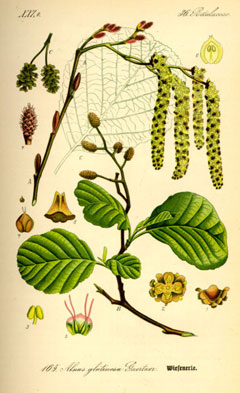
 |
|
http://commons.wikimedia.org/wiki/File:Illustration_Alnus_glutinosa0.jpg |
 |
| http://commons.wikimedia.org/wiki/User:Alinja |
Translate this page:
Summary
A medium size pioneer species, short-lived tree in the family Betulaceae, native to most of Europe, southwest Asia and northern Africa. Bloom Color: Purple, Red.
Main Bloom Time: Early spring, Late spring, Mid spring. Form: Oval, Pyramidal.
Physical Characteristics

 Alnus glutinosa is a deciduous Tree growing to 25 m (82ft) by 10 m (32ft) at a fast rate.
See above for USDA hardiness. It is hardy to UK zone 3. It is in leaf from March to November, in flower from March to April, and the seeds ripen from September to November. The species is monoecious (individual flowers are either male or female, but both sexes can be found on the same plant) and is pollinated by Wind.
It can fix Nitrogen.
It is noted for attracting wildlife.
Suitable for: medium (loamy) and heavy (clay) soils and can grow in heavy clay and nutritionally poor soils. Suitable pH: mildly acid, neutral and basic (mildly alkaline) soils. It can grow in semi-shade (light woodland) or no shade. It prefers moist or wet soil. The plant can tolerate maritime exposure.
UK Hardiness Map
US Hardiness Map
Synonyms
A. rotundifolia. Betula glutinosa.
Plant Habitats
Woodland Garden Canopy; Hedge; Bog Garden;
Edible Uses
References More on Edible Uses
Medicinal Uses
Plants For A Future can not take any responsibility for any adverse effects from the use of plants. Always seek advice from a professional before using a plant medicinally.
Alterative Astringent Cathartic Emetic Febrifuge Galactogogue Haemostatic Parasiticide
Skin Tonic Vermifuge
The bark is alterative, astringent, cathartic, febrifuge and tonic[4, 7, 14, 46, 269]. The fresh bark will cause vomiting, so use dried bark for all but emetic purposes[21]. A decoction of the dried bark is used to bathe swellings and inflammations, especially of the mouth and throat[4, 9, 21, 254]. The powdered bark and the leaves have been used as an internal astringent and tonic, whilst the bark has also been used as an internal and external haemostatic against haemorrhage[21]. The dried bark of young twigs are used, or the inner bark of branches 2 - 3 years old[9]. It is harvested in the spring and dried for later use[9]. Boiling the inner bark in vinegar produces a useful wash to treat lice and a range of skin problems such as scabies and scabs[21]. The liquid can also be used as a toothwash[21]. The leaves are astringent, galactogogue and vermifuge[7]. They are used to help reduce breast engorgement in nursing mothers[254]. A decoction of the leaves is used in folk remedies for treating cancer of the breast, duodenum, oesophagus, face, pylorus, pancreas, rectum, throat, tongue, and uterus[269]. The leaves are harvested in the summer and used fresh[238].
References More on Medicinal Uses
The Bookshop: Edible Plant Books
Our Latest books on Perennial Plants For Food Forests and Permaculture Gardens in paperback or digital formats.
Edible Tropical Plants
Food Forest Plants for Hotter Conditions: 250+ Plants For Tropical Food Forests & Permaculture Gardens.
More
Edible Temperate Plants
Plants for Your Food Forest: 500 Plants for Temperate Food Forests & Permaculture Gardens.
More
More Books
PFAF have eight books available in paperback and digital formats. Browse the shop for more information.
Shop Now
Other Uses
Charcoal Dye Hedge Hedge Ink Insecticide Parasiticide Pioneer Shelterbelt Soil reclamation Tannin Teeth Wood
Tolerant of clipping and maritime exposure, the alder can be grown in a windbreak or a hedge[75]. The trees are very quick to establish[200] and will grow at a rate of 1 metre or more per year when young[K]. This is an excellent pioneer species for re-establishing woodlands on disused farmland, difficult sites etc. Its fast rate of growth means that it quickly provides sheltered conditions to allow more permanent woodland trees to become established. In addition, bacteria on the roots fix atmospheric nitrogen - whilst this enables the tree to grow well in quite poor soils it also makes some of this nitrogen available to other plants growing nearby. Alder trees also have a heavy leaf canopy and when the leaves fall in the autumn they help to build up the humus content of the soil. Alder seedlings do not compete well in shady woodland conditions and so this species gradually dies out as the other trees become established[K]. Because they tolerate very poor soils and also produce nitrogen nodules on their roots, alders are suitable for use in land reclamation schemes. The plants can be used as a source of biomass[269]. According to the phytomass files, annual productivity is estimated at 6 to 9 tonnes per hectare. The tree has yielded 11.8 tonnes per hectare per annum on pulverized fuel ash and annual productivity has been estimated at 8.66 tonnes per hectare, with 5.87 tonnes in wood, bark, and branches, 2.79 tonnes in foliage[269]. Alder has been recommended for consideration for firewood plantations in Tropical highlands where unseasonable cold might destroy the red alder[269]. The powdered bark has been used as an ingredient of toothpastes[9]. Sticks of the bark have been chewed as tooth cleaners[9]. An ink and a tawny-red dye are obtained from the bark[4, 6, 7, 66]. A green dye is obtained from the catkins[4, 6, 66]. A pinkish-fawn dye is obtained from the fresh green wood[4, 6, 66]. A yellow dye is obtained from the bark and young shoots[4, 6, 66]. A cinnamon dye is obtained from the shoots if they are harvested in March[4]. If they are dried and powdered then the colour will be a tawny shade[4]. The bark and the fruits contain up to 20% tannin[46, 61, 223], but they also contain so much dyestuff (imparting a dark red shade) that this limits their usefulness[4, 7]. The leaves are also a good source of tannin[4]. The leaves are clammy and, if spread in a room, are said to catch fleas and flies on their glutinous surface[4, 7]. Wood - very durable in water, elastic, soft, fairly light, easily worked, easily split. It is often used for situations where it has to remain underwater and is also used for furniture, pencils, bowls, woodcuts, clogs etc. It is much valued by cabinet makers[4, 7, 11, 13, 26, 46, 66, 100, 115]. The wood also makes a good charcoal[4, 115].
Special Uses
Attracts Wildlife Carbon Farming Food Forest Hedge Hedge Nitrogen Fixer
References More on Other Uses
Cultivation details
Agroforestry Services: Nitrogen Industrial Crop: Biomass Industrial Crop: Tannin Management: Coppice Management: Standard Minor Global Crop Other Systems: SRC
Landscape Uses:Firewood, Pest tolerant, Pollard, Screen. Prefers a heavy soil and a damp situation[1, 11], tolerating prolonged submergence of its roots and periods with standing water to 30cm deep[186, 200]. Plants can also grow quickly in much drier sites, though they will usually not live for so long in such a position. Alders grow well in heavy clay soils[24, 98], they also tolerate lime and very infertile sites[200]. Tolerates a wide range of soils but prefers a pH above 6[186]. Very tolerant of maritime exposure[49, 75, 166]. Alder is estimated to tolerate an annual precipitation of 40 to 200cm, an annual average temperature of 8 to 14°C and a pH of 6 to 8[269]. The leaves often remain green on the tree until November, or even later on young seedlings. The seeds contain a margin of air-filled tissue and are capable of floating in water for 30 days before becoming waterlogged[186]. This enables distribution of the seed by water. The alder has a very rapid early growth[98], specimens 5 years old from seed were 4 metres tall even though growing in a very windy site in Cornwall[K]. This species has a symbiotic relationship with certain soil micro-organisms, these form nodules on the roots of the plants and fix atmospheric nitrogen. Some of this nitrogen is utilized by the growing plant but some can also be used by other plants growing nearby[98, 200]. Nitrogen-fixation by trees up to 8 years old has been put at 125 kg/ha/yr., for 20 years at 56 - 130 kg/ha/yr.[269]. Trees often produce adventitious roots from near the base of the stem and these give additional support in unstable soils[186]. Trees are very tolerant of cutting and were at one time much coppiced for their wood which had a variety of uses[4, 186]. Alders are an important food plant for the caterpillars of many butterfly and moth species[30] and also for small birds in winter[24].There are 90 insect species associated with this tree[24]. There are some named varieties, selected for their ornamental value[200]. Special Features:Not North American native, Naturalizing, Wetlands plant, Inconspicuous flowers or blooms. In garden design, as well as the above-ground architecture of a plant, root structure considerations help in choosing plants that work together for their optimal soil requirements including nutrients and water. The root pattern is branching: a heart root, dividing from the crown into several primary roots going down and out [2-1].
Carbon Farming
-
Agroforestry Services: Nitrogen
Plants that contribute to nitrogen fixation include the legume family – Fabaceae.
-
Industrial Crop: Biomass
Three broad categories: bamboos, resprouting woody plants, and giant grasses. uses include: protein, materials (paper, building materials, fibers, biochar etc.), chemicals (biobased chemicals), energy - biofuels
-
Industrial Crop: Tannin
Occur generally in the roots, wood, bark, leaves, and fruit of many plants. Used in tanning leather, dyeing fabric, making ink, and medical applications.
-
Management: Coppice
Cut to the ground repeatedly - resprouting vigorously. Non-destructive management systems maintaining the soil organic carbon.
-
Management: Standard
Plants grow to their standard height. Harvest fruit, seeds, or other products. Non-Destructive management systems.
-
Minor Global Crop
These crops are already grown or traded around the world, but on a smaller scale than the global perennial staple and industrial crops, The annual value of a minor global crop is under $1 billion US. Examples include shea, carob, Brazil nuts and fibers such as ramie and sisal.
-
Other Systems: SRC
Short-rotation coppice.
References Carbon Farming Information and Carbon Sequestration Information
Temperature Converter
Type a value in the Celsius field to convert the value to Fahrenheit:
Fahrenheit:
The PFAF Bookshop
Plants For A Future have a number of books available in paperback and digital form. Book titles include Edible Plants, Edible Perennials, Edible Trees,Edible Shrubs, Woodland Gardening, and Temperate Food Forest Plants. Our new book is Food Forest Plants For Hotter Conditions (Tropical and Sub-Tropical).
Shop Now
Plant Propagation
Seed - best sown in a cold frame as soon as it is ripe and only just covered[200]. Spring sown seed should also germinate successfully so long as it is not covered[200, K]. The seed should germinate in the spring as the weather warms up. When large enough to handle, prick the seedlings out into individual pots. If growth is sufficient, it is possible to plant them out into their permanent positions in the summer, otherwise keep them in pots outdoors and plant them out in the spring. There are about 700,000 - 750,000 seeds per kilo, but on average only about 20 - 25,000 plantable seedlings are produced[269]. Seeds can remain viable for at least 12 months after floating in water[269]. Seeds germinate as well under continuous darkness as with normal day lengths. Air-dried seeds stored at 1 - 2°C retained their viability for two years. Seeds can however be sown immediately as soon as ripe[269]. If you have sufficient quantity of seed, it can be sown thinly in an outdoor seed bed in the spring[78]. The seedlings can either be planted out into their permanent positions in the autumn/winter, or they can be allowed to grow on in the seed bed for a further season before planting them. Cuttings of mature wood, taken as soon as the leaves fall in autumn, outdoors in sandy soil.
Other Names
If available other names are mentioned here
Native Plant Search
Search over 900 plants ideal for food forests and permaculture gardens. Filter to search native plants to your area. The plants selected are the plants in our book 'Plants For Your Food Forest: 500 Plants for Temperate Food Forests and Permaculture Gardens, as well as plants chosen for our forthcoming related books for Tropical/Hot Wet Climates and Mediterranean/Hot Dry Climates. Native Plant Search
Found In
Countries where the plant has been found are listed here if the information is available
Weed Potential
Right plant wrong place. We are currently updating this section.
Please note that a plant may be invasive in one area but may not in your area so it’s worth checking.
Alnus glutinosa is a moderate to serious invasive species of wet sites in parts of North America, Australia and New Zealand. A category 1 invasive species in southern Ontario, Canada [1c].
Conservation Status
IUCN Red List of Threatened Plants Status : Least Concern.

Growth: S = slow M = medium F = fast. Soil: L = light (sandy) M = medium H = heavy (clay). pH: A = acid N = neutral B = basic (alkaline). Shade: F = full shade S = semi-shade N = no shade. Moisture: D = dry M = Moist We = wet Wa = water.

Expert comment
Author
(L.)Gaertn.
Botanical References
1117200
Links / References
For a list of references used on this page please go here
Readers comment