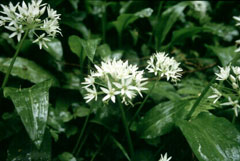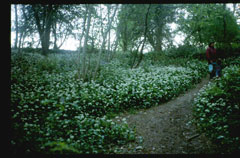
There have been cases of poisoning caused by the consumption, in very large quantities and by some mammals, of this species. Dogs seem to be particularly susceptible[76].
Range
Much of Europe, including Britain, east to the Caucasus and W. Asia.
Habitat
Damp soils in woods, copses, valleys and similar moist shady localities[9].
Edibility Rating
5 (1-5)
Medicinal Rating
3 (1-5)
Physical Characteristics
Bulb growing to 0.3m by 0.3m.
It is hardy to zone 5 and is not frost tender. It is in leaf from February to June, in flower from May to June, and the seeds ripen from May to July. The flowers are hermaphrodite (have both male and female organs) and are pollinated by Bees, insects.
The plant prefers light (sandy) and medium (loamy) soils.
The plant prefers acid, neutral and basic (alkaline) soils.
It can grow in full shade (deep woodland) semi-shade (light woodland) or no shade.
It requires moist soil.
Habitats
Woodland Garden; Dappled Shade; Shady Edge; Deep Shade; Hedgerow;
Leaves - raw or cooked[2, 5, 9, 12, 24]. Usually available from late January[K]. One report says that they have an overpowering garlic odour that dissipates on cooking[183], though our experience is that they are considerably milder than garlic[K]. The leaves make a very nice addition to salads, and are especially welcome as a vital and fresh green leaf in the middle of winter[K].
Flowers - raw or cooked. These are somewhat stronger than the leaves, in small quantities they make a decorative and very tasty addition to salads[K]. The flowering heads can still be eaten as the seed pods are forming, though the flavour gets even stronger as the seeds ripen[K].
Bulb - raw or cooked[2]. A fairly strong garlic flavour, though it is quite small and fiddly to harvest[K]. The bulbs can be harvested at any time the plant is dormant from early summer to early winter. Harvested in early summer, they will store for at least 6 months[K]. The bulbs can be up to 4cm long and 1cm in diameter[00].
The small green bulbils are used as a caper substitute[183].
Medicinal Uses
Plants For A Future can not take any responsibility for any adverse effects from the use of plants.
Always seek advice from a professional before using a plant medicinally.
Ramsons has most of the health benefits of the cultivated garlic, A. sativum[7, 238], though it is weaker in action[254]. It is therefore a very beneficial addition to the diet, promoting the general health of the body when used regularly. It is particularly effective in reducing high blood pressure and blood cholesterol levels[9]. It is recognised as having a good effect on fermentative dyspepsia[244]. All parts of the plant can be used, but the bulb is most active.
The plant is anthelmintic, antiasthmatic, anticholesterolemic, antiseptic, antispasmodic, astringent, cholagogue, depuritive, diaphoretic, diuretic, expectorant, febrifuge, hypotensive, rubefacient, stimulant, stomachic, tonic and vasodilator[7, 21]. Ramsons ease stomach pain and are tonic to the digestion, so they can be used in the treatment of diarrhoea, colic, wind, indigestion and loss of appetite[254]. The whole herb can be used in an infusion against threadworms, either ingested or given as an enema[254]. The herb is also beneficial in the treatment of asthma, bronchitis and emphysema[254]. The juice is used as an aid to weight loss and can also be applied externally to rheumatic and arthritic joints where its mild irritant action and stimulation to the local circulation can be of benefit[254].
The juice of the plant is used as a moth repellent. The whole plant is said to repel insects and moles[20].
The juice of the plant has been used as a general household disinfectant[7].
Cultivation details
Prefers woodland conditions in a moist well-drained soil[203]. Plants are often found in the wild growing in quite wet situations[K].
When growing in suitable conditions, wild garlic forms a dense carpet of growth in the spring and can be a very invasive plant[24, 203, K]. It dies down in early summer, however, allowing other plants to grow in the same space[K].
The bulbs should be planted fairly deeply[1].
The seeds are dispersed by ants[244].
Grows well with most plants, especially roses, carrots, beet and chamomile, but it inhibits the growth of legumes[18, 20, 54]. This plant is a bad companion for alfalfa, each species negatively affecting the other[201].
Members of this genus are rarely if ever troubled by browsing deer[233].
Propagation
Seed - best sown as soon as it is ripe either in situ or in a cold frame. It germinates quickly and can be grown on in the greenhouse for the first year, planting out the dormant bulbs in the late summer of the following year. Stored seed can be sown in spring in a greenhouse.
Division in summer after the plants have died down. Very easy, the divisions can be planted out straight into their permanent positions.
[K] Ken Fern Notes from observations, tasting etc at Plants For A Future and on field trips.
[1] F. Chittendon.RHS Dictionary of Plants plus Supplement. 1956 Oxford University Press 1951 Comprehensive listing of species and how to grow them. Somewhat outdated, it has been replaces in 1992 by a new dictionary (see [200]).
[2] Hedrick. U. P.Sturtevant's Edible Plants of the World. Dover Publications 1972 ISBN 0-486-20459-6 Lots of entries, quite a lot of information in most entries and references.
[5] Mabey. R.Food for Free. Collins 1974 ISBN 0-00-219060-5 Edible wild plants found in Britain. Fairly comprehensive, very few pictures and rather optimistic on the desirability of some of the plants.
[7] Chiej. R.Encyclopaedia of Medicinal Plants. MacDonald 1984 ISBN 0-356-10541-5 Covers plants growing in Europe. Also gives other interesting information on the plants. Good photographs.
[9] Launert. E.Edible and Medicinal Plants. Hamlyn 1981 ISBN 0-600-37216-2 Covers plants in Europe. a drawing of each plant, quite a bit of interesting information.
[12] Loewenfeld. C. and Back. P.Britain's Wild Larder. David and Charles 0 ISBN 0-7153-7971-2 A handy pocket guide.
[17] Clapham, Tootin and Warburg.Flora of the British Isles. Cambridge University Press 1962 A very comprehensive flora, the standard reference book but it has no pictures.
[18] Philbrick H. and Gregg R. B.Companion Plants. Watkins 1979 Details of beneficial and antagonistic relationships between neighbouring plants.
[20] Riotte. L.Companion Planting for Successful Gardening. Garden Way, Vermont, USA. 1978 ISBN 0-88266-064-0 Fairly good.
[21] Lust. J.The Herb Book. Bantam books 1983 ISBN 0-553-23827-2 Lots of information tightly crammed into a fairly small book.
[24] Baines. C.Making a Wildlife Garden. 0 Fairly good with lots of ideas about creating wildlife areas in the garden.
[54] Hatfield. A. W.How to Enjoy your Weeds. Frederick Muller Ltd 1977 ISBN 0-584-10141-4 Interesting reading.
[76] Cooper. M. and Johnson. A.Poisonous Plants in Britain and their Effects on Animals and Man. HMSO 1984 ISBN 0112425291 Concentrates mainly on the effects of poisonous plants to livestock.
[183] Facciola. S.Cornucopia - A Source Book of Edible Plants. Kampong Publications 1990 ISBN 0-9628087-0-9 Excellent. Contains a very wide range of conventional and unconventional food plants (including tropical) and where they can be obtained (mainly N. American nurseries but also research institutes and a lot of other nurseries from around the world.
[200] Huxley. A.The New RHS Dictionary of Gardening. 1992. MacMillan Press 1992 ISBN 0-333-47494-5 Excellent and very comprehensive, though it contains a number of silly mistakes. Readable yet also very detailed.
[201] Allardice.P.A - Z of Companion Planting. Cassell Publishers Ltd. 1993 ISBN 0-304-34324-2 A well produced and very readable book.
[203] Davies. D.Alliums. The Ornamental Onions. Batsford 1992 ISBN 0-7134-7030-5 Covers about 200 species of Alliums. A very short section on their uses, good details of their cultivation needs.
[233] Thomas. G. S.Perennial Garden Plants J. M. Dent & Sons, London. 1990 ISBN 0 460 86048 8 A concise guide to a wide range of perennials. Lots of cultivation guides, very little on plant uses.
[238] Bown. D.Encyclopaedia of Herbs and their Uses. Dorling Kindersley, London. 1995 ISBN 0-7513-020-31 A very well presented and informative book on herbs from around the globe. Plenty in it for both the casual reader and the serious student. Just one main quibble is the silly way of having two separate entries for each plant.
[244] Phillips. R. & Foy. N.Herbs Pan Books Ltd. London. 1990 ISBN 0-330-30725-8 Deals with all types of herbs including medicinal, culinary, scented and dye plants. Excellent photographs with quite good information on each plant.
[254] Chevallier. A.The Encyclopedia of Medicinal Plants Dorling Kindersley. London 1996 ISBN 9-780751-303148 An excellent guide to over 500 of the more well known medicinal herbs from around the world.
Readers Comments
Plants for a Future does not verify the accuracy of reader comments,
use at your own risk. In particular
Plants For A Future can not take any responsibility for any adverse effects from the use of plants.
You should always consult a professional before using plants medicinally.
Allium vineale
Michael J. Orlove D.I.C., D. Phil
Sun, 25 Jul 1999
Universe!
Dear Rich, 24-July-1999
I discovered your page with the following URL:
http://www.scs.leeds.ac.uk/pfaf/onions.html
In it you made reference to Allium ursinum, as "wild garlic". I
always
thought A. ursinum was a rare species in North American woods,
and
that in Britain and North America the term was usually applied to
A vineale. It is also applied to A. canadesne as you know, and also
feral populations of A. sativum whose origin in the New world is
considered
mysterious, Native Americans and early White settlers have both been
suspected of introducing it, or possibly it spread on its own without
human agency (which I doubt). A. vineale is a tubular leaved species
but it is much more closely related to A. ampeloprasum, A. sativum,
A., scorodoprasum, A. shaeonoprasum, and A. rosem than to A. cepa,
or A. fistulosum. It is the one that is a pest in wheatfields because
of the similarity of its bulbils in shape and density to wheat kernels,
making mechanical separation very difficult.
what has fascinated me so much about A. vineale is its extreme
variation
in umbel contents even within a local population. some plants have
flowers some bulbils, and some both. When bulbils are few or absent
in the umbel, the blossoms are VERY showy --being companulate instead
of ovatge.
At such times they are purple instead of green. The very showy form
is known as A. V. capsuliferum in reference to its seed capsules.
the half and half (bulbils and blossoms) form is called A. V. typicum,
and the all bulbil one is A. v. compactgum. Two dark pigmented
bulbilforms
are also described, one reproduces like compactum, and is called A.
v. fuscescens, and the other appears to have viviparous bulbils, but
the "sprouts" are actually non-vestigal blades on scale leaves on the
bulbils, and is known as A. v. crinitum. crinitum usually has one
or 2 ovate flowers per umbel which are lavender or purple in color.
All sorts of intermediates exist between these forms. Here in Ithaca
fuscescens-like ones have flowers, and crinitum like ones don't or
crinitum like ones will have many flowers and viable flowers with
many capsuls forming.
I once found a clump of capsuliferum surrounded by a vast field of
hundreds and thousands of typicum. Those typicum near the capliferum
had purple flowers like the capsuliferum, but the ones farther out
had the green flowers typical of typicum. The blossoms of this species
are usually visited by tiny ants, sweat bees, or nothing at all, but
the capsuliferum where being actively and aggressively visited by
large bumblebees (Bombus pennsylvanicus --a large pocket maker, related
to the British species B agrorum, but as big as B. terristris). Large
paper wasps (Polistes fuscatus) were equally present and interested
in the nectar.
An article by Hugo Iltis in the 1940's (it was either in Scientific
Monthly or Atlantic Monthly) claimed that this showy capsuliferum
form made it as far north a as North Carolina, and . v. typicum was
as good as you could get in the Northeast.
Nevertheless this wonderful clump of capsuliferum I found was in
the Bronx! that was in 1979, and it continued to persist there until
1983. could this have been global warming? the real question was this
capsuliferum more related to the non - sexual nonspecific neighbors
around it, or capsuliferum in N. Ccarolina? did it evolve denovo from
non-sexual or less sexual forms?
Many biologists say it is a mystery how sex evolved to begin with
(the origin - of- sex question" and it is equally a mystery how sex
stays in the population and doesn't get selected against (the
maintenance
- of -sex question). John Maynard Smith (at the University of Susex),
Goeffrey Parker (University of Liverpool), and George Williams
(University
of the State of New York at Stonybrook) have become famous elucidating
and trying to solve this mystery. It seems that mating with a stranger
may further the fitness of your offspring, but it appears not enough to
justify throwing half-of your genes away, as a female does when mating.
Plants with both cleistogamous and chasmogamous flowers, like Violo
sp., Impatiens capensis (Orange balsam), and I. noli-tangeri
(touch-me-not),
and the very similar North American I. palida, not to mention the
hog peanut, Amphicarpaea xxx, present a similar example of this mystery.
What are your thoughts on this issue? How far north does A. v.
capsuliferum
make it in Britain? I have found capsuliferum in Interlaken, N. Y.
Near Ithaca, N. Y. where Cornell University is, but these ones were
not as tall or showy as the ones from the much warmer Bronx. but they
were capsuliferum, and made good seed. I have 2 accessions of them,
one from a bulbil, and the other from a seed collected from the same
umbel in Interlaken.
I have been unable to get them to blossom or even bolt with bulbils
in my garden, just getting non scapigqarous growth every spring.
There is some folklore in this country that A. vineale takes on its
capsuliferum form when in the vacinity of an underground stream, and
dowsers exploit the information provided by the occurrence of the plant
in particular instances.
Well I must go now, Please forgive my sloppy typing, I am disabled
and it takes me eons to proofread things. Incidentally, are you in
Cornwall, or Yorkshire?
Some day I will, if I only live, compare the DNA of different forms
of A. V. vineale from different locations. the Bronx material seems
to be now absent from the original site, I have been back 3 times
over the years, and the material I collected now exists as seed in
cold storage, but I lack access to it over a technicality (it was
shipped to another storage facility instead to Harvard where I was
going to grow it out, due to an accident, and it would take a very
large sum to recover it, as well as the permission of the person who
became its accidental owner who is not willing to release it to me.
this is very frustrating.
sincerely yours,
Michael J. Orlove D.I.C., D. Phil
Allium ursinum, Wild Garlic
Konni Worsley
Mon Apr 8 17:45:03 2002
Does anyone out there know how to get hold of some bulbs? We encountered Baerlauch, or Allium ursinum in Germany, but have been unable to successfully germinated the seeds.
crod@orland.net
Have not been able to find a source of seed or bulbs of Ramsons
in the US. I'd like to see if they will survive in California's Sacramento
Valley. Can anyone out there help?
Allium ursinum
luk
Wed Sep 29 10:35:43 2004
I am interested in any information about Allium ursinum aspecially
in its use in medicine (formal and unformal).
I am also looking for information about its ingredients,
how this substances work , if i can find thwem in some other plants
I wanted to know where it grows ,
what are the wheather- and ground-conditions of such places.
I will be gratefull for all news about
A. ursinum also e-mail links , site's address, etc.
luk www.klaser5@wp.pl
Allium ursinum
John Fielding
Sun Apr 2 2006
The leaves shredded make a tasty addition to a peanut butter sandwich
Bleaklowjohn General interest of the countryside and moorland
Allium ursinum, Wild Garlic
Felicitas
Sun Apr 30 2006
Large drifts of this plant can be found in the woods in the hilly
areas round the Conwy estuary in north Wales. Saw and smelt them
last week.
The Germans seem to put it in everything, from pesto to bread.
Allium ursinum
Dallas Clouatre, Ph.D.
Sun Jun 18 2006
Having been directly involved myself in research on Allium ursinum, I suspect that the toxicity warning actually involves mistaken intake of autumn croccus. Moreover, in comparative trials, Wild Garlic proved superior to cultivated garlic in reducing blood pressure and LDL cholesterol while raising HDL cholesterol levels. For this research, see:
Preuss HG, Clouatre D, Mohamadi A, Jarrell ST. Wild garlic has a greater effect than regular garlic on blood pressure and blood chemistries of rats. Int Urol Nephrol. 2001;32(4):525-30.
When groups of 10 Spontaneously Hypertensive Rats (SHR) were fed diets containing either 1% w/w regular garlic (Allium sativum) (AS) or 1% w/w wild garlic (Allium ursinum) (AU) for 45 days, the final mean systolic blood pressure (SBP) was reduced significantly compared to control (C) (C 189; AS 175; Au 173 mm Hg). Compared to C, body weight and circulating glucose and triglyceride levels were not significantly different; but circulating insulin was significantly higher (C 23.6; AS 33.9; AU 29.5 uIU/dl), and total cholesterol was significantly lower (C 133; AS 115; AU 117 mg/dl) in the two groups consuming AS or AU. HDL rose in the two garlic groups, but the differences from C were statistically significant only for the AU group. In a second study, the effects of a lower dose of dietary AS and AU (0.1% w/w) on SBP and various blood chemistries were compared head-to-head in 80 SHR-40 control and 40 test rats. Both AS and AU decreased SBP significantly compared to a control group of 10 SHR followed simultaneously. However, AU at this lower concentration produced a significantly greater SBP-lowering effect compared to the AS group. In addition, AU decreased total cholesterol significantly and tended to increase HDL compared to AS. Accordingly, the results suggest that AU has a greater therapeutic benefit compared to AS at a given concentration.
Mohamadi A, Jarrell ST, Shi SJ, Andrawis NS, Myers A, Clouatre D, Preuss HG. Effects of wild versus cultivated garlic on blood pressure and other parameters in hypertensive rats. Heart Dis. 2000 Jan-Feb;2(1):3-9.
Two separate studies were performed on hypertensive rats to assess the effects of wild, uncultivated garlic on elevated systolic blood pressure (SBP) and other cardiovascular parameters. Also, effects of wild garlic and cultivated garlic preparations were compared and the mechanisms behind pressure-lowering abilities of different garlic preparations were examined. The initial study determined that wild garlic lowers blood pressure. In the second study, cardiovascular effects of three different concentrations of wild garlic and two different cultivated garlics, i.e., a preparation low in allicin and one high in allicin, were compared. All three garlic preparations decreased SBP significantly. Wild garlic produced the greatest pressure-lowering effects, and the least pressure-lowering effects were seen with low-allicin garlic. Compared with control rats, circulating angiotensin II levels were significantly lower in all garlic-eating rats. Losartan decreased blood pressure significantly less and Nw-nitro-L arginine-methyl ester hydrochloride (LNAME) increased blood pressure significantly more in garlic-eating rats than in control rats, suggesting that the renin-angiotensin system (RAS) was less active and the nitric oxide system more active in garlic-consuming hypertensive rats. Accordingly, different garlic preparations, especially wild garlic, favorably influenced high SBP in hypertensive rats. These results suggest that both the RAS and the nitric oxide system are involved in the antihypertensive effects of garlic in hypertensive rats.
Allium ursinum
Raluca
Tue Oct 24 2006
Hey,there,I agree with Dallas C(he seems to be more than
scientifically-intim with this subject)
,must be a confusion between Allium Ursinum
and toxic autumn croccus,as far as I know,wild garlic,canŽt give
this bad simptoms,even if it is, let say "overtaked":)).What can I say,is
that,this plant is verry popular in Romania,where is also called "LEURDA"
and here is used since ages:)))for folkloric gourmand-recipies and also
for medical reasons,especially in the spring time,when the leavs are green-
freche and are collected in quite large quantities for salads.I proudly say(
without exagerating) Romania is well known as being one of the richest land
"green-gold",mean,the soil over here,offer best support for hundred of species of
medical plants.Living long time outside Romania,IŽm intrested to know if Allium Ursinum
can be found in fresh or dry stage on the european market,as a food product or spicy,or
however....Scandinavian part of Europe is out of
question in order to aclimatizate(??this is the word?)this plant here.
IŽllbe more than happy if Dallas Clouatre,who seems to be really informed!!can share
other informations about plants..medical plants!Best wishes from here!
Allium ursinum
Vietta Clark
Mon Jan 15 2007
The bottom of my garden (a woodland area) has come alive with bright green spear-like leaves that taste like strong, hot garlic. The previous owner of this house told me about the "mass of wild garlic flowers" that initially emerge in January/February but research on the web only details wild garlic (ransons) with a much broader "lily-of-the-valley" type leaf.
I'm pretty sure these plants are of the garlic family but could they be another type?
Allium ursinum
River46
Tue Mar 25 2008
This type of wild garlic grows all over our small farm in Southern Illinois. Though I believe the species is Allium vineale. It resembles chives but has a strong garlic fragrance. In early spring I use the chopped leaves in pasta salads and chicken soups. In the spring the leaves are tender. As summer approaches the leaves become tough. People who have tasted my chicken soup in the Spring has said it is delicious and makes them feel good. This is a tradition with me and spring. I have dried the bulbs in bunches to use for later use. Most people consider wild garlic a weed, but many plants that are considered weeds are good for you! I will try to take photos of my wild garlic and post on the yahoo group.
This work is licensed under a
Creative Commons License. You
can copy, distribute, display this works and to make derivative works but: Attribution is required, and it's Share Alike (GNUish/copyleft)
i.e. has an identical license. We also ask that you let us know (webmaster@pfaf.org) if
you link to, redistribute, make a derived work or do anything groovy with this information.