 |
|
(c) ken Fern, Plants For A Future 2010 |
 |
|
Translate this page:
Summary
Physical Characteristics

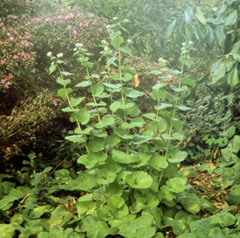
 Alliaria petiolata is a BIENNIAL growing to 1 m (3ft 3in) by 0.4 m (1ft 4in).
See above for USDA hardiness. It is hardy to UK zone 7 and is not frost tender. It is in flower from April to June, and the seeds ripen from June to August. The species is hermaphrodite (has both male and female organs) and is pollinated by Bees, flies, Lepidoptera (Moths & Butterflies). The plant is self-fertile.
It is noted for attracting wildlife.
Suitable for: light (sandy), medium (loamy) and heavy (clay) soils. Suitable pH: mildly acid, neutral and basic (mildly alkaline) soils. It can grow in full shade (deep woodland) or semi-shade (light woodland). It prefers moist or wet soil.
UK Hardiness Map
US Hardiness Map
Synonyms
A. officinalis. Erysimum alliaria. Sisymbrium alliaria.
Plant Habitats
Woodland Garden Dappled Shade; Shady Edge; not Deep Shade; Hedgerow; Bog Garden;
Edible Uses
Edible Parts: Flowers Leaves Seedpod
Edible Uses:
Young leaves - raw or cooked as a potherb or as a flavouring in cooked foods[4, 5, 9, 12, 62, 115, 244]. A mild garlic and mustard flavour, the leaves are also believed to strengthen the digestive system[244]. They can be finely chopped and added to salads[7, 183]. The leaves are available very early in the year and provide a very acceptable flavouring for salads in the winter[K]. Flowers and young seed pods - raw[62]. A mild, garlic-like flavour[K].
References More on Edible Uses
Medicinal Uses
Plants For A Future can not take any responsibility for any adverse effects from the use of plants. Always seek advice from a professional before using a plant medicinally.
Antiasthmatic Antiscorbutic Antiseptic Deobstruent Diaphoretic Eczema Sternutatory Vermifuge
Vulnerary
Garlic mustard has been little used in herbal medicine[268]. The leaves and stems are antiasthmatic, antiscorbutic, antiseptic, deobstruent, diaphoretic, vermifuge and vulnerary[4, 7]. The leaves have been taken internally to promote sweating and to treat bronchitis, asthma and eczema[4]. Externally, they have been used as an antiseptic poultice on ulcers etc[4], and are effective in relieving the itching caused by bites and stings[244]. The leaves and stems are harvested before the plant comes into flower and they can be dried for later use[238]. The roots are chopped up small and then heated in oil to make an ointment to rub on the chest in order to bring relief from bronchitis[245]. The juice of the plant has an inhibitory effect on Bacillus pyocyaneum and on gram-negative bacteria of the typhoid-paratyphoid-enteritis group[240]. The seeds have been used as a snuff to excite sneezing[4].
References More on Medicinal Uses
The Bookshop: Edible Plant Books
Our Latest books on Perennial Plants For Food Forests and Permaculture Gardens in paperback or digital formats.
Edible Tropical Plants
Food Forest Plants for Hotter Conditions: 250+ Plants For Tropical Food Forests & Permaculture Gardens.
More
Edible Temperate Plants
Plants for Your Food Forest: 500 Plants for Temperate Food Forests & Permaculture Gardens.
More
More Books
PFAF have eight books available in paperback and digital formats. Browse the shop for more information.
Shop Now
Other Uses
References More on Other Uses
Cultivation details
Prefers a damp rich alluvial soil[7, 53]. Succeeds in damp shady places where few other herbs will grow[238]. A good woodland edge plant, it also grows well in the bottom of hedgerows[24] and will self-sow freely in suitable conditions[238]. On a calm day the plant emits a strong smell of garlic. This is especially pronounced if the leaves are bruised[245]. This species is an important food source for the orange-tip butterfly[238]. In garden design, as well as the above-ground architecture of a plant, root structure considerations help in choosing plants that work together for their optimal soil requirements including nutrients and water. The root pattern is a tap root.
References Carbon Farming Information and Carbon Sequestration Information
Temperature Converter
Type a value in the Celsius field to convert the value to Fahrenheit:
Fahrenheit:
The PFAF Bookshop
Plants For A Future have a number of books available in paperback and digital form. Book titles include Edible Plants, Edible Perennials, Edible Trees,Edible Shrubs, Woodland Gardening, and Temperate Food Forest Plants. Our new book is Food Forest Plants For Hotter Conditions (Tropical and Sub-Tropical).
Shop Now
Plant Propagation
Seed - sow outdoors in situ either in spring or autumn.
Other Names
If available other names are mentioned here
Common Names: English: garlic-root; garlicwort; hedge-garlic; Jack-by-the-hedge; Jack-in-the-bush; mustard-root; poor-man's-mustard; sauce-alone. Spanish: Ajo mostaza; Hierba del ajo. French: Alliaire officinale. Portuguese: erva-alheira. Germany: Gemeine Knoblauchsrauke. Italy: Alliaria; Erba alliaria. Netherlands: Look-zonder-look. Sweden: Loektrav.
Native Plant Search
Search over 900 plants ideal for food forests and permaculture gardens. Filter to search native plants to your area. The plants selected are the plants in our book 'Plants For Your Food Forest: 500 Plants for Temperate Food Forests and Permaculture Gardens, as well as plants chosen for our forthcoming related books for Tropical/Hot Wet Climates and Mediterranean/Hot Dry Climates. Native Plant Search
Found In
Countries where the plant has been found are listed here if the information is available
Weed Potential
Right plant wrong place. We are currently updating this section.
Please note that a plant may be invasive in one area but may not in your area so it’s worth checking.
An invasive species in much of North America. Listed as a noxious or restricted plant in the US states of Alabama, Connecticut, Massachusetts, Minnesota, New Hampshire, Oregon, Vermont, West Virginia and Washington.
Conservation Status
IUCN Red List of Threatened Plants Status : This taxon has not yet been assessed.

Growth: S = slow M = medium F = fast. Soil: L = light (sandy) M = medium H = heavy (clay). pH: A = acid N = neutral B = basic (alkaline). Shade: F = full shade S = semi-shade N = no shade. Moisture: D = dry M = Moist We = wet Wa = water.

Expert comment
Author
(M.Bieb.)Cavara.&Grande.
Botanical References
17
Links / References
For a list of references used on this page please go here
Readers comment